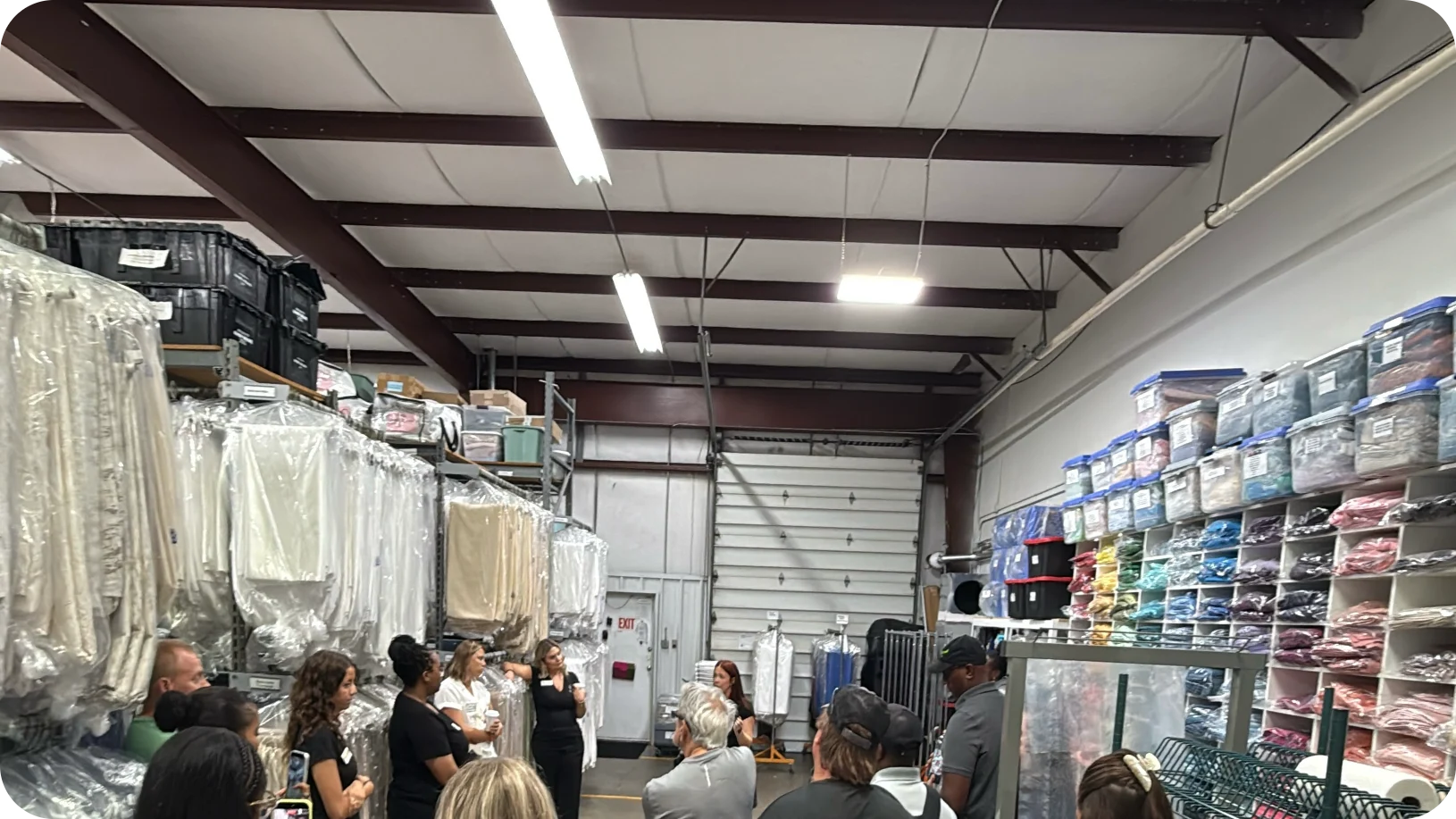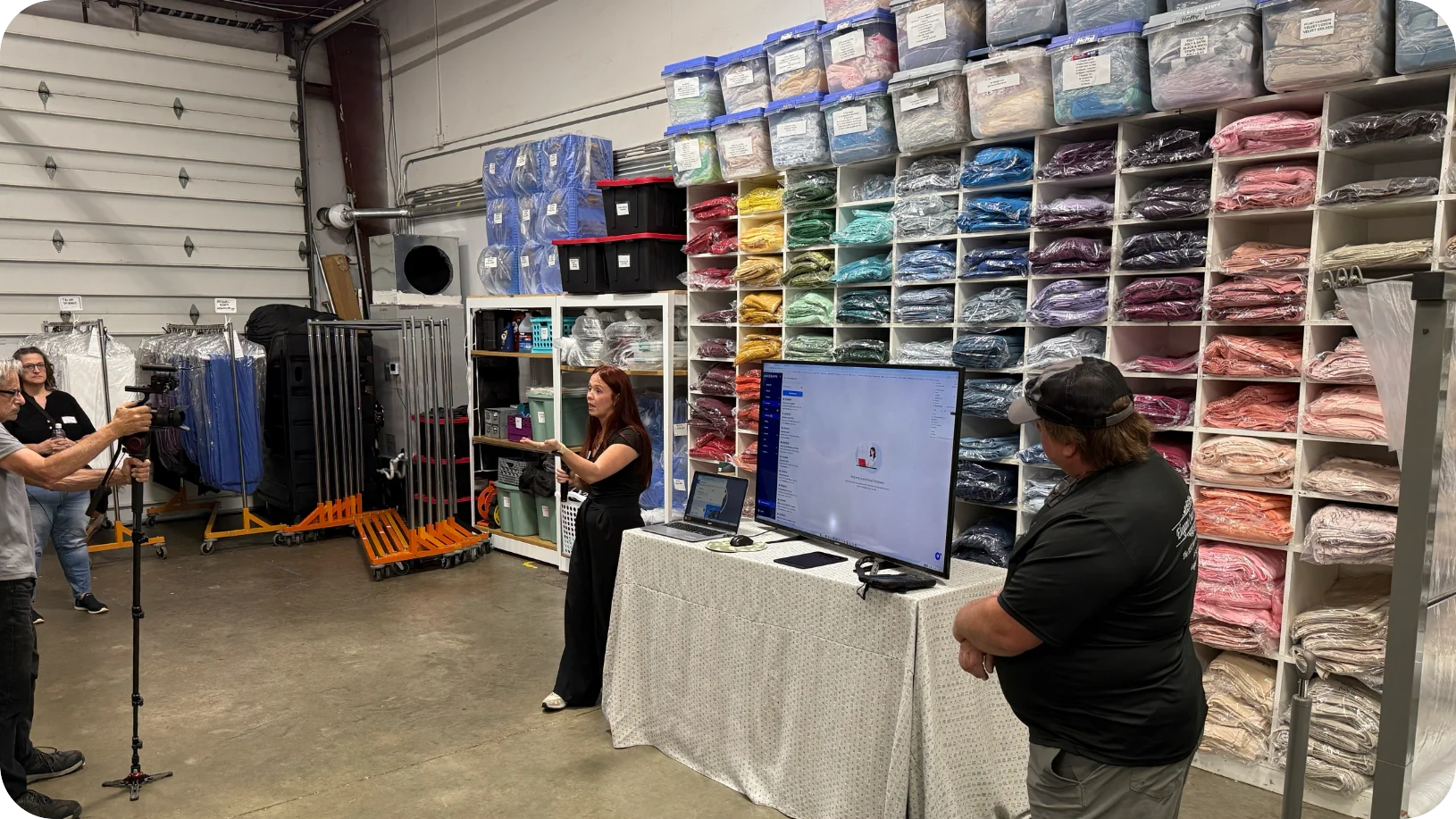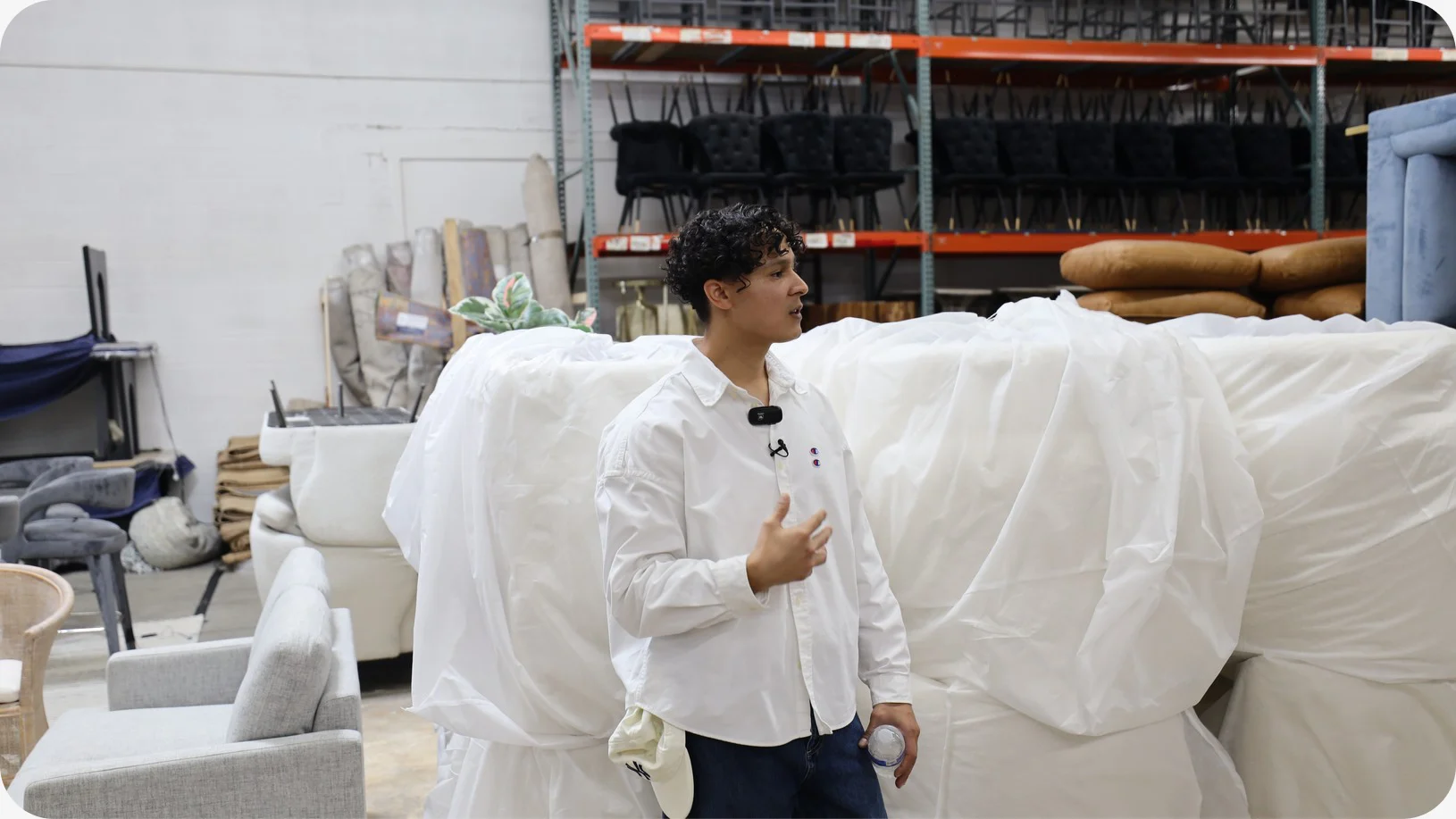

At the Dallas-Fort Worth warehouse tour, Goodshuffle’s Colin Connor asked the panel a question that is harder to answer than it sounds: what is the number one constraint in your business right now? Three operators gave three different answers, and none of them hesitated.
You can watch the full thing here, or keep reading for the breakdown:
Key Takeaways:
-
The owner is often the constraint.
Cam Petty named herself as the bottleneck in her own company, because the inventory knowledge and the client relationships both route through her.
-
A slow step in one service line can hold up the whole sales team.
Drape quotes took longer to turn around than rental quotes, so Party! Dallas Rentals split that service into its own operation.
-
Space is a real ceiling, not a soft one.
When Melissa Teague ran her own rental company, square footage was the thing she could never solve her way around.
-
Buying what your market already has costs you your only real advantage.
The operators on this panel check competitors’ catalogs before large inventory purchases and pass when an item is already saturated locally.
-
Lease negotiation is where growth plans quietly break.
Annual rate escalators, certificate-of-occupancy requirements, and what counts as a landlord expense all get decided before you move in.
When the Owner Is the Bottleneck
Cam Petty owns Render Collective, the Dallas-Fort Worth parent of Render Events and Scout Floral. She started as a wedding planner, moved into rentals fourteen years ago, and added florals ten years ago. She answered first, and she answered about herself.
“I’m the bottleneck to my company.”
— Cam Petty, Render Collective
Her reasoning was specific. She built the company, so she knows the inventory, holds the client relationships, and carries more on her plate than anyone else on the team. The problem isn’t knowledge sitting in one person’s head by accident. It is what happens when a company outgrows the systems that got it here.
Her fix is process, not hours. Petty pointed at systems, processes, and standard operating procedures that worked for a while, then stopped working after the company grew. She has taught this publicly before, and our guide to writing SOPs was built from a talk she gave on exactly this problem.
When One Slow Step Holds Up Everything
Liz Curlin runs Party! Dallas Rentals, which she helped launch out of Todd Events after starting there a decade ago. Her constraint wasn’t a person. It was a single step in the sales process.
Drape had always been part of the offering. As demand grew, quoting it started taking noticeably longer than quoting furniture, and that lag was landing on clients waiting for information. Curlin split drape out into its own operation, Vertical 360, with its own account and its own workflow.
The reasoning was structural. Asking for four bars is straightforward. Asking for forty feet of drape raises questions about ceiling height, whether the site is outdoors, and how wind will be handled. Drape often goes up two days before furniture arrives, and a different team installs it. Two service lines running on two timelines were being forced through one process.
When the Constraint Is Square Footage
Melissa Teague spent years running Simply Chic, an event rental company she started in 2014 and later sold, and she joined the panel as a former owner rather than as a vendor. Her answer was one word: space.
“I could never get enough space. And so that just that was so hard to scale with.”
— Melissa Teague, former owner of Simply Chic
Space is worth naming plainly because it resists clever solutions. It caps how much inventory you can hold, how fast a crew can pull an order, and how much revenue the building can support. Sometimes the honest answer is a bigger lease rather than a better process.
What Nobody Warns You About a Bigger Lease
Petty has moved several times and is preparing for another expansion. Her warning was about the gap between the rent you agree to and the rent you end up paying.
At a previous 7,000-square-foot space, her landlord was an individual and the rate stayed flat for nearly seven years. Moving to a corporate landlord introduced annual escalators. She negotiated hard on those percentages when signing a seven-year lease, because otherwise the rent at the end of the term would be multiples of where it started.
Then there is the building itself. Petty walked through the questions she had to resolve before signing: which repairs and aesthetic changes are the landlord’s responsibility versus her tenant improvement allowance, and what her city will require for a certificate of occupancy. Bathroom counts per square foot, unenclosed showroom doors that would force the air conditioning to cool the entire building, exterior colors that clashed with her brand. Her advice was to talk to operators who have recently moved rather than relying on a search engine or a chatbot for what counts as normal.
Why They Refuse to Buy What Dallas Already Has
The most transferable idea of the afternoon had nothing to do with buildings. Curlin described a philosophy she and Todd settled on when Party! Dallas launched, knowing they were entering an already crowded market: if there are already a thousand Chiavari chairs down the street, there is no reason to add more.
Before a large inventory purchase, they check whether competitors already carry the item. If the answer is yes, they often pass and look for something the metro is missing. The goal is filling holes in the market rather than deepening the saturation.
Petty described the flip side, which is what happens when duplication is unavoidable. Several companies in Dallas carry the same black ghost chair she does. Clients pick her when she also has the bars and banquettes they want, and she sub-rents from a competitor when a client needs a hundred of something she has seventy-six of. Sometimes the differentiator is quantity, sometimes it is having the adjacent pieces, and often it is a relationship built over years of showing up at the same industry events.
Deciding What Earns Its Space
Asked how she decides whether an item stays, Petty starts with reporting from her system and then applies judgment the report can’t. An item that books occasionally but is easy and cheap to replace is an easy cut. An item that is hard to replace and occasionally indispensable is worth keeping even if the numbers look thin.
Two factors override the report. One is space: an item that performs adequately on paper but eats significant square footage gets scrutinized. The other is field reliability, meaning whether something always seems to need fixing on site. She also runs the decision as a vote.
“This is a democracy. I want everybody to vote on this.”
— Cam Petty, Render Collective
Sales and production sometimes disagree, and she considers that disagreement useful information rather than noise. For a longer look at how a growing operation moves decisions off the owner’s desk, Luna Tolunay of Fun Planners walks through the SOPs behind scaling to 1,200 events a year.
The Common Thread
Three operators, three completely different constraints, and one thing in common: each could say hers in a single sentence. That is rarer than it sounds, and it is the part worth stealing. You can read Teague’s own takeaways from the same day in her recap of the Dallas warehouse tour.
FAQs
Pick the single step where work piles up and ask what happens if you fix only that. The operators on this panel could each name theirs in one sentence: owner bandwidth, quote turnaround time, and physical space. If you can’t say yours out loud, that is usually the first sign it hasn’t been examined.
When it runs on a different timeline than the rest of your work. Drape gets installed days before furniture arrives, needs different site questions answered, and involves a separate install team. Those are structural differences, not scheduling ones.
Gig platforms are the common short-term fix, with filters for lifting requirements and dress code. Operators on this panel also request more workers than they need, because not everyone shows. The longer question is whether the same bottleneck keeps recurring, which points to hiring instead.
Not without a reason. In a saturated market, duplicating a widely available item leaves you competing on price alone. Several operators here deliberately buy what their metro is missing instead.
Annual rent escalators, which improvements are the landlord’s responsibility versus your tenant improvement allowance, and what your city requires for a certificate of occupancy. Ask other operators who have moved recently rather than guessing.

Share On