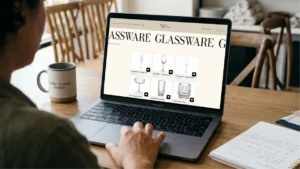

Emily Foster gives your event rental homepage about 0.05 seconds.
That’s her figure for how long you have to impress a visitor. If the page doesn’t land in that time, the referral, Instagram post or Google search that sent them was wasted.
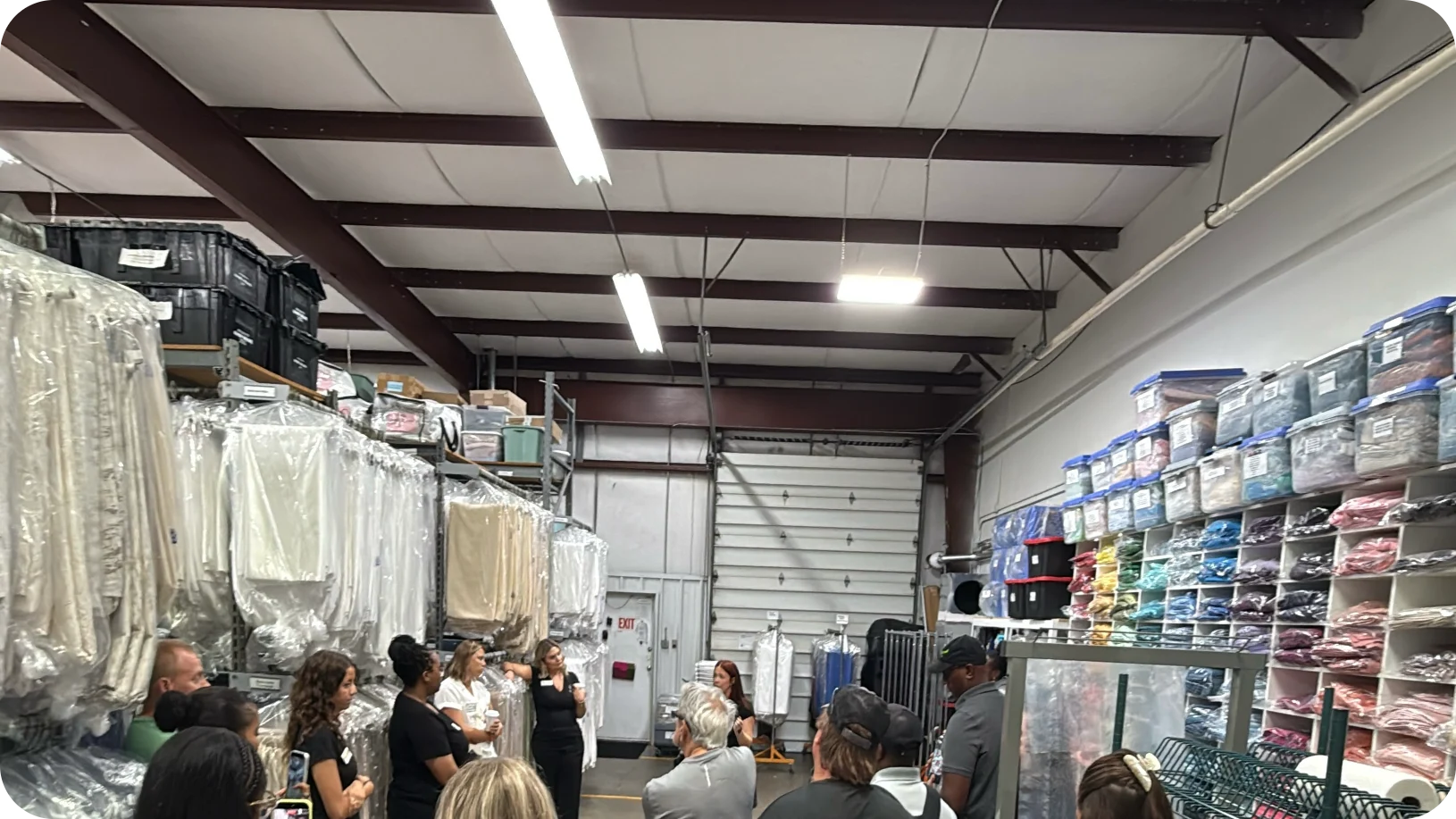
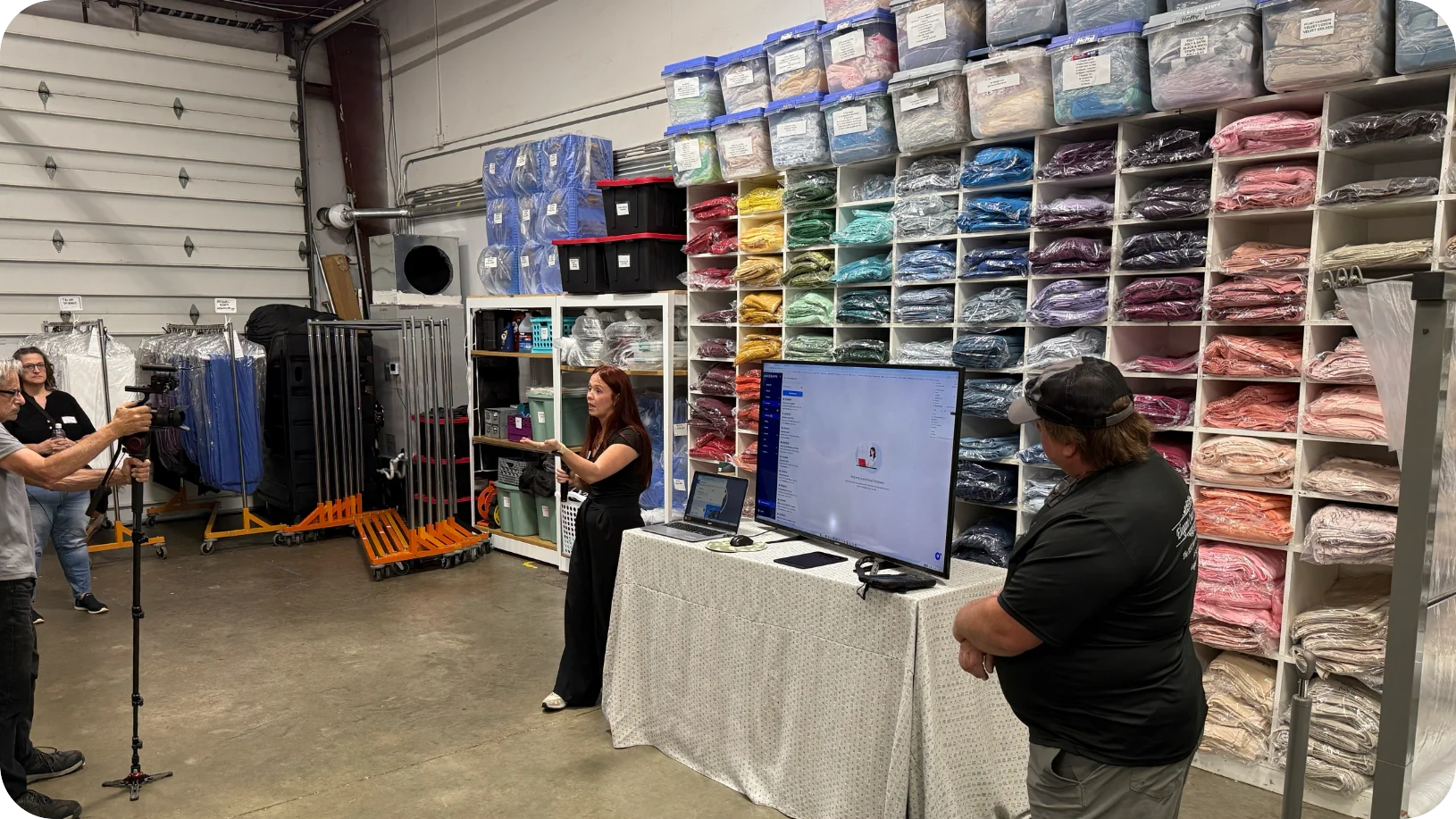
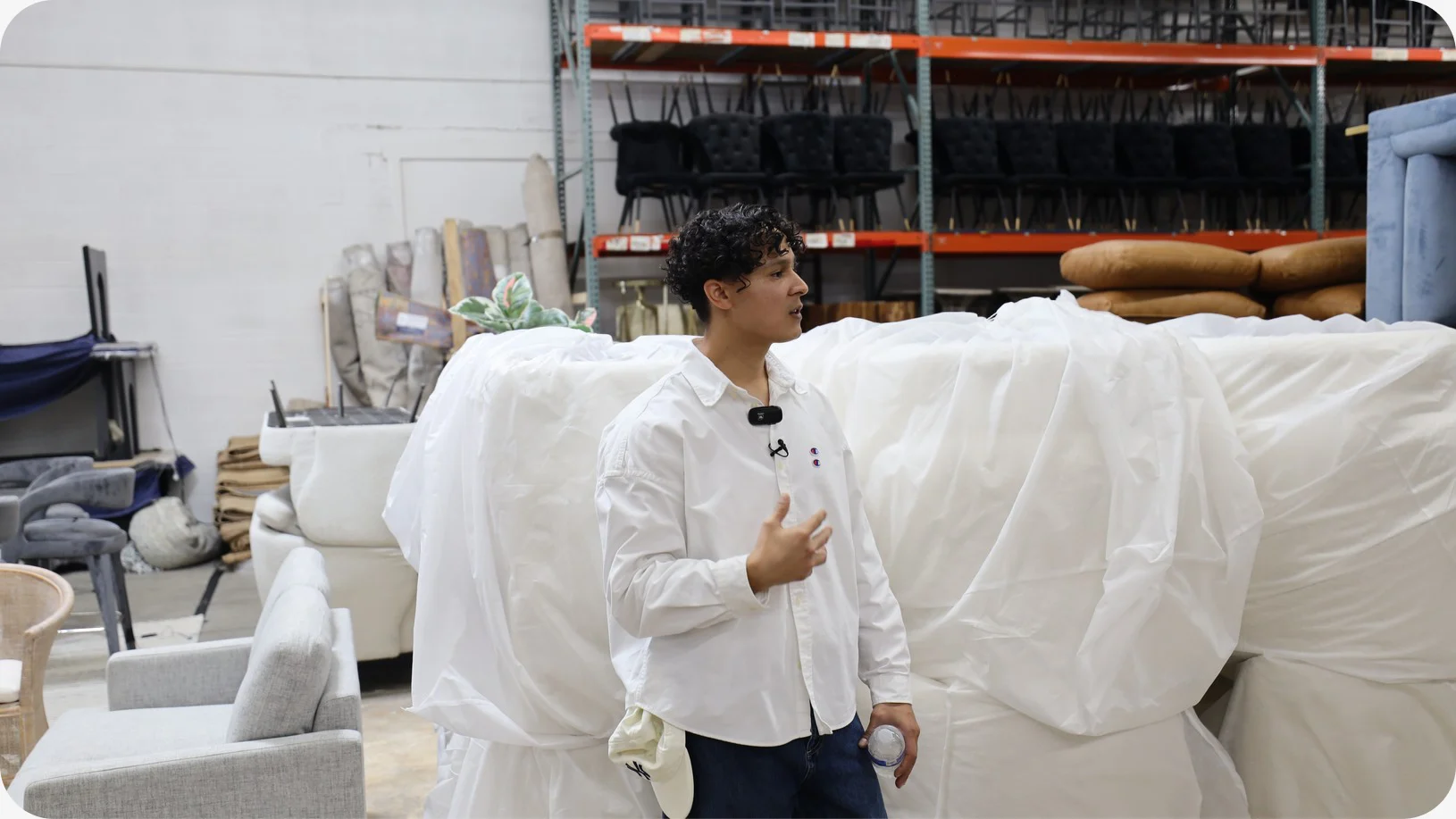
Foster, who has designed sites for more than 120 wedding businesses, led Marketing 101 at our 2026 User Summit. Her case is to get findable first, and the rest of your marketing falls in behind it. Five web and marketing partners on the Positioning & Demand panel picked up where she left off, with what the site has to do once people land. Both sessions are in our User Summit on-demand library.
This post puts their advice in the order you’d work through it, starting with two lines on your homepage you can fix tonight.
Key Takeaways:
-
An event rental website has to be findable before the rest of your marketing pays off.
Emily Foster told the Goodshuffle User Summit that posts, referrals and searches all send people to the site, and the site decides whether any of it becomes an inquiry.
-
Emily Foster finds most local wedding and event businesses don't say where they are at the top of their homepage.
Her fix is a small line naming your city or region above a headline about the value you bring.
-
AI search rewards event rental websites that get specific.
Brian Lawrence’s example: clients ask AI who rents a dance floor for 200 people near Houston. The product, place and capacity belong on the page.
-
An event rental website serving two kinds of buyer needs two paths through it.
The Summit panel’s advice: send the shopper who knows what they want straight to the catalog, and guide the buyer who needs help.
-
Event rental owners should search for their own business signed out.
Cam Petty of Render Events checks in an incognito window and a signed-out ChatGPT, because signed-in results flatter the owner.
Why Findability Comes First for Rentals
An event rental business is visible when it shows up often: posting, networking, keeping a website live.
It’s findable when someone searching for what it rents, where it rents it, lands on its site and stays. Emily Foster puts findability first because every post, referral and search ends on your website, which decides whether it becomes an inquiry.
Owners, in her view, pour most of their energy into being visible: social media, blogging, networking.
But being visible isn’t the same as being findable.
She sees two kinds of owner get this wrong. One spends real money on a beautiful website and gets no inquiries from it, because the site does nothing for search. The other ranks well with a site that feels like it’s from 2015, and visitors leave.
“Ranking in that first spot on Google or showing up as first in AI searches means nothing if that traffic gets lost once people get to the website.”
— Emily Foster, Emily Foster Creative
The worst case, she said, is showing up for searches that have nothing to do with what you rent. Whoever lands there was looking for something else, and they click away inside those 0.05 seconds.
Your Rental Homepage Needs Two Lines
The first thing Foster wants a homepage to do is let a visitor confirm they’re in the right place. Most local wedding and event businesses skip it, she says, which is “so confusing for your clients.”
That costs you twice. A visitor from Google can’t tell whether you deliver to their venue, and AI search may give them wrong information about where you work. The fix is two lines at the top of your homepage:
- An eyebrow line for your city or region: Small text above the headline.
- A headline about the value you bring: Her off-the-cuff example was rentals so beautiful “your guests will think it belongs to the venue.” A line like “We’re the best chiavari chairs rental company” won’t connect with clients the same way.
Then show your real work and the people behind the business, with no AI-generated images. Put a button in the top navigation and the hero for whatever starts your sales process, like exploring your rentals or booking a showroom visit. Our Busy Season newsletter covers the Google side of location in local SEO quick wins.
How Rental Clients Search Now
Clients search two ways now. On Google the search is short, like Foster’s example “Phoenix wedding rentals.” In AI search it can run to a few full sentences: “I’m getting married in February in Phoenix. I’m looking for chiavari chairs that are pink. What companies near me offer these?”
Every detail in that search, the product, color, month and city, needs to be on your site. Brian Lawrence, founder of Brian Lawrence Web Design & SEO, put it bluntly on the panel.
“People aren’t asking AI for a passionate rental company.”
They ask, in his examples, who rents a black-and-white dance floor for 200 people near Houston. Or who delivers tables and chairs to Montclair this weekend. “We bring your vision to life” tells an AI tool nothing, and your competitors say the same thing.
Foster’s way in is to think like the client. The questions real clients ask you, like whether you carry pink chiavari chairs or peach linens, can become your FAQs and page copy. Lawrence adds two more:
- The copy-paste test: If you could paste your copy onto a competitor’s website and it would still apply, rewrite it.
- Your reviews: He calls them “the best possible focus group” and a great source of original content. Our newsletter makes the case that your reviews are your SEO.
For page titles, headings and layout, see the full guide to structuring your site for search.
Three Questions Rental Visitors Ask
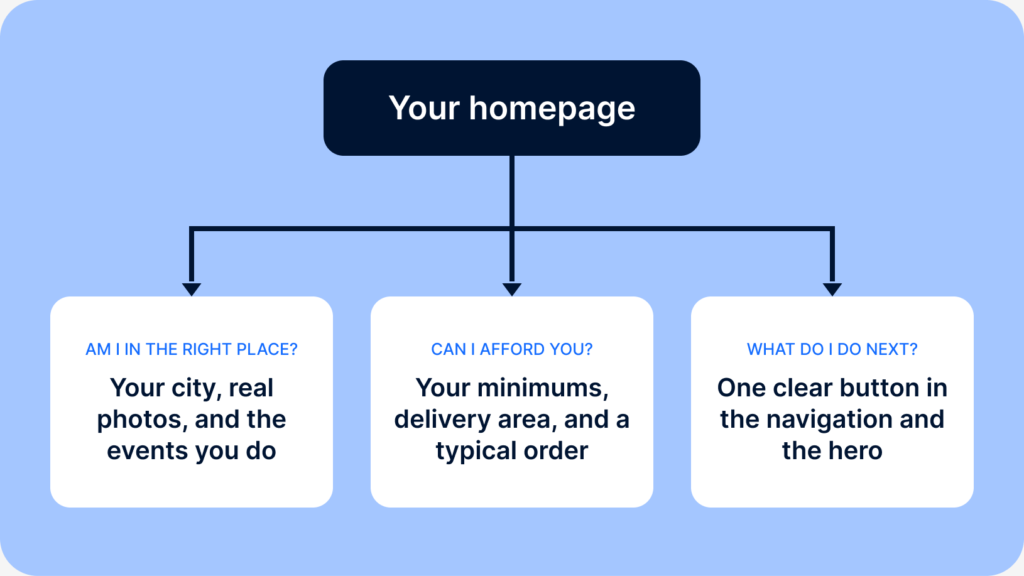
Brian Lawrence’s test for an event rental website is three questions a visitor should answer quickly: Am I in the right place? Can I afford you? What do I do next? If he could fix one thing, it would be a pricing page that qualifies the customer before they reach out.
Nobody’s renting a $12 chair, Lawrence said. They’re renting the chair plus delivery, setup, minimums, location, timing, and the date they need it.
You don’t have to publish every price, he said. A custom buyer learns nothing from the price of one chair, though. Show them an investment range and a few real events you’ve done. Our newsletter on whether to list pricing walks through the options.
One Event Rental Website, Two Buyers
Colin Connor of Goodshuffle opened the panel with the split he hears about from customers: some clients want it fast and cheap. Others want it custom and will wait for it, and you can’t price for both the same way.
Ralitsa (Rali) Carter, digital strategy director at Twelve Legs Marketing, spots the symptom when she audits a site.
“If within the first 10 seconds I cannot tell who this website is for, we have a problem.”
The line she sees most is some version of “from backyard parties to luxury weddings, we do it all.” Then the $500 party and the $50,000 event get exactly the same experience. Her fix keeps both customers and gives each one a way through the site. One panelist described the two: the visitor who says “send me to your catalog, don’t talk to me,” and the one who wants a few guiding questions first.
Build for Your Best Client
Garrett Dandreo, senior web developer at Compete Now, builds around the ideal client, usually the full-service higher spender. Then he structures the catalog so bargain hunters can still browse and build a wishlist. Tents get broken out by size with starting prices. The add-ons (sidewalls, ceiling draping, ballast covers, leg drapes) go in front of the full-service client.
Without your rental catalog built into your site, he said, you’re answering contact forms with almost nothing in them. You trade messages five or six times over an hour or two, then find out the client was never in budget.
Lawrence added that catalog shots and glamour shots do different jobs. If the same homepage has to sell an elegant wedding and a porta-potty rental, curate it carefully, or you’ll lose either the bargain hunter or the upscale client.
The Third Buyer: Planners
Patrick Pitman, founder of eBusiness WP, argued for a third buyer. Alongside the quick shopper and the do-it-yourself mother-and-daughter wedding, there’s the planner-led, high-margin event built around a look book. Lawrence suggested a landing page for planners and venues, since repeat buyers can be your best clients.
The structure carries into paid search. Leyah Cole of Logical Position builds campaigns along the lines the website already draws. A one-page site gives her nothing to segment.
Carter frames the choice as a brand question: “Do I wanna be a Toyota Corolla? Do I wanna be a Cadillac?”
What Gets a Rental Business Found
Cam Petty of Render Events, who hosted Marketing 101, asked Foster for the top three things that decide whether people find you online. She named:
- Trust: Honest information, including “some clarity around what the barrier to entry is to work with you.”
- Originality: Fresh content with a point of view. AI can help you outline, but the events and expertise have to be yours.
- The technical basics: Page titles, meta descriptions and heading tags set correctly. Once you learn your website builder, she said, it’s a checklist.
Lawrence added two more for AI search. Your business name and address should read the same everywhere online, down to whether “street” is abbreviated. Your Google Business Profile is the first place to check, and here’s how to set one up for party rentals. And AI works from whatever it finds. Pricing you set years ago and never updated can get you into trouble.
Blogs still matter, Foster said, and once a quarter is plenty.
“Intentionality is gonna be more important than quantity.”
One panelist added a yearly habit: go through the blog and purge, merge or update every post.
Fix Your Rental Website This Week
Start with Petty’s test. Search for your business in an incognito window, where Google doesn’t know it’s you. Then sign out of ChatGPT and ask it the same question.
She learned why the hard way. Signed in, she asked ChatGPT for the best event rental company in Dallas–Fort Worth and was told Render was great. Signed out, Render still came up, but lower on the list.
Then work down the list:
- Add your city or region above your homepage headline, and rewrite the headline around the value you bring.
- Run the copy-paste test on your homepage and main rental pages.
- Check that the button in your navigation and hero goes to the first step of your sales process.
- Write down the questions clients asked you this month. Those are your next FAQs.
Or, as Colin Connor closed the panel: “Pick a side and price like you mean it.”
Watch the Summit sessions
Every recorded session from the 2026 User Summit is one form away.

Session Transcripts
The full recordings are in the User Summit on-demand library. Cam Petty (Render Events): We’re excited to jump into today’s session. We’re gonna talk about marketing. In the last session, we talked about sales, Emily, just so you know where we came from, and this is a great bridge to sales. In my opinion, I think sales and marketing are both equally as important to each other, so I’m excited. Emily Foster: Yeah, I totally agree. I think that’s a perfect segue. Cam Petty (Render Events): Yes. Okay, so today’s session is Marketing 101: Fix Findability and All Your Other Marketing Assets Will Fall into Place. Most new entrepreneurs are getting inquiries off word of mouth and Instagram, and their website is either a placeholder or an afterthought. In this session, you’re gonna learn what actually turns a visitor into a booked inquiry, from your site structure, the SEO basics that get you found in a local search, and the systems thinking that you need on your website so it’s not just pretty, but it is working for you. So Emily Foster is the founder of Emily Foster Creative. After more than a decade in agency design work building brand strategy and Showit websites for wedding pros so that their sites do more than just look nice. Both important, but they need to work for you. She’s designed for 120-plus wedding businesses and hosts the Engage Your Brand podcast. So she knows exactly where a business website is quietly losing their inquiries. So we’re excited to hear from you, Emily, and let’s get started. Emily Foster: Yeah. Thank you so much, Cam. I know that we have a short time, so I’ll just get into it, but if there is time for questions at the end, I’m happy to answer any. Thank you so much to Goodshuffle and Cam for having me here today. I’m so excited to chat about fixing findability and all your other marketing assets will fall into place. I think it is a really great segue from a sales conversation, because one of my biggest opinions about a website is that it should function like sales for your business. It really should be doing a lot of the preemptive sales for you before you get on a call with your clients. And I know for a lot of you in the rentals business, it can be more complex than that. It could be more like getting them into the showroom, and that’s where you really do the sales, or whatever your sales process looks like. My goal for your website is for it to really sell the value of your rentals business before you have to sell it yourself. So really your website is where everything comes back to in your business. And like Cam introduced, it should be doing more than looking pretty. It’s only valuable at the end of the day if the right people can find your website. So my take is that it needs to look pretty, yes, because we are in such an aesthetics-focused industry, and if you don’t have that aesthetics focus, you’re just not going to stand out to your clients who are looking for that. But I think it’s really an outdated opinion that in order for your website to convert well and to have great SEO and great AI search capabilities, it has to look like a clunky old WordPress site or a gridded Squarespace site. It can look so much better than that, but at the same time function well as a high sales converting tool. I know that when I was putting together the presentation, some of the Goodshuffle team was actually surprised to hear that you only get about .05 seconds to impress your ideal clients on your website. So that’s one of the reasons that the aesthetics matter so much. Instantly on your homepage, before people even get to any sort of shopping experience for your rentals or any sort of gallery, you have this little time to impress people. And that’s why I really want you to focus so much on your website. We focus so much energy on social media, and blogging, and getting content out there, and networking, and all of those things are fantastic, but at the end of the day, your website is like your home base that people come back to. And if you do all of this work to get word-of-mouth business, and social media traffic, and SEO traffic to your website, and then they leave after just that .05 seconds, then it’s been a waste of your dollars and time. So you really have to make sure that that front page experience is really great, and then also make sure that we have the tools to convert people on your website. I know I’ve said it a couple times, but your website really is your home base. And the exciting part is that once you get this done, you can repurpose so much of your website content into other marketing assets. So your website content that we’ll be talking about can be turned into your social media strategy. You can use it to boost referrals in your networking efforts, your Pinterest strategies and your email, and you can continue to drive traffic to your website in really strategic ways from all of the hard work that you did to build a high converting website. And at minimum, I think that your website should do this right away to get that traffic converting, because you have that .05 seconds. So immediately you want your clients to be able to confirm they’re in the right place. You would be surprised by how many times this doesn’t happen in the wedding industry. I would say the majority of our clients and the majority of people in the wedding industry are local based businesses, right? You have a main city or region that you’re serving. And the majority of people don’t actually put their city or their region immediately on their website, which is so confusing for your clients, especially when they are finding you through more of a colder traffic lead area like Google. Or if they’re finding you through AI now, it could even be that AI is giving them incorrect information if you’re not making this very clear where you’re from. So immediately you want to confirm that they’re in the right place on your website. And then you also want to clearly explain what you offer. And this doesn’t have to be basic, like we offer rentals in the LA area. It can be a different way to say this. You can have maybe a small eyebrow copy line on your hero section, like the city and region you’re in. And then your main big headline that captures people’s attention, you want that to be the value that you offer. So it’s not literally, “We’re the best chiavari chairs rental company,” or something like that. That’s not really going to be what connects with your clients. But something like, this is just off the cuff, “We offer rentals so beautiful your clients will think it belongs to the venue,” or, “Your guests will think it belongs to the venue,” or something like that. Something that really connects to the emotion of what you’re providing to your clients, because that emotion and that feeling that you’re selling is what’s really high value and something that is harder for people to put a dollar on than a price comparison of literal rentals. That also helps to build trust quickly. But what else helps build trust quickly is immediately showing your work, showing something that helps people to connect quickly on your homepage, maybe a couple sections down, showing your team or you, whoever people are interacting with, so that they understand that there are humans behind the business. Obviously avoiding AI content, not creating images using AI, and just having authentic content that really showcases the best of your work. And then another step that people really miss is making the next step obvious. So what I mean by that is a call to action. Having a messy or nonexistent top navigation is a common problem that I see where people miss telling people where to go. Usually that’s going to be booking a call or booking an appointment for your showroom or exploring your rentals. So you want to have some link up in the top navigation, preferably also somewhere in that top hero section or the top scroll. You might have heard that term. So as much as possible on the homepage, driving people to that next step to fill out the inquiry form, book a call, book an appointment, whatever your specific initial part of the sales process is. I wanted to start with that and give you some information, but just to give you a little bit more background on who I am: I’m Emily Foster. I own Emily Foster Creative. I’ve been in business over five years now, and basically that whole time in my business have worked with the wedding and event industry. I was in the middle of planning my own wedding when I decided to niche down in events and weddings. And I’ve loved working with wedding pros and event pros because I think there’s just so much that goes into the events that you produce. I love the creativity that everyone brings, and really one of my biggest missions is to allow you to focus more on your passions and creativity, and not be so in the weeds of pushing pixels on your website, or coming up with your own social media strategy. Cam Petty (Render Events): Quick question for you, Emily. I know what SEO is, but for those who are using Google or AI to search, what is SEO? Can you break it down real quick just so that as we keep going, people understand what SEO actually means and does? Emily Foster: Yeah. Thank you so much for the reminder. I was gonna get into it on this page. That’s actually a great segue. I know you’ve probably heard SEO before. It stands for search engine optimization. So basically, it’s the way that you get found on platforms like Google or Bing or, I think, Yahoo Search. Those are the most common ones. And then you may have heard GEO, which is generative engine optimization, or AIEO, which is intelligence engine optimization. I call it AI search. I feel like that’s the clearest way to describe it, but that’s basically the AI half of SEO. And there’s all these buzzwords right now about GEO and AIO being different than SEO. The core principle is that they’re really the same. Both terms are essentially describing how you get found on a tech platform that people are searching for answers on. So the strategies are just slightly different, because people are typically doing shorter searches on platforms like Google and Bing. So for example, if they’re looking for a rentals company in Phoenix, then maybe they’re literally typing in Phoenix wedding rentals or a keyword like that into Google, and that’s what we would call a short tail keyword. Whereas with AI search or GEO, especially younger generations are going to be typing in something very specific, like, “I’m getting married in February in Phoenix. I’m looking for chiavari chairs that are pink. What companies near me offer these?” So a very extensive search, and you wouldn’t necessarily optimize your site to that very specific long search, but you still can use best SEO practices, and then also have really strategic copywriting and other factors on your site that help. So both of these are really important because they’re going to drive traffic to your site. It’s how your site gets found other than through social media and word of mouth, and backlinks, which is a part of your SEO. But it’s one of just the five pillars of your website that I talk about. So if you have heard of SEO, you probably know that it’s important, and a lot of people put emphasis on it. It is very important, but it’s not the only thing that is important on your website. I see two camps of people. People who launch a beautiful website, and then it does nothing for their SEO. They just launch it, and maybe they invested a ton of money in a rebrand and a website redesign, and then it’s just crickets, and they’re not getting any leads to their website. Maybe they’re not even networking and doing word-of-mouth marketing, and they’re definitely not getting any of that SEO or AI search traffic. And that’s obviously sad, because we want you to be getting inquiries and making money. And then the other camp I see is people focusing so much on SEO that they’re optimizing, using schema, which is basically code that can help optimize your site, and they’re doing all of the techy aspects well, but they’re not actually considering the user experience of their site and making sure that it looks up to date for today’s clients. So maybe they have a site that feels like it’s from 2015, and it’s well-optimized. It might even be ranking first on Google. But ranking in that first spot on Google or showing up as first in AI searches means nothing if that traffic gets lost once people get to the website. So that’s why I’m such a big advocate for these five pillars. I came up with these a few years ago, and it’s something that we integrate into all of our processes for our clients. Whether we’re doing a smaller package where we help with some of the support or whether we’re literally handling all of this for you, we factor in all five pillars to make sure that you’re being strategic. So the first one is brand strategy. I created this graph. It’s like a web, the way that these pillars connect, because it’s not like you start with one thing and then move on to the next step. We do have a chronological order that we work in a little bit, but really you have to consider all five pillars when you’re building your website, but then also as you continue to grow it, because you can’t just post your website and then never do anything with it for years. You do want to continue to build momentum if you want to be competitive, especially in a more saturated or a large market. So brand strategy is going to be that core strategy that everything comes back to. That’s understanding your ideal clients, your competitors, your market analysis, your SWOT analysis if you’ve heard of that, brand archetypes. Everything that goes into who your business is and what really sells it and sets you apart. And this is something that you develop initially. It is the start and the core of everything, but then you can add to it and continue to pivot a little bit as time goes on, because the market’s going to change, your ideal clients are going to change, especially if you focus primarily on weddings, and it’s an ever-evolving clientele that’s always getting younger. So you’re going to continue to develop that. And then you want to consider design. I lump branding and website design into one. They are two different aspects of a project. So your branding is going to be your colors, your typography selections, your logos. It could be tangible print assets. And then your website is what we’re talking about today, but the aesthetic of your website. And so it’s funny, we talk about a website design, but it’s really just one-fifth of the puzzle of what you need to focus on. We also talk about copywriting. So copywriting is going to be the text on your website. That’s not the legal trademark claim; that’s a different spelling of copyrighting. But this is going to be how you write the text on your website. So things like what I was talking about earlier, the headline. You also want to consider how SEO is integrated into your copywriting. So that’s going to be things that I talked about, like the keyword search, like Phoenix wedding rentals, making sure that you have those intentional keywords infused into your copywriting. You want your copywriting to speak to real humans, connect with the values that they have, and connect with the value that they want to pay for. But you do also have to consider technical-wise how SEO and AI is going to read the copy and help rank you in their tools for that. And then I also have this fifth pillar, content. So this stems from everything else. This is going to be your blogs, frequently asked questions, lead magnets, the extras on websites that a lot of people miss, because I think we just try to get those main website pages up. We want to obviously showcase your rentals, have a really solid homepage, a really good About page. But the content is really going to be what adds more value. So a lead magnet is going to be what captures people onto your email list and really helps you to get more of those warm and hot leads versus the cold leads that are coming from SEO. And then continuing to add value through blogging, maybe showcasing different rental items, that’s going to really help boost your SEO. So we’d want to infuse this with your SEO strategy, and that’s how it all connects. It all connects to be one cohesive ecosystem, and I know it feels really overwhelming, but there are some really good ways to just get through it and make sure that you’re at least considering the basics. Just to get you started today, I wanted to give you some tips. Being visible isn’t the same as being findable. I wanted to share that. We talk a lot about visibility and showing up, but really visibility means showing up consistently and having some strategic marketing plan where you’re posting regularly, you have your website. Findability means that someone can intentionally discover you. So this is what I’m talking about when we talk about search engine optimization or AI search. It means being very strategic with those pillars that I just talked about, so that your website is optimized and people can actually find you when they’re searching for the right thing, and you’re getting found for the right thing. Because the worst case, especially with AI search, is getting found for something that’s irrelevant to your business and having someone click out in that .05 seconds. So you want to really start with how your clients search. Before you worry about complicated SEO strategies, like I mentioned a term earlier called schema, and there’s all kinds of different strategies that you could go really in-depth with, really I want you to start with the basics, which is a part of that brand strategy component. So thinking like your client and asking some questions, like what service are they actually looking for? Where are they looking for it? And so where is, yes, geographically, where are they located? Will they actually drive out to your rentals company or have you deliver something? Does that work logistically? But then also, where in their wedding planning process or their event planning process are they going to find you? Is it near the very end, like it’s the last item on their checklist? Are they actually working with a high-end planner, and maybe the planner is supporting them with this step? You want to think through that. And then what words would they actually type into Google? And then this also extends to those longer terms. What questions or terms are you actually hearing from real humans that you work with that might show up in AI search? So things like, do you have pink chiavari chairs, or do you have peach-colored linens? Those kinds of aspects can actually turn into that content pillar that you write about on your website. It can show up in your frequently asked questions, and it can definitely show up in your copywriting on the core pages. And then does your website clearly use those words? That’s what I’m speaking of: the pain points and the problems that people actually have and the things that they’re looking for. Are you actually expressing that on your website, or are you just showing it or explaining it somewhere in the sales process? So this is where you really want to sell the value right away. And then you want to make it easy for search engines to understand that you offer those things. Again, we don’t have to plainly state it everywhere. We do want to be strategic with how we word things for your clients, but you also want to sometimes literally use the words in certain areas. So that includes clear page titles and topics on each page, strategic headings that both speak to humans but then also include those kinds of keywords for the platforms that people are searching on, including those relevant keywords, and then also that helpful supporting content that I’m talking about, like blog posts, frequently asked questions, attachments and lead magnets. And then you want to make it obvious what you do. So I touched on this a little bit earlier. I won’t spend too much time on it, but basically making it really clear what your service is, what you provide, the area that you serve, who you work with. So this could be a number of things. It could be the demographics that you work with, like the age of clients or the area, but it could also be the more intangible things like their values or their style. And then what makes your offer relevant. And then you want to support that through your site with these kinds of on-page SEO tactics, like page titles and headings, dedicated service pages and relevant blog content. Local SEO starts with that context. So it really is about naming the areas that you actually serve, creating useful content around the local and relevant searches that you have, and making sure that you’re keeping that clear throughout your website. And then you want to give every page a job. So don’t just have a thousand pages just for the sake of having them. I recommend starting at least with these ones. So for portfolio, it’ll probably be more like a rentals page, or you could change your services page into a rentals listings page. But really having at least four to five pages that explain clearly what you do, the value that you offer, and then they lead to each other through clear calls to action. The one thing that I really want you to take away from this is not making one page do everything, especially in the rentals business, because that’s going to feel so overwhelming to your client when they get to the site and they’re trying to learn everything at once, about your business, about you and your team. They have to figure out how to navigate and maybe add rentals to cart. So that’s why you really want to split your website into multiple pages, have a clear navigation, have really user-friendly calls to action, and that makes each page useful for both SEO and AI search, but then also for your humans who are navigating the site. And then after you get found, that’s just half the job of converting on your website. So after that, you really want to ensure that the copywriting and the design aspects on your site are really creating the value and building trust for your clients. That’s the sales piece I’m talking about, where it helps you to sell. So part of that is making the next step obvious and making sure that your potential client doesn’t have to think too hard about what to do next. So the easiest way to do that is to provide clear, consistent calls to action that help turn their interest into actual inquiries, whether that’s booking a call or coming to the showroom. So that’s a button at the top of your homepage, buttons throughout the rest of your homepage that lead to that, and calls to action to the other parts of your website, like your About page and your portfolio or your galleries or your rentals pages. I recommend having at least two to four buttons on each page, avoiding clutter throughout the page. So it’s not about just having a ton of information in one short scroll. It’s actually going to be more user-friendly, both on mobile and desktop, if it’s very easy for your visitors to skim. So that’s why you want to have a hierarchy with clear headlines, really easy to look at videos and photos, and then clear calls to action, so that way their brains can just really skim. It eases the eye, and then they can flow into the next section. Cam Petty (Render Events): Awesome. Thank you so much, Emily. These were so helpful to understand this. Emily Foster: Yeah, thank you, Cam. I hope it wasn’t too rushed and you all got something out of it. Cam Petty (Render Events): To start us off on a question, what are the top three factors driving discoverability of someone online? Emily Foster: I think one of the biggest ones is trust, which is intangible, but I think especially with AI coming into play, that’s going to be a huge one. Honest information, transparency. I feel like that’s also a little bit easier to do when you’re a rentals company. By transparency, showing your pricing, and you can do that in a number of ways. It doesn’t have to be literally listing everything that you charge for. But having some clarity around what the barrier to entry is to work with you. And then you can also build trust through authentic images and just being clear about what you provide, where you’re located. So trust is the biggest one. That’s going to be true where you may have heard of AI slop blogs not getting ranked or getting taken down, and that’s an aspect, because AI and Google are noticing that that content isn’t really as transparent or as unique. So trust, I think, is one of the biggest ones. Originality is a tangential thing to that. So fresh content that you’ve created. It can be somewhat sourced with AI, so I don’t want you to be afraid of using ChatGPT or Claude to create a blog outline, but you really want to have a unique point of view and some originality. And that’s really easy to do if you have work to come back to, if you can showcase the unique work that you and your team have done and showcase your unique point of view and expertise from events. So that would be the second one. And then the third one I would say are the technical aspects, making sure that your website is optimized with the best SEO practices for today. So that’s going to be having page titles and meta descriptions that are infused with the right keywords on your site, having your heading tags, which are H1, H2, H3 tags, tagged correctly on the back end of your site. And it sounds very complex, but once you understand how to do it in your platform, it’s like a black-and-white checklist task list you can work on. Cam Petty (Render Events): Right. In the chat I had put a little bit of helpful information. One of our attendees had asked, “Has anyone actually Googled themselves as a client would?” I mentioned to her, if you’re gonna do that, make sure that you put your computer in incognito mode. It’s usually the top three little buttons at the top of your screen. Because your Google will already know that you own the company that you do, because you are using Google for your company, and you’re signed in probably to your own platform. And so make sure you go in incognito mode, and then same thing with any AI that you’re doing. ChatGPT, I said, “Ask me how I know this.” In ChatGPT I had put, “Who’s the best rental company in DFW for events?” And it was like, “Render is so great.” And I was like, “Oh, wow, thank you. I’m so glad I’m doing so many great things.” And I was like, wait, Chat knows about my company because I’ve asked it about my company. And so I had to sign out of my Chat and go in as a new free user with your one or two prompts that you can make, and I asked the same question. And Render still came up, but it was lower on the list. And so then taking that useful information into your Chat and saying, “What will help me get there?” Or asking an expert how they know that. But if you don’t do it in incognito mode and you don’t sign out of your ChatGPT, it is going to show you some results that are nice for the ego, but they aren’t necessarily true. Emily Foster: Yeah. I feel like both tools, Claude and ChatGPT, love to people-please. So yeah, the incognito is a great tip. I look up myself too with incognito mode, and I joke it’s like the queen from Snow White: who’s the fairest of them all? Cam Petty (Render Events): Yes. Emily Foster: But I think it’s a nice little trick to do at least maybe a couple times a quarter to see where you are, and especially if you are creating new content and new blogs, making sure that that’s actually showing up. Cam Petty (Render Events): Yeah, exactly. One of our attendees asked, “Would you recommend having or creating a blog if you don’t already have a blog?” Some people can think, ugh, blog is so 2000. How important is a blog nowadays for marketing? Emily Foster: Yeah, very important still. Not all of our clients have blogs, but the ones that see the best SEO results are those that do have blogs and are adding new pages consistently. And by consistently, I don’t mean that you have to do once a week or twice a week. Even once a quarter is great, or a couple times a year, whatever your team can manage right now. The thing is, blogs in 2000 were so different from blogs now. There is still a storytelling aspect, but I feel like blogs back in the day were more lifestyle, and like a journal, whether it was for commerce or personal. But now it is that intentionality of getting found with SEO and AI search and making sure that you are writing in an optimized way. So I would say yes, at least get started with a couple blog posts. But intentionality is gonna be more important than quantity. So you want to make sure that it’s optimized well for a keyword, answering problems, and then also that you have some strategic funnel started from it, whether it’s a lead magnet that you’re getting people onto or having several calls to action to have them book a call or a showroom appointment. Cam Petty (Render Events): Right. And making sure that you are still having that human aspect in it. That’s really important, ’cause you can go on ChatGPT and say, “Write a blog post for me about this wedding that I did,” and you do upload real photos, not Chat photos, because we all know a Chat photo from a mile away nowadays. But then also make sure that you are adding a human element into it, because whoever’s reading your blog is gonna be able to understand that you did use Chat if you don’t take out those long dashes, if you’re not speaking in the way that you normally speak. Emily Foster: Yeah. The long dashes ping me because it’s how I naturally write. Our team and some copywriters, we went to journalism and English school, so we naturally have used them for years, and we’ve had to adjust that. Cam Petty (Render Events): Dial it back. Emily Foster: Yes, exactly. Cam Petty (Render Events): Emily, thank you so much for teaching us a bit more about marketing. Colin Connor (Goodshuffle): So my name’s Colin. I’m the Principal Customer Success Manager here at Goodshuffle Pro, and I’ll be your host for today. A lot of you I know already, and some of you I’ve been on calls with this month, this week, today. And what I hear from this group over and over is a version of the same thing. The business works, it’s just getting harder to run. Demand is weird right now. Hiring is harder than it should be, and the margin doesn’t feel like it used to. So that’s what today is all about. We built this day around operators who are past the figuring it out stage and are squarely in the making it work at scale stage. So let’s go ahead and dive in. We’re opening this conversation with one that I think is very important as what’s happening in the industry right now. The rental market is splitting. On one side you’ve got clients who want it fast and want it cheap and want it yesterday. On the other side, you’ve got clients who want it custom. They want it considered, they want it bespoke right to them, and they are willing to wait for it. And here’s the problem: you can’t price for both in the same way. A lot of the operators are trying to do it, and it’s quietly costing them. So we brought together a panel to break down how to actually position for one side or the other or both. So where I would like to kick things off is first, send things over to the team at Twelve Legs Marketing. So to get things started, what’s the single biggest sign a business is trying to serve both market segments and serving neither well? Ralitsa Carter: Absolutely wonderful question. Good morning, everyone. Thank you for having me on the panel. When I’m auditing a website, one of the biggest signs that I run into for the problem that you’re describing, Colin, is if within the first 10 seconds I cannot tell who this website is for, we have a problem. We very often see messaging such as, “From backyard parties to luxury weddings. We do it all. We serve everybody.” And ultimately, every single website user gets the same product catalog, gets funneled through the same journey, and ultimately, that poses challenges. So ultimately, whether somebody is working on a $500 party or a $50,000 event, they get exactly the same experience. So ultimately, the problem is not serving both types of customers. It’s really identifying a way for each of them to navigate through your website, in order to be able to get on their merry way and achieve what their goals are. Colin Connor (Goodshuffle): Gotcha. Very cool. Right on. The next question I have is for you, Brian. If you can only fix one thing on your pricing page or the messaging this year, what should it be? Brian Lawrence: Well, I would make the pricing page do a better job of qualifying the customer before they reach out. In the rental business, nobody’s renting a $12 chair. They’re renting the chair plus delivery, setup, minimums, location, timing, and the date they need it. So the gap between a $12 chair and the actual cost of doing business is where sometimes there’s wasted increase. So if I could fix one thing, I’d make sure somebody could answer these three questions very quickly: Am I in the right place? Can I afford you? What I can do next? That’s the short version. There’s so much more to talk about. I don’t know how much time I have to talk. Colin Connor (Goodshuffle): I would say you can continue to expand on that. One of the things that came up, not only on the warehouse tour that we had yesterday, but that I’ve been hearing consistently throughout the customer meetings I’ve had, is a need to train the customer, to set the expectations and to make sure that they know what they’re getting into when they start to work with you. So would love if you could chat a little bit more about that on your side, Brian. Brian Lawrence: Sure. So it doesn’t mean that every company needs to publish every price, but I do think people should understand your minimums, where you deliver, what delivery generally involves, and some realistic idea of what a typical order event might cost. So for the faster buyer, of course, availability is part of the conversation. For a custom buyer, the price of one chair isn’t gonna be helpful at all. So it’s really served by seeing an investment range, a few real projects, some idea of what’s actually going on. Case studies I think are a wonderful way of actualizing the buyer’s understanding. Colin Connor (Goodshuffle): Gotcha. Right on. My next question is going to be for Garrett. And Garrett, you’ve already got some love in the chat. So the question for you, Garrett, is, what does a website actually have to do structurally to convert both bargain hunters and full-service clients without looking like two separate businesses? Garrett Dandreo: Yeah. I think there’s a lot that can go into this. We’ve been working with Goodshuffle clients for, I think, almost six years now, almost 100 different clients. So we’ve seen a very wide range of event rental companies that are providing high-end rentals, some that are more focused on tents, tables, chairs, kinda churning out some of the basics. Then all different DJs. We have all the arcade games, all the different LED games. We have casino party rentals. There’s a big wide range of companies we worked with, and I think that’s where, when we start with building a website, we ask, “What is your target client?” ‘Cause we’ve had companies that have come to us, they’ve had the integration on the site. They are delivering high-end events, but their website isn’t matching that. They don’t look high-end, whether it’s the pictures, it’s the way their inventory is set up. It’s hard to navigate. So we usually identify what your ideal client is. Ideally, it’s gonna be the higher spenders with the full service, but we also don’t want to exclude the bargain hunters or clients that are just looking to pick up some chairs and tables. Obviously, you still want to bring that in to supplement the larger projects, especially in off-season times. So we usually identify who that target client is and build the website around them, but structure the rest of the site, especially the Website Integration, to make it easy for bargain hunters to navigate, build a wish list. I think that’s one of the best parts about the Website Integration: if you don’t have it on your site, you’re getting contact forms with minimal information, and you go back and forth five or six times, spend an hour or two, and then realize that they were out of budget, and you don’t have all this time to spend fielding all these leads to find that out later. So with the Website Integration, we like to make sure it’s easy to navigate, include the pricing. And for the bargain hunters especially, I think it’s nice to break up the pages. So if you have tents, for example, showing all the different sizes you have, what the starting prices are. So the bargain hunter might just want a plain pole tent. And then for the full service and upgraded clients, you can show all of the add-ons: sidewalls, ceiling draping, ballast covers, leg drapes. You can really deck out these tents and increase that order value. But for the bargain hunters, they might just want a small tent and not be willing to pay that. So if you’re organizing your website in a way that it’s easy to browse and view the accessories, view the tents, view the pole tents versus sailcloth, have pictures that are really showcasing the work you can do, I think that helps break up the different paths, so people can see the full range of capabilities that you have, how nice an event you can do, but then also have the basics available. Same thing with chairs. And then that comes in with just organizing the inventory. Instead of just having a mess of chairs everywhere, breaking them up between folding chairs, accent chairs, lounge chairs, so it’s easier for people to navigate, people to view the different pricing options there are. And then also just making the pricing clear, because I think that’s some feedback we’ve gotten from clients with tents, where it’s not just the price of the tent, and trying to avoid the friction where a client calls and they want a tent, but now it can’t be staked, so now you have to bring in ballast and anchoring, and it increases the cost. So making that clear up front for clients where there are add-ons, there’s delivery. Having a frequently asked questions page on your website that talks about delivery minimums for the bargain hunters, if pickup is available, especially for bargain hunters. So structuring your website in a way that it accommodates both sides will help people be able to navigate it, help build their own wish list, and reduce the workload for event rental companies to be able to provide quotes and figure out who they do wanna work with, and price out others that maybe aren’t gonna be worthwhile. So doing that upfront without having to spend so much back and forth time when you’re already busy and trying to keep up with all the other jobs and all the different setup and delivery and everything else. And then for the high end, just pictures, making your website high-end looking, having those case studies, portfolios of different events, showcasing that full service capabilities that you can offer. So it really all starts with very nice pictures, a good website to make a good impression, and then organize your inventory. There’s a lot of capability with the Website Integration, with setting up your pages, with filters and breaking them out, to make it easier for the different levels of buyers to be able to browse your site. Colin Connor (Goodshuffle): One thing I would like to double-click on, as our co-founders say, is the differentiator between a good-looking website and one that feels either a little bit clunky or maybe not as high-end in terms of navigation. You mentioned having images on the site, making it easier to browse. Are there any other symptoms that the folks in the audience today should be looking out for, or when we’re off the session should take a look into their website? Brian, we’ll kick things over to you. Brian Lawrence: So I think that Garrett really described it in a very strong way. But one of the things that I wanted to double down on, to expand on what Garrett is saying, is that the hierarchy on the homepage is really, really important. First of all, there’s a big difference between catalog shots and glamour shots to express a brand, and it’s really difficult sometimes if you’re a rental company where you’re trying to jump between the discerning upscale customer and the customer that’s just renting something, like having an elegant wedding and in the same breath renting porta-potties. There has to be some sort of really curated approach on the homepage to honor both buyers, or else you’re gonna lose the bargain hunter because they’re gonna think we’re too expensive, or you’re gonna lose that upscale client that you want. So I just wanted to clarify how important that is. It isn’t just having those different types of photographs, it’s how they’re placed and how the different parts of the homepage in particular, ’cause that’s really where it’s so high stakes. Of course, when people are searching on Google or AI, they’re not just gonna land on your homepage, so they could find exactly what they’re looking for. But I would really lean in big time to a very strong thought process on the strategy on the homepage content. Colin Connor (Goodshuffle): One question that I see in the Q&A that’s in this realm of knowing what items to show and knowing what items to show where comes from one of our attendees. So this comes from their audiovisual production company, so I imagine they have a lot of speakers, amps, a lot of different equipment. The question is, have you seen this helpful, the Website Integration, allowing people to browse and add things to the cart when it’s hard to get the person to go through the inventory page? From my side, I’ve seen some AV companies offer, as you were mentioning, Garrett, some of the more bundles and kits. If you’re a decision-fatigued bride, groom, celebrant, what have you: just tell me where to go. You’ve got to train me as your customer to guide me to where the optimal package for my 50-person backyard event is going to be. But where or how else have you seen this be successful for companies that work in pro audiovisual? Panelist: Colin, can I jump in here? Colin Connor (Goodshuffle): Absolutely. Love that. Panelist: So that’s such a fantastic question, and actually I’ll take it a little bit further back. Audiovisual equipment rentals as well. So there’s two types of customers. I either know what I need: send me to your catalog, don’t talk to me, I just wanna browse, add to wishlist, move on. There’s other customers who may not be 100% sure what they need. When we develop websites working with the Goodshuffle integration, we also take into account that side of the customer journey, where we may have a user experience where you ask two, three, four, five main questions in order to gather what type of project are you working on. So is it going to be a small shoot somewhere, and all you need maybe are a couple of lights, professional microphone, two cameras, three lenses? Or is it more of a big production, where you may need RED cameras and all sorts of other equipment? So being able to guide the customer with a few key strategic questions that come obviously from your expertise, and then point them to, based on your answers, here’s a selected items list that you can look at. Colin Connor (Goodshuffle): Right on. Nice. Thank you for that insight. We’re now gonna shift things over to the team from Logical Position here. How does a split market change how you’d structure a paid campaign or a budget? Leyah Cole: Yeah, absolutely. Thank you for having me here. And I wanna start with, what Garrett had mentioned is so valuable. Starting with a proper foundation is a good website, a website that is segmented by categories and product pages. That helps me set up my campaign on my side, and helps to basically define what budgets should be, and to be able to help get better follow-through and conversions for clients, and better understand how we wanna split a market. So for example, if a website comes in with only a one-pager, and they’re expecting us to have all these different products on one page or two pages, that is not going to perform well for the ad side, because there’s no possibility of segmentation. My segmentation essentially follows what the website is laid out as, and in addition to SEO. Now, when I’m bringing clients down to the basics of where I think they should start, it’s with a proper website, and then we go to ads. And then from ads, we build revenue, and then we go to SEO. Now, SEO or email marketing or paid social, just depending on what the data is telling us. When we’re doing a split market this way, usually clients have a service, say, for example, casino party services versus rental: renting chairs, renting a poker table, renting a roulette table. And we wanna make sure that we split our campaigns as such. When we start this whole process, we’ll do an intake call to find out what’s the focus of their business. Are clients more focused on these corporate services, or are they more focused on rentals, photo booth rentals, for example? ‘Cause it’s good to know the actual true lead value, the unit economics of it, because let’s say that one conversion for a corporate event rental is not the same as one lead for a table. So what is the value to the client? And that’s where, in that discovery call and intake, we wanna find that out. What is more valuable to the client? And that is how we base our budgets, is knowing this breakdown in the services, and our segmentation, honestly. Does that help a little bit, explaining that? Colin Connor (Goodshuffle): That’s great. Yeah. But we have a question from one of our attendees: Why focus on ads before SEO? Leyah Cole: Generally, it depends on how far along a business is. So when businesses come to me in this space, a lot of them on the casino side, they are new to the online digital marketing world. These folks have been grandfathered in. They’re going on their third generation of, most of them, not even having websites. I’m assuming Garrett has seen that on the casino party side. And so we’re basically taking them through that process. If we’re trying to get revenue right away, it’s typically with ads. Okay? So you have your website set up, it’s typically gonna be pay-to-play ads. And then we can start thinking long-term returns, which is SEO. So ads are a short-term play. SEO is the long-term play. It’s like investing in a 401(k). You do win when you do SEO, but it takes a lot of patience on the SEO side. So that’s typically why we start off with the ad side, that we’ll see more monies in the door right away, versus SEO that could be a six-month, nine-month, twelve-month strategy. Colin Connor (Goodshuffle): Great. Right on. Well, I appreciate those insights. I would love to kick things back to Brian. I’ve got a question for you from our side. How does AEO change how positioning has to work compared to where we were two years ago? Brian Lawrence: Well, I think the biggest change is that you really can’t afford to be vague anymore. You see a lot of companies that are competing with each other say the same thing. “We bring your vision to life. We create unforgettable experiences.” But in the AI world, that doesn’t really tell you very much about your business, and people aren’t asking AI for a passionate rental company. They’re asking for specific questions like, “Who rents a black-and-white dance floor for 200 people near Houston?” Or, “Who delivers tables and chairs to Montclair this weekend?” So it’s much more specific: product, event type, location, capacity, service, and timing. So that tells us a lot about how we need to have that included on the website to communicate. The more original you are, the better it is. But if you look at your content and you can copy and paste it onto any other competitor’s website and it applies, that’s where you really need to reevaluate. And one of the best ways to curate original content is to use your reviews. Your reviews are the best possible focus group. And in actuality, compared to you looking at your reviews and just ogling them and appreciating, “Oh, I feel so good about myself,” they are the greatest resource for great content, great headlines, great things to feed to AI. And actually it’s a great use of AI to take your hundreds of reviews and prompt AI to make sense of them, to turn them into headlines and content pieces and relevant testimonials to prove a point that you’re trying to make yourself. Colin Connor (Goodshuffle): Yeah. That social proof is tremendously huge. And even here at Goodshuffle, that’s something that we cherish, and we always love the feedback, positive and otherwise, ’cause it helps us learn where we can build more for y’all. Patrick, I would love to turn this next question over to you. What’s the most common way you see good positioning or marketing push undermined by site speed or stability issues? So a good site that looks good, feels good, but the speed may not be there, or the navigation might be a little bit choppy. Where have you seen that? Patrick Pitman (eBusiness WP): Well, hi. Yeah, thank you, Colin. My name’s Patrick. I’m from eBusiness WP in Austin, Texas. And I guess a lot of my experience to the question of speed and website performance comes from working with brands like Montana Party Rentals. The last 15 years, we’ve helped them figure out how to make their event business run, and in the last couple years we moved them to the Goodshuffle platform, in part because we wanted to be able to upgrade their website and be able to show the full breadth of their catalog, and have that be responsive, snappy, working on a mobile phone just as well. And so I think the combination of solid hosting, in this case they’re running on a WordPress platform, but we can also make it work on Squarespace and others, is to make sure that you’ve got the hosting taken care of. But I think the bigger question than even the speed or responsiveness is really being able to speak to the way you framed this larger panel discussion, which is, how do you speak to the one who wants a full custom event sometime in the future done perfectly, versus someone who wants a quick, fast, cheap supply for their party? And I would say that the framing of those two is an important one, but there’s a third type that I think the website needs to speak to. In that case, they’re trying to address, I would say, three different types of customers. Not just the quick, fast, cheap, not just the perfect custom in a long time in the future, but there’s a third part, and I think it really comes down to distinguishing whether you have a professional planner involved in the process. And so for those who work with professional planners, there’s a deep relationship. There’s a need to communicate the look book. You see the look book section here on this site that a planner can go through with their client and say, “Here’s broadly the mood and vibe that we can accomplish.” You can see in this case it’s a Western motif. Destination weddings, for example. But I think this company wants to speak to that professionally planned destination wedding, for example. High margin, big project. But they also need to speak to the other two, and the one is the quick, fast, “I’m gonna organize it myself, just want tables and chairs. What’s the price? Do you have it in stock?” But there’s a third one, and that is it’s often the do-it-yourself mother-daughter wedding project that still could be months and months in advance, but they do need to answer the question of how much does it cost and do you have it in stock? And they wanna see the full breadth of the catalog. And so that’s why in this case Goodshuffle made perfect sense for this company, because we can show the full breadth of all items. We can show its inventory availability on the dates that matter. We can choose whether to show prices or not prices. And you’ll see that in that website example, there are prices on most items, but there’s not prices on linens, and that’s an internal decision about why. And so I think what was compelling about how Goodshuffle enables that, it enables us to speak to those three types of customers: the do-it-yourself wedding planner who wants all the details of products and inventory and builds a wish list, the quick shopper who wants it quick and fast, build their own wish list, and then the third one, that broader long-term wedding planner organized event that is much more substantive in terms of needing to show the vibe and the look books that come through there. So that’s why it’s been a good example. And I think all those three are important to distinguish, not just two. Colin Connor (Goodshuffle): So this question I wanna open to the entire room that we have with us here. So whoever wants to hop in first, feel free, and as things come up, if you wanna interject or get contradictory with each other, that’s why we’re here. So what’s a positioning mistake you see across the industry that is easy to fix? Go ahead, Brian. Brian Lawrence: So before I answer that question, I just wanted to elaborate on something that Patrick brought up, which I thought was an excellent point: that third type of buyer. And he mentioned wedding planner. I wanted to expand that thinking a little bit more, and I’m sure many businesses here have relationships with other businesses in the industry that buy from them again and again. And one of the ideas that I have about how you can flesh more of those relationships out is to actually build a landing page that speaks to event planners, wedding planners, venues, all the type of clients that you somehow unintentionally get, and realize that those could be some of the best clients because they’re repeat business. And then it also, it’s like a welcome that you’ll do business with them on a separate level. So I just wanted to share that. I think it’s been mentioned a few times already. It’s the mistake of rental companies letting the inventory become the website. I think that’s a really big miss. I think that all websites need to have their own individual voice and the why of their brand. And there’s a difference in a website that is company-centric and client-centric. And in our rental world, there’s no way of getting away from being company-centric. You have to show what you have. You have to be able to rent the things that you do. But there needs to be a part of your own individual brand and your own individual voice that will help a client know that you could satisfy their thirst for individuality, that their needs will be heard, that you can count on you to have their back. Panelist: And I can follow up on that just to say that, Brian, you spoke earlier to the importance of reviews, and I think that’s where the reviews need to affirm what Brian just said. “I felt so understood. They understood me perfectly. They did exactly what I dreamed it would happen to be.” And also, Brian spoke earlier about AEO and search engines. People are not necessarily typing in, “Show me a passionate event planner.” But the reviews on the website can convey that passion, and are just as much a part of that SEO, AEO effort as the product inventory is. So I would just affirm that. Colin Connor (Goodshuffle): Gotcha. And Leyah… Leyah Cole: I’d like to add that on our side, what we see, a big mistake is that there’s lack of segmentation. So people are bundling their accounts together rather than pulling out, for example, branded terms, and those tend to muddy up all the rest of the campaigns. So proper segmentation, do not be afraid of that. And it allows you to segment your audience and locations in such a coordinate. And I notice that a lot of companies are jumping right into PMax campaigns. That’s something that I’d probably steer from. First you wanna have a normal search campaign, and then build, gain those conversions, and bring the model to move over to a PMax, and now AI Max. Panelist: Can I also add… Colin Connor (Goodshuffle): Go ahead, yeah. Panelist: Thanks. Everybody’s making such excellent points in the room. Just to bring it a little bit further up, really the experience with your company is not only your website. People go on social media, people see your ads. So at any given point, people are asking not whether you’re a good rental company, everybody’s a great rental company, they’re asking if you’re the right rental company for them. So really taking the intention that people are going into, whether it’s ChatGPT asking a question or doing Google searches, what are they looking for, in order for you to position yourself, your company, and those journeys that originally we spoke about. When I land on your website, allow me to self-select. Am I the quick transactional customer, all I need to know is your inventory prices, boom, in a wishlist? Or do I need more hand-holding? I need inspiration. I need to talk to somebody, so on and so forth. And all of those can really be guided throughout every single touchpoint your company has out there. Colin Connor (Goodshuffle): Nice. When we were in Oklahoma for an ARA event, there was an SEO session that was happening at the same time. And the one thing I took away from that is creating more video content or more YouTube content for your business. I’m seeing a lot of head nods, so I’m glad to see people are just gonna be like, “No, that’s not gonna do anything.” So that’s great to hear. So there’s a couple companies that I work with. I love following them on social media because they do such cool events, and they shoot it not with a professional videographer or photographer or anything like that. It is just them with their cameras while they’re driving, setting up, tying things, getting tents built and setting out chairs. But it’s so exciting, and it lets me see, as a potential customer or as a viewer, the vibe or the experience that I’m probably gonna have with them if I choose to move forward with them. Is there anything else with building on YouTube that we can dig a little bit deeper? And I’m seeing some head nods. Leyah, on your side, was there anything that you wanted to add? Leyah Cole: Yeah. YouTube videos, they do really well in this space. So absolutely take advantage of videos, YouTube videos, that is in the PMax campaign, part of the mix. Yeah, highly, highly recommended. Clients are converting from that. Ralitsa Carter: Colin, you hit something very important here. Different people consume information in different ways. Some people like to read, other people like to watch, third like to listen. So we really live in a very segmented world nowadays. Garrett was making a great point earlier about the quality of images that you have on your website, if you compare that with video. Usually when people come to us, they’ve been using a cellphone, and nowadays iPhones are amazing. You can do a lot, you just need to know the right settings. So there, Leyah, you’re absolutely right, AI is wonderful. I think AI is probably for a user who’s a little bit more sophisticated. But even to get yourself started with a YouTube channel, there’s so much low-hanging fruit. I think oftentimes people are just scared to either be in front of a camera or to point the camera, because they’re not sure if what they capture is going to be the quality that they intend. So don’t fear it. Videos are a thing. If you go on Facebook or any other social media channel, all you see is videos. So even if you produce the first few which are not perfect, just keep on pushing yourself and keep on doing it, ’cause you’ll get better at it. Just do it. Colin Connor (Goodshuffle): Nice. Yeah, I love that mentality of just start with something, get something out there, and then you can refine it as you go, and you can see what works, what doesn’t. One of the other things that came from this workshop at ARA was run an experiment for a month and see how it goes. And if you’re not running an experiment, it’s time to start. So that can apply to SEO, that can apply to the keywords on certain pages. Anything that you could do to then measure things and know what’s working and what’s not is gonna put you in a much stronger position on the other side. Either you’ll learn something and you’ll remove something that wasn’t working, or you’ll have something that you can add to your repertoire from there. Patrick Pitman (eBusiness WP): And I guess I would say one more thing, that just broadly speaking I’ve learned, is most or many Goodshuffle customers are not taking advantage of the Website Integration functionalities of the platform, which surprises me. And I think there’s a real opportunity for companies to be able to show the breadth of their catalog with relative ease. Because the way Goodshuffle has structured their website functionality, it overlays on top of the site you already have. So it’s not overwhelming. You don’t necessarily have to replace the site you have. You can enable this broader display of the categories. And Brian said earlier that it’d be much more specific about your catalog, as being discovered by these AI agents and so forth. Enabling the Goodshuffle full inventory and catalog to be available on your website is the greatest, easiest step to accomplish that. And then of course, the website can speak to the positioning of your point of view as an event planner or event organizer, the vibe, the look book, “we make beautiful things come to life.” But if you’re not taking advantage of Goodshuffle’s Website Integration functionality, it’s the most easiest next best thing you could do for your business, I’d say. Colin Connor (Goodshuffle): That is one thing that, if I ever work with a company and we’re doing our seasonal business review and I don’t see the website connected, I have them talk me through, “What’s your current process?” “Oh, we have a contact us form, and then we get an email, and then we’ve got to put it in Goodshuffle, and then sometimes it’s overnight or sometimes things get crosswired.” So I’m like, “Well, boy, do I have good news for you. We have something that is going to take all of that off your plate.” Patrick Pitman (eBusiness WP): And I think that’s how you address the bigger way you present this whole panel discussion, is the dichotomy between the perfect custom expensive website and then there’s the do-it-yourself quick, fast. You can serve both with the same website by enabling the Website Integration with Goodshuffle and showing all that inventory and its pricing and its availability. That’s how you do both. And you have a beautiful addressing of how you do with events, and the videography is beautiful. That complements it. But you accomplish both audiences, and I say it’s actually three, by making advantage of the Website Integration with Goodshuffle. That’s the big takeaway I’d encourage people to leave there with. Colin Connor (Goodshuffle): Right on. And one thing with having good photos or high-quality photos: the company that we toured yesterday at the warehouse tour, they have a small section of their warehouse dedicated to doing photo shoots. So if there is some square footage that you have available, I know that’s not an option for a lot of folks. I know real estate and square footage is tight, especially in the DC area. But if there is a room or a space where you can convert that to a photo booth or a photo room, that has been a great tool for people just to make sure they have consistently high-quality photos. And I think it’s the consistency, whenever I’m looking through websites, is what sticks out to me the most. If I see three photos in a row, and the first two are lovely, crisp, neutral background photos, and the other one has weird margins or cutoff, it sticks out, or it doesn’t look as professional as if they were all consistent. So the question that we have from one of our attendees is, let’s consider a chair rental landing page. Would it be helpful to show the full inventory first and then subsequently break down by category? I believe that with chairs, that would be folding chairs, chiavari chairs, and so on. That would create some duplication of the items, because you may have the full inventory and then the breakdowns below. But curious what our experts today have to say. Garrett Dandreo: Yeah, I was gonna put an example in. This is a seating and chairs page, which shows the breakdown of breaking them down by type of chair. But then I think it’s a good example of just also photography. This client does a great job with keeping the backgrounds consistent, sizing consistent on the pictures. And what I love is that if you click on a picture, the first picture is just the item, and then when you click on it, you get the item at an event, to really show how it would look in a ceremony setting or reception setting. This inventory is particularly huge, but you can see at the top we broke them down into the different sections with anchors for dining chairs, lounge chairs, benches. I think this is a good example of how, if someone really knows what they’re looking for, whether it’s dining chairs or lounge chairs… They’re more higher end, no real folding chair options, but you can do the same thing where you have folding chairs, chiavari chairs, dining chairs, to break it down that way. And then another way to elevate this is, this inventory is all organized by color. By default, the Goodshuffle integration is in order by alphabetical. In this case, they’re grouping the whites, the ivories, the blacks, and the different colors together, to make that really next-level look and feel, where everything is grouped together instead of it looking so scattered. So I think this is an example of breaking out by category. It depends on the size of your inventory, if you have all the chairs together. But I think some level of sorting or breaking them out by categories, having a filter at the top, is another option that we can do. A little more of a custom solution. You could break them into multiple pages, but depending on what we can do, it’s nice to reduce clicks, make it easier to browse. So that’s, I think, an example of one way that we’ve done it, but this one is particularly a larger amount of inventory. I just love the design with the images and their examples of how they’ve really taken advantage of the Website Integration and brought it to the next level by having so many pictures, which obviously is a lot of work. But you can always improve that over time, add more pictures as you get them from events, if you take a little bit of time to populate those. Put in descriptions and everything for the products can also help with SEO as well. Instead of having empty descriptions and nothing really in the pop-ups, having a description for each of the chairs to describe what it might work well with. And then creating packages is another good route to go, where they have lounge packages, tabletop packages, bar packages available on their site to put things together. Because if I was looking for items, I don’t know what looks good, so it’s nice when they can let the experts do it and piece together the lounge pieces, because if I do it, it’s not gonna look very good. Colin Connor (Goodshuffle): And this one comes with AI and ChatGPT. Hot topic. So this one comes from one of our attendees. With ChatGPT and AI generally, how is SEO and marketing changing? Is Google and all the other platforms still the way to go, or is there something that AI has changed in this landscape? Go ahead, Brian. Brian Lawrence: So interestingly enough, a lot of the principles and strategies that are used for SEO still apply. And some of these strategies from years ago that were now considered passé from SEO have come back. Number one, actual press releases. There are a lot of companies that do press releases, and it’s not the type of press release where you have had to have done something so extraordinary that it’s worthy to be on television, or really have that spotlight. It’s more of announcing a new location or a new product, that press release companies will accept. What happens with AI is that they will find anything anywhere. So it’s not just what’s on your website, it’s what’s all over the net, and they will consider press releases as something important, and it could actually elevate your authority by doing press releases. From an SEO perspective, it used to be considered wasteful, that getting links from news agencies really don’t mean anything. You have to have relevant backlinks. So that’s one thing that has come back. Another thing is making sure that you have total consistency wherever your name and location is mentioned, that it has to be exactly the name, exact address. If you have street abbreviated, it should be abbreviated everywhere. AI is so exacting that the more that they see it in the same way, the better it is. It’s not just Google Business Profile or your social media or your website or Yelp, but there are other little less-known directories that collectively are important to have standardization. But in general, the way that content is shown has become more important to be detailed for AI. It’s a challenge because you don’t wanna overwhelm the viewer, so it’s a matter of how you have all of that specific information, and it’s also accurate information. Because if they don’t have accurate information, they’re gonna guess, and sometimes you could end up getting yourself into trouble by having wrong pricing, because if you have your pricing from years ago that you never updated. There’s a lot of different variables that you have to be more specific. And one last thing, I can talk about this for hours, is that FAQs have become really important for AI. Most businesses are familiar with FAQs, having all of their frequently asked questions on one page. Now it’s about having a smaller amount of FAQs on all of your main pages, as almost like an overview of what that page was about. Because what AI likes to do is, there’s certain ways that they like to grab clusters of information. So the easier that you make it for AI, the more likely that they’ll be able to grab your information easily and mention it above others. So the good news is that a lot of the things that you may have already been doing, you can still do. Panelist: Well, it also has added segmentation. So we run a lot of ChatGPT ads, for example, so we do a lot of experimentation there. And just understanding how the user uses AI platforms versus going straight to Google to search is very different. The intent is different. But coming to one very important thing that Brian just mentioned: uniqueness is great. That’s still part of how you promote yourself, how you position yourself, but dependability is very important as well. So dependability of, of course, the experience you offer to your clients, but dependability of your information online across all of these different segments of directories, press release and media outlets, social media channels, so on and so forth. One area that we see very regularly being forgotten about is, if you’re actively writing blog articles, maybe you pump out two blog articles a month, take a breath at least once a year. Look through your library of blog articles on your own website and either purge, merge, or update. So purging means get rid of anything that’s not relevant anymore, because Brian mentioned that AI goes off of data. If you have something that’s false on your website, there’s no safety net that AI won’t pick it up for whatever reason. So if it’s not relevant, get rid of it. Merge items: if you have two or three of very similar topics, put them together and have one very strong article versus many, many segments of it. And then, of course, if something just needs to be updated because you wrote it three years ago and things have changed, just do it. Colin Connor (Goodshuffle): Right on. Nice. We’ve got a big question that I think is going to sum all this together, or wrap us all up here. Where should budget go? Leyah Cole: Okay. I’ll jump in here. Colin Connor (Goodshuffle): Go ahead. Leyah Cole: This is a funny question because, like all things, it’s not the same across the board. It’s not as simple as, okay, you have a small foot so you need a small shoe, on budgets. But what I found is that if we do segmentation well… Basically, budget’s gonna follow the priorities of the business, and that’s how you’d wanna look at it. And I would say, if I were to put something towards AI, the AI Max campaign, maybe 10% of the budget. Otherwise the rest is gonna go to everything else. So mostly search, beta test, PMax eventually, and 10% max towards AI Max. And also, I would probably limit your budget towards branded. A lot of people like to put a lot of money towards branded campaigns. The reason is because you get conversions, but what we’re doing is then limiting ourselves on finding new leads, because we’re spending it so much on people that already know that you exist. That would be my suggestion from what I’ve seen, but I’d like to hear what everybody else has to say about this. ‘Cause again, it’s not a one size fits all, and honestly, how you start one way, you might be in a completely different position in 30 days. So keep in mind it’s fluid. It’s a fluid process. Ralitsa Carter: Also, don’t be cheap on your website. I’m not saying that everybody should spend $20,000 on a website, but there’s areas that are absolutely worth investing in. So the visual appeal, the presentation, that’s your 24/7 window into your business. So if you have unpleasant-to-see images, low quality, you cannot expect that somebody will spend a lot of money with you, because that’s what you’ve put into it. If you look at a luxury brand, Louis Vuitton, you never see pixelated images of bags just hanging in somebody’s messy wardrobe, right? It’s always polished. So just think, try to position yourself as if I were a brand, any brand out there: who would I wanna be? Do I wanna be a Toyota Corolla? Do I wanna be a Cadillac? What type of brand do I wanna be? And try to reverse engineer. So I specialize in the digital space. I’m all about the digital space, but there’s also a time and a place for more traditional means as well. So being out there meeting people, being at events that matter. Maybe there’s a conference coming into town that’s for event planners. Why wouldn’t you have some presence there if you’re a rental operation, especially if you have multiple locations? Direct mail. There’s ways to do very well organized, efficient direct mail, where you send direct mailers only to people who matter. So there’s so many different channels. But something that Leyah was saying: always align it with your business goals. Be absolutely clear on where your highest profit margin is, where do you make your money on, and prioritize your spend based on that. So don’t just go spending the same amount on everything. Be strategic about it. And make sure your conversion tracking is set up properly, ’cause otherwise you just don’t know. You can’t justify anything if your conversions are all over the place. And there are programs to help monitor that, like CallRail. There’s Triple Whale. There’s options, and just make sure that a great website and correct conversion tracking are your foundation. Panelist: Sorry, I was just gonna mention that since we’ve worked with so many different types of businesses, it’s not one for one. Every company’s different, where some companies that are tents, chairs, tables, those are much simpler. I think if someone clicks on maybe a Google ad, they’re not shopping the different tabletop collections and flatware collections. They’re just, 20 by 20, 20 by 40 tent is gonna get the job done. It’s easier to convert. But if you’re more decor-focused, depends on what your inventory is, it’s not always gonna be the same across the industry. So it depends on your inventory, your location, budget, and then, yeah, the conversion tracking. So you can try them all moderately, and then adjust your spend into whatever is converting the most. So that’s really key, so you’re not blindly spending money on channels that are not bringing in revenue. Colin Connor (Goodshuffle): And one thing to piggyback, Rali, on what you were mentioning about identifying the vibe or the persona that you want to put on your website. One of our marketing directors took us through a workshop of the different personas that brands can have. They defined it as, it could be the clown, it can be the helper, it can be the warrior, and how brands position themselves, like how Fiji Water presents themselves versus how Liquid Death presents themselves. They’re still just selling canned and bottled water, and yet I can tell myself a story when I look at their branding and their marketing, what they’re trying to attract or the persona that they’re trying to portray. Ralitsa Carter: You’re absolutely right. Yeah. Toilet paper’s another great example. How many things can you say about toilet paper? Yet you have different brands, and people have their favorites. Some is softer, some is not, whatever. But you’re absolutely right. And again, just taking a beat, taking a little bit of time to sit down and think about your brand and map it out to what’s out there. You don’t have to reinvent the wheel. You can really take strong principles from what we’re surrounded by every day. Panelist: I wanna say a huge thank you to you guys. I’m glad to be here today. Colin Connor (Goodshuffle): Well, thank you for being a part of it. And, Brian, if you can close… Brian Lawrence: Yes, I wanted to piggyback on what Ms. Carter just talked about, about the brand. I think that for most of the businesses, you really have one chance to win them, and sometimes the littlest details mean the most. Like thinking about your calls to action: how intentional are they? How inviting and welcoming they are, as opposed to “More info,” “Contact us.” “Schedule a free vision session”: things that really invite. With Goodshuffle a lot of times it’s the wishlist, and you wanna be able to have that two-way conversation with them. And sometimes also even the engagement on the contact form: having the right amount of fields. A lot of times there’s no memo field. Sometimes you can get more out of what someone is looking for and what’s important to them by a really good guided memo field. Colin Connor (Goodshuffle): Well, amazing. Thank you all for the insights and for the conversations, especially the ones that I’ve been seeing happening in the chat. I’d like to give a tremendous, thunderous round of applause for our amazing panel today, for fielding all of our questions and giving us some tremendous insights. There’s been a lot in here, and if you take away one thing, pick a side and price like you mean it.Expand to read the full transcripts
Emily Foster: Fix Findability and All Your Other Marketing Assets Will Fall into Place
Colin Connor and Panel: Positioning & Demand, Split Market, Split Pricing
FAQs
Say your city or region plainly at the top of your homepage. Use the words clients actually search with (the product, the event type, the place) in your page titles and headings. Keep your business name and address identical everywhere they appear online. Emily Foster’s caution is that ranking first means little if visitors leave the moment they land.
An event rental homepage should answer three questions fast, in Brian Lawrence’s test: Am I in the right place? Can I afford you? What do I do next? That means your service area at the top, a sense of your minimums and a typical order, and one clear button.
Emily Foster says yes. Among her clients, the ones with the best search results are the ones that keep adding pages. Once a quarter is enough if each post answers a real client question. A panelist in the Positioning & Demand session added a yearly review: remove, combine or update anything that’s out of date.
Start with the website, then ads, then SEO. Leyah Cole of Logical Position works in that order for event rental businesses, because her campaigns follow the way the site is organized. Ads bring revenue now. SEO is the long-term play, which in her estimate takes six to twelve months.
Cam Petty of Render Events signs out of ChatGPT and asks the question a client would ask. She runs the same search on Google in an incognito window. Signed in, both tools already know your business, and the results flatter you.

Share On