
The best software for event designers and decor companies depends on one thing: whether you mostly design, mostly rent, or do both. If you design custom looks and rent physical inventory, you need software that tracks the stock and turns it into a signed proposal in one place. Here are the tools worth comparing, and who each one fits.
Key Takeaways:
-
The right tool depends on whether you mostly design, mostly rent, or both.
Designers who also rent inventory need software that tracks the stock and produces client-facing proposals in one place, which narrows the field fast.
-
Goodshuffle Pro is built for operators who design and rent.
It combines rental inventory, branded proposals, client wishlists, and payments, and it publishes its pricing (Lite $39/mo, Standard $99/mo).
-
The specialists win on their niche.
RW Elephant is strongest for boutique and vintage rental collections, Curate for floral-led designers, and HoneyBook for design or planning studios that don’t hold inventory.
-
Published pricing is the exception in this category.
Goodshuffle Pro, HoneyBook, and Rentman list prices publicly; Curate, TapGoods, and Point of Rental require a quote, which makes fast comparison harder.
How We Picked
We looked at the tools event designers and decor companies actually use and switch between, based on our own customer data and public reviews on Capterra, G2, and Software Advice. Then we checked each one against the jobs that come up on almost every sales call: building branded proposals, tracking the inventory you own and rent, letting clients request items from your website, and syncing to QuickBooks.
A few honest notes up front. We make Goodshuffle Pro, so treat this as our informed take rather than a neutral referee, and we’ve tried to be fair about where other tools win. Pricing is current as of 2026 and pulled from each vendor’s site; where a company doesn’t publish pricing, we say so. And the single biggest filter is whether you hold rental inventory at all, because that splits this list in half.
How the Options Compare
A quick side-by-side before the details. “Public pricing” means you can see real numbers without a sales call.
The Best Options, One by One
Goodshuffle Pro
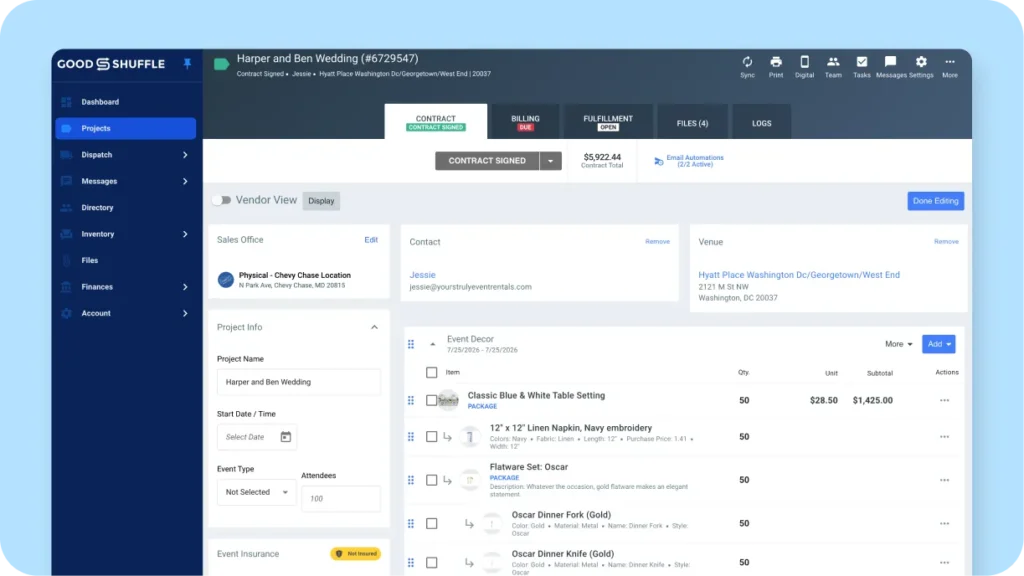
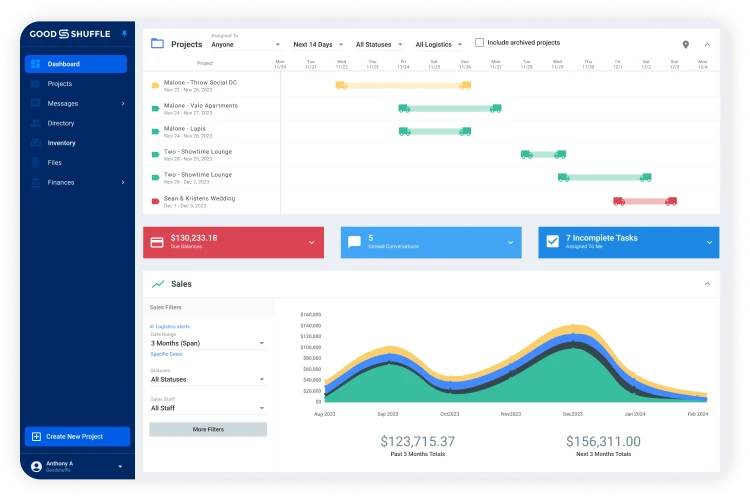
Goodshuffle Pro is event rental software built for pros who both design and rent, which is most decor and event-design businesses. It keeps inventory, branded proposals, client wishlists, payments, and event-day fulfillment in one system, so the piece you own and the proposal you send live in the same place. Inventory tracking with conflict detection stops you double-booking the same arch across two weekends, and Website Integration lets clients build a wishlist and request a quote from your site.
Best for: Designers and decor companies that rent physical inventory and want one system instead of a stack of tools.
Pricing: Lite $39/mo, Standard $99/mo, published on the pricing page. Add-ons (Website Integration, QuickBooks Online, Advanced Inventory with barcoding) are listed publicly. Free trial available.
Watch-out: It produces professional, on-brand proposals, but it isn’t a graphic-design canvas. If you need fully custom, magazine-style layouts or mood boards, that specific depth isn’t the point of it. Multi-warehouse is on the roadmap, but it’s not available today.
Third-party reviewers back up the fit. Goodshuffle Pro holds a 4.9 out of 5 on Capterra across more than 150 reviews, and a 2026 event-rental software roundup called it the strongest option for “purpose-built availability management and warehouse fulfillment tools.”
RW Elephant
RW Elephant is inventory software made specifically for boutique and specialty event rental, and it’s the most decor-native tool on this list. It’s built around a curated collection: photo-rich item galleries, order PDFs, wishlists, and a WordPress plugin that puts your catalog on your own site. Delivery and pull checklists keep crews organized on event day.
Best for: Vintage, specialty, and boutique rental collections where the pieces are the product and presentation matters.
Pricing: Plans are tiered by number of users (up to 10, then enterprise), with the WordPress wishlist on the higher tiers. Free 14-day trial, no contracts. Exact rates aren’t posted as a flat number, so check their plans page.
Watch-out: Reviewers note the reporting is thin and some data entry feels clunky, and the WordPress plugin can occasionally act up. It’s focused on rental inventory, so it won’t run the design-services side of a business the way a CRM does.
Full comparison: Goodshuffle Pro vs RW Elephant
Curate
Curate is floral and event-design software, and for floral-led designers it’s hard to beat on proposals. It’s built around beautiful, visual proposals with mood boards, plus recipe and stem costing that protects your margins, and it has a rentals module for physical inventory. It connects to QuickBooks and Stripe.
Best for: Florists and floral-forward event designers who live in proposals and need stem-level costing.
Pricing: Starts around $100/mo, with a free trial. Curate doesn’t publish flat pricing, so you’ll request a quote.
Watch-out: Cost is the most common complaint, and in 2025 Curate forced customers off its “Classic” system onto a new version mid-wedding-season, which a lot of longtime users found rough. If your business is more rental and decor than floral, you may outgrow the floral focus.
Full comparison: Goodshuffle Pro vs Curate
HoneyBook
HoneyBook is client-management software for creative service providers, and it’s the tool the most decor and design operators in our data already use. It handles proposals, contracts, invoices, payments, scheduling, and a client portal really well. What it doesn’t do is track rental inventory.
Best for: Event designers, stylists, and planners who sell a service and don’t need to track physical rental stock.
Pricing: Starter $36/mo, Essentials $59/mo, Premium $129/mo (lower on annual billing), plus payment processing fees on every transaction. Short free trial.
Watch-out: No inventory or availability tracking, so the moment renting physical decor becomes real revenue, you’ll be running HoneyBook plus something else. Processing fees stack on top of the subscription.
Full comparison: HoneyBook vs Goodshuffle Pro

TapGoods
TapGoods is all-in-one party and event rental software with a strong online storefront. It covers inventory, quotes, payments, warehouse and routing tools, dynamic pricing, and a Storefront that offers wishlists or full ecommerce. It’s built to run a busy rental operation at volume.
Best for: Established party and event rental companies that want an online storefront and warehouse tooling at scale.
Pricing: Quote-based; independent roundups put the warehouse-heavy tier around $6,000/year, with card processing from 1.9% + $0.25. Positioned for higher-revenue operations.
Watch-out: The cost is hard to justify for a small or brand-new decor shop, and some reviewers find the interface dated. Better fit once you’re managing thousands of items than for a boutique collection.
Point of Rental
Point of Rental is general equipment rental software that also serves events, spanning small shops to enterprises across three product tiers. Its DNA is broad rental operations, with deep customization and on-premise options at the top tier. It’s more than most decor businesses need, and that’s the point.
Best for: Larger or mixed rental operations, especially those renting beyond decor into heavy or general equipment, or running multiple warehouses.
Pricing: Not published; every tier requires a sales call for a quote.
Watch-out: Overkill for a boutique decor or design studio, and the event-specific proposal experience is less native than the specialists. Opaque pricing makes quick comparison hard.
Full comparison: Goodshuffle Pro vs Point of Rental

Rentman
Rentman is rental software built for AV and event production, so it fits the production-and-design end of this segment. It’s strong on crew scheduling, transport and logistics, sub-hire, and equipment tracking with QR and barcode scanning. If your design work involves gear, crews, and multi-day load-ins, this is your lane.
Best for: Production-heavy design and AV shops that manage equipment, crews, and transport, not just decor pieces.
Pricing: Modular: the Platform is $39/mo and you add products (Crew scheduling from $14/user/mo, Inventory from $19/user/mo). Warehouse and freelance staff are free basic users. Free trial.
Watch-out: Built around equipment and crew logistics, not aesthetic decor proposals, and it has a steep learning curve. If you don’t manage crews and gear, it’s more system than you need.

Spreadsheets and QuickBooks
The honest baseline. Plenty of designers run on a spreadsheet for inventory and QuickBooks for invoicing, and for the right business you can get by with those tools. It’s cheap, flexible, and there’s not too much of a learning curve.
Best for: Brand-new operations, very low volume, or businesses where every order is fully custom and there’s no repeatable inventory to track.
Pricing: Low. QuickBooks Online starts in the tens of dollars a month; a spreadsheet is free.
Watch-out: It breaks down with any volume. No conflict detection means double-bookings, no client-facing wishlist means more back-and-forth, and proposals are manual. Most operators move off it once losing track of inventory starts costing real money.
Which Should You Choose?
Match the tool to how your business actually runs, not to how big you are.
Choose Goodshuffle Pro if you design and rent, want inventory and proposals in one system, and like seeing the price before you talk to sales. Choose RW Elephant if you’re a boutique or vintage collection where presentation is everything. Choose Curate if you’re floral-first and your proposals are your pitch. Choose HoneyBook if you sell a service and don’t hold inventory.
Choose TapGoods or Point of Rental if you’re running rental at real volume across a warehouse or multiple locations. Choose Rentman if your work is AV and production with crews and gear. And if you’re just starting out or every order is one-of-a-kind, a spreadsheet and QuickBooks can get you off the ground, but we’d recommend moving to real software as soon as possible.
If the design-and-rent description fits, the fastest way to decide is to try it on your own inventory. You can book a quick demo and see it run with a decor and design workflow like yours.
FAQs
Most use one of a handful of tools: Goodshuffle Pro and RW Elephant for tracking rental inventory and sending proposals, Curate for floral-led design, HoneyBook for the client side without inventory, and TapGoods or Point of Rental for higher-volume rental operations. Plenty still run on spreadsheets and QuickBooks until the volume forces a change.
Yes, with the right tool. Goodshuffle Pro’s Website Integration, RW Elephant’s WordPress gallery, and TapGoods Storefront all let clients browse your catalog and build a wishlist or quote request from your site. For custom design work this is a request you review and price, not an instant booking, which is usually what you want.
Get your inventory into software that tracks availability and prevents double-booking, then put a catalog online so clients can request items. Designers with pieces they’ve only used for their own events often start here, turning sitting inventory into a rental line. Goodshuffle Pro and RW Elephant are both built around this.
Yes. Goodshuffle Pro offers a QuickBooks Online integration as an add-on, and Curate, TapGoods, and HoneyBook connect to QuickBooks as well. If accounting sync matters, confirm it’s QuickBooks Online (not just Desktop) and check whether it costs extra on your plan.
Designers leaving Curate over cost or the 2025 platform migration usually look at Goodshuffle Pro if they rent physical inventory, or RW Elephant for a specialty collection. Curate is still the strongest choice for pure floral design and stem costing, so the alternative depends on how much of your business is rental versus floral.
Maybe not yet. If every piece is one-of-a-kind, you don’t hold repeatable inventory, and volume is low, a spreadsheet plus QuickBooks can be enough. Software earns its cost once you’re double-booking pieces, losing track of what’s out, or spending real time on proposals.

Share On