
Rebecca Warnick hears the same sentence from event rental owners all year: we’re booked every weekend, where is all the money?
She’s a CPA whose firm specializes in event rental companies, and she’s heard it often enough to know it’s usually not a bookkeeping error. It’s three things getting mistaken for one, and your calendar looks identical in all three.
She and Sam Jahanbeen, Goodshuffle’s fractional CFO through Varus One, each took a session on this at our 2026 User Summit. What follows is their guidance, not financial advice from Goodshuffle, so take anything that applies to your books to your own accountant.
Key Takeaways:
-
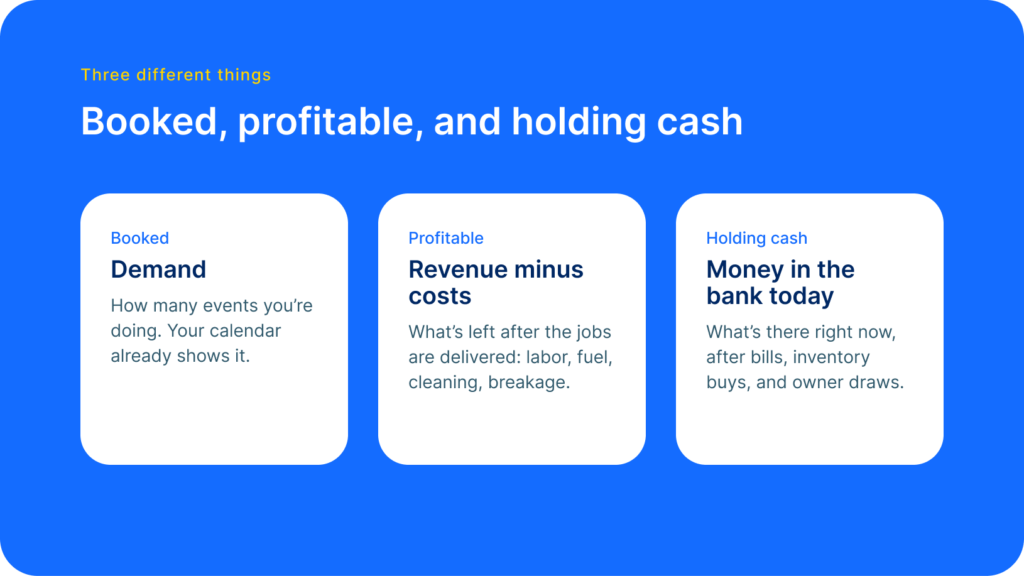
Booked, profitable, and having cash are three separate things, and an event rental business can be any combination of them.
A full calendar tells you people want what you own. It doesn’t tell you whether the work paid.
-
Sam Jahanbeen's point: margin leaks in small amounts rather than one big loss.
Underpriced delivery, labor nobody tracked, a line item set three years ago. In his example, a job quoted at 20 percent lands at 9.
-
An event rental item earns its keep on price and frequency together, not price alone.
Knowing what a chair rents for tells you very little until you know how many times a year it goes out.
-
Rebecca Warnick's point on taxes: the bill comes from net income, whether or not you paid yourself.
Nobody is withholding for you, so the set-aside has to happen as you go.
-
Clean books and clean rental records answer different questions.
One tells you what went out the door. The other tells you what the job actually earned.
Booked, Profitable, and Holding Cash
Booked, profitable, and having cash are three different things. Booked is demand, or how many events you’re doing. Profit is what’s left after the costs of delivering them. Cash is what’s in the bank on a given day. An event rental business can be strong on one and weak on the others.
“Knowing the difference between being booked, being profitable, and having cash… is one of the most valuable things that a new owner in particular can learn.”
— Rebecca Warnick, CPA, The Warnick Group
What a $5,000 Event Rental Job Costs
A $5,000 event is not $5,000. Before anything reaches you, the job pays for getting the goods there, handling them, storing them, and running the business, and then it pays taxes. Warnick’s exercise is to peel a job apart and look at all of it.
Delivery is one of the lines that gets underpriced most often. It’s easy to quote as a flat number and hard to see what your delivery fee has to absorb in fuel, hours, and routing. If yours hasn’t been revisited in a couple of seasons, tightening up your routing is a fast place to find money. The damage waiver is worth the same look, since it’s the one line on the invoice that exists because things break, and it’s usually set once and never revisited.
Warnick puts it to owners this way:
“Your customer isn’t just renting a chair or tables, they’re renting the chair, the warehouse space it sits in, the person who cleans it, the person who loads it, the truck that delivers it, the software that tracks it, and the time your team spends making all of that happen.”
— Rebecca Warnick, CPA, The Warnick Group
What Your Event Rental Inventory Earns
Warnick’s benchmark is dollar utilization: aim to earn roughly twice what an item cost you within 12 months, so a $100 chair should bring in about $200 a year. That’s for event inventory. Heavier equipment works differently, so don’t carry the number across your whole catalog. Then frequency does the rest.
Which matters because you pay $100 for a chair and then have to decide whether to rent it for $10, $15, or $25. Checking competitors tells you what your market will bear, but it won’t tell you whether you can make money at that price. The same math scales up, where a $500 piece renting 15 times and a $1,000 piece renting 12 times need very different rates.
Warnick’s math:
Price times frequency is what tells you how an item performed. Which is why the buying advice is to buy what your market rents, not what you love. Plain white stacking chairs aren’t the most interesting thing in the warehouse, but they work in almost any setup and they go out constantly. Before you buy anything, ask what you can rent it for and how often.
To run this against what you already own, a regular inventory audit will tell you which items are earning their space. Which is a per-item view. The leaks in your event rental profit margin are smaller than that.
The Leaks Hiding in an Event Rental P&L
Event rental profit margin rarely disappears in one visible loss. It leaks, and finding out where is what Jahanbeen does for a living. He’s spent 20-plus years building the reporting that catches it, across our books and plenty of others.
“There’s rarely one or two issues that eat into margins. It’s usually a concerted effort of pennies here, pennies here that add up.”
— Sam Jahanbeen, fractional CFO, Varus One
The usual suspects: underpriced delivery, labor that never got assigned to a job, a line item that made sense three years ago and hasn’t been revisited since. None of them feels big alone. In Jahanbeen’s example, together they’re how a job quoted at 20 percent lands at 9.
You can’t find leaks that small by looking harder. You find them when everything lands in one place. Payroll, your card and payable accounts, and your rental software all feed the same accounting file, and then nobody is retyping anything.
Get Onto Accrual Accounting
Owners resist this one, and it’s the one that changes what a profit and loss statement can tell you. Accrual puts a job’s revenue and that job’s costs in the same month. Cash accounting puts the deposit in September and the costs in November. Neither month tells you the truth. When you collect months ahead of the event, that gap is constant. The deposits sitting in your account for a spring event are a liability, not profit you’ve earned.
Build the Chart of Accounts to Your Business
If you want to know whether drivers or warehouse staff are where labor is growing, they need separate lines. Same with rent and utilities. Don’t overdo it, though. A profit and loss statement that runs ten pages doesn’t get read.
Clean reporting is what makes per-job margin visible instead of guessed at, and our financial fitness newsletter covers the wider view.
The Tax Bill Event Rental Owners Miss
Your tax bill comes from your bottom-line net income, not from what you paid yourself. Warnick’s rule of thumb is to set aside about 35 percent for federal and state combined, and more in a high-tax state.
Owners tell her all the time that they don’t understand why they owe tax when they never took money out. It doesn’t work that way. Nobody is withholding for you either, which is what surprises people coming out of a job.
A few traps she sees:
- Buying inventory isn’t an automatic write-off: $20,000 of rental inventory can often be deducted this year through depreciation, but it depends on how the purchase is set up, and states have their own rules. Check with your accountant before you count on it.
- Borrowed money isn’t income: a $50,000 loan raises your bank balance without raising your profit, and it has to be paid back.
- Only the interest on a loan payment is deductible: your cash can drop by $2,000 while the deductible part is closer to $100.
- Don’t spend to save on tax: erasing a $1,000 tax bill takes roughly $4,000 of spending. Sometimes paying the tax and keeping the money is the better business decision.
The ordinary deductions are worth capturing properly: mileage, home office, software, card processing, business insurance. All easier if those charges ran through the business account in the first place.
What to Change Before Your Next Close
Separate the money first. Mixing personal and business spending makes it hard to tell whether the business is carrying itself. Open a business bank account and a business card, use them only for the business, and get bookkeeping running against your rental software so the two sides agree.
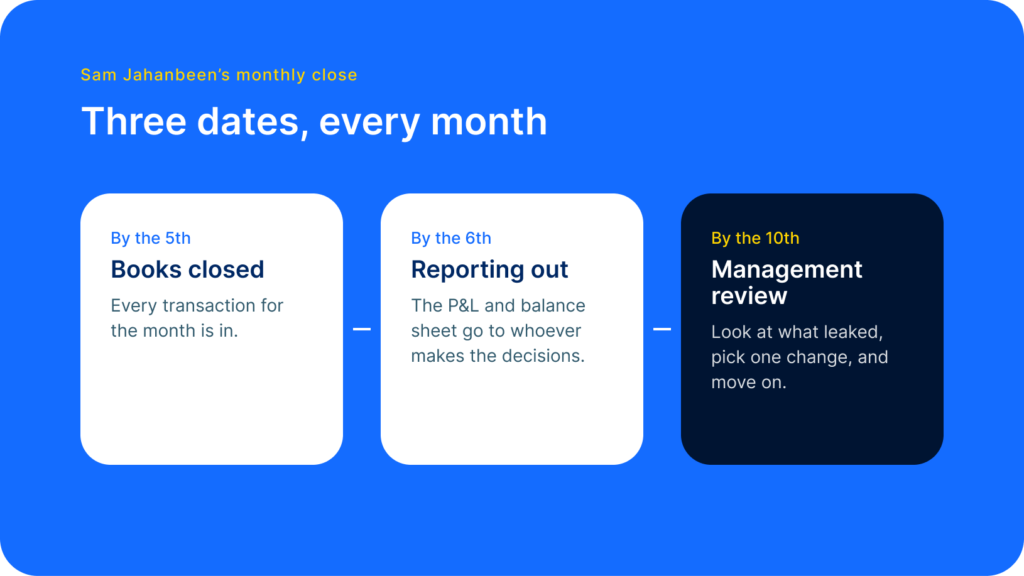
Jahanbeen puts the month on a schedule and keeps it there. Books closed by the 5th, reporting out by the 6th, a review by the 10th. Pick different dates if your month runs differently, just don’t pick new ones every month.
Then the assignment both of them gave: pull one real job, look at what it earned after everything, and make one change based on what you find.
Warnick’s signals that it’s time to bring in help:
- You don’t trust your numbers.
- You’re deciding off your bank balance instead of a profit and loss statement.
- Revenue is growing while money feels tighter and you can’t say why.
She closed her session on the reason any of this matters:
“A full calendar of bookings can make you feel successful, but a good financial system can tell you whether you actually are.”
— Rebecca Warnick, CPA, The Warnick Group
Watch the Summit sessions
Every recorded session from the 2026 User Summit is one form away.

Session Transcripts
Both sessions are below. The full recordings are in the User Summit on-demand library. Cam Petty (Goodshuffle): This is going to be all about Accounting 101, so needed for our businesses. We are gonna talk about why I’m making money doesn’t always start with I’m booked up. A full calendar and a profitable business aren’t the same thing, and rental specific costs are where the gap usually hides. Rebecca’s firm works exclusively with event rental companies, so this is a real look at how pricing and inventory costs should be shaping your numbers, plus the tax basics that catch first time owners off guard before the IRS comes knocking on your door. Taxes are a real thing. Rebecca Warnick of the Warnick Group, she founded the Warnick Group to do one thing well: tax strategy and planning for rental stores. She is a licensed CPA since 2013, and her clients are rental business owners, not businesses just in general. So the advice in this session is built on the numbers specifically for companies like ours. And so we’re excited to have you here, Rebecca, and we’ll let you kick it off. Rebecca Warnick: Thanks, Cam. I’m excited to be here with everyone. Good morning for our Pacific and West people, and good afternoon for some of you other ones. We’re gonna dive into a bunch of things today, and then there’s an opportunity at the end. First, let’s talk about being booked does not necessarily mean being profitable and does not necessarily mean you have a lot of cash. One of the most common things I hear from rental business owners is, “I don’t understand. We’re booked every weekend. Where is all the money?” And that’s because being booked, being profitable, and having money in the bank are three completely different things. Let’s break down each of those. Booked equals demand. It’s people wanting what you sell. How many jobs are you doing? How many events? How many locations are you going to? That’s the booked portion. And that’s probably one of the easiest for you to be aware of. You’re looking at your calendar. You see the items going out. You’re doing jobs, going to events, all of those things. So then let’s take the next step. Profit is how much money are we making at the end of the day? So after expenses. You’ve got your top line revenue, which is the money coming in from jobs at the top, but then you’ve also got costs and things like that that are going against that. What do you have at the end of the day to cover those costs, and what’s left over at the bottom? And that’s how we know, did I make money. That’s what the profit word is. I’ll do my best to break down any of these complicated terms into things that you guys understand. And if we get any Q&A or whatever, happy to go through those more, but that’s what profit means. We wanna know at the end of the day, how much money did we make? What do we have left over? So then we have cash, and this one can be a fairly easy one to keep an eye on. You pull up your bank account, and you can look at how much cash you have. But there’s things beyond that. So cash is, it might be great on the first of the month and a little bit tough on the 15th, depending on when debt payments come, credit card bills, things like that. So when we look at cash, we also wanna look at timing and use that to help us make decisions. Another example is, it’s great to have a job and book a job, but did the customer actually pay for it? And when did they pay? Were we able to get that money before we went out, before the event? Or are we having to chase the customers later to get that after the event has happened? Also with timing and decisions, when bills are due, when those need to be paid, when you decide to buy more inventory. That can be a pretty heavy cash outlay. And then taxes plus owner draws, owner compensation. Running the business, we want you to get paid as well. So we have three different things. A rental company can be booked and profitable, so you’re busy, you’re doing jobs, and you’re making money. Or we have the flip side of that, booked and losing money, so maybe the cost of the events and putting those things on are causing you to lose money, the staff and things like that is more than what you’re bringing out in revenue. Or you’re doing the jobs for too low of a price. Then there can be profitable, so you are making money at the end of the day, but you’re still short on cash. So maybe you have bought a lot of inventory, but you financed it with debt, and you’ve got those hefty debt payments and things like that, so you’re making money, but at the end of the day, there isn’t a lot left over in the bank account because it’s going to debt. Or the last thing is you’re sitting on a bunch of cash, but maybe the business isn’t great. Maybe you’re not providing excellent customer service or a lot of turnover, different things like that. So I think knowing the difference between being booked, being profitable, and having cash, knowing the difference between those three things is one of the most valuable things that a new owner in particular can learn. One thing that we wanna do at the very beginning is lay the foundation. We want to be able to have an ability to track information and know how we’re doing, but the best way to do that is to have a separate business bank account and a separate business credit card so that you can actually see how the business is doing, what is coming in, what’s going out, and it’s not mixed in with your own personal transactions and things like that. We call that co-mingling when you’ve got business and personal things running together, and it’s not just gonna annoy your accountant, but it’s gonna make it harder for you to know whether the business is actually supporting itself. So we wanna get those two accounts set up, get the bank account, get the credit card, use them for the business, be disciplined with it. And then the next step is we wanna set up bookkeeping from the beginning. Grab a QuickBooks file or Xero or something like that. Ideally, it’s gonna tie into your rental software with Goodshuffle, and they’re gonna talk to each other, and that’s gonna help you know better, are we making money on our jobs? How are we doing? And how much did we sell? What did it cost us to deliver those events? What do we own? What do we owe? And are we making money? So having both the rental software and the accounting software together, and then having them talk to each other is gonna help you answer those questions. I wanna tell you about when rental math revenue does not necessarily equal profit. Let’s put an example of a $5,000 event. The owner and the operators of the business are like, “Yes, we just got a $5,000 event. That’s 5,000 into the bank account. Yay, good for us. We’re really excited.” Now we’ve gotta start peeling that back because of the costs that are going to go against that. You’ve got delivery labor, set up and strike labor, truck fuel costs, credit card processing, cleaning, damaged or missing inventory items, anything that you had to subrent or outsource, wear and tear on the inventory, warehouse or storage, where are you keeping items, insurance, software, marketing. And then even after all of that, we still have taxes. One thing to keep in mind is just because we brought in a 5,000 or a $50,000 job doesn’t mean that that’s what we have at the end of the day and that that’s what we can go spend or take out as money for us or different compensation. One thing to keep in mind with your businesses, your customer isn’t just renting a chair or tables, they’re renting the chair, the warehouse space it sits in, the person who cleans it, the person who loads it, the truck that delivers it, the software that tracks it, and the time your team spends making all of that happen. All of these costs and things have to come into your pricing. Now what we wanna be looking at is, did our inventory actually make us money? That profit at the bottom of the day, what do we have left over? Let’s do a similar scenario, but talking about an actual item. How do we figure out what to charge and how does that look like? One of the things is you buy a chair for $100, do you rent it for $10, 15 or 25? And how do you know? Well, a great place to start, and this is where a lot of owners do, is looking at competitors, and that’s useful. That will absolutely give you an idea of what your market will bear. You can maybe pull up some of their websites and see what their pricing looks like. But looking at competitors’ pricing doesn’t necessarily tell you if you can make money at that price. So we wanna look at something that’s gonna be a benchmark and give you an idea of where to go, and that is a complicated sounding term called dollar utilization. It tells us how hard our inventory or our rental items are working for us. So we want, and we’re trying to make this math as easy as possible, we want it to be about two times that amount. So if we bought a chair for $100 that year, in a year’s time, within 12 months, we wanna make $200 off of that chair, that one chair in particular. Think of that as a benchmark of what we’re trying to earn off the cost of our equipment. And this benchmark is just for the event side. Equipment side is gonna be a little bit different, because their items might be more costly and things like that. So when we talk about this two times benchmark, we’re talking about the event side in particular. That’s our goal. Dollar utilization, I know it sounds really complicated, but it’s how much money are you trying to make versus how much did that cost? How much did that original item cost? And our goal is two times. We wanna double what we’ve made in that rental item. So we’ve got that chair, and we know that we wanna earn $200 from that $100 chair. Now the question is: how many times a year can you rent it? And that will help us dive into a benchmark figure for that item. Can we rent it for 20 times per year? Then if that’s the case, then we only need $10 per rental, per item it goes out. We’re gonna charge $10 for that chair. We’re gonna rent it 20 times a year, we get to the 200 that we’re shooting for. But what if you think you can only rent it 10 times a year? Maybe you’re in a place that is more seasonal, you’ve got a shorter season, or you’ve bought something that isn’t as broad as, say, a general Chiavari chair. Well, now, if we’re only gonna rent it 10 times per year, then we need to charge $20 per rental instead of 10. So that’s the other factor that we want to look in, is how often can you realistically rent it? Is it an item that is going to be in high demand that can go out every week? Is it more of a niche item that would be only sometimes rented? And do I have the staff to rent this, myself or my team or my family members or whoever, do I have the people to actually get that delivered or get that used, get it wiped down to be able to rent it 20 times a year? So we’re looking at price times frequency gives us the performance. It’s not just about what the rental item costs, but it’s also about how often you can realistically rent it. Now we’ve decided with this particular chair, we’re gonna charge $8 a rental, and we think that we can make 13 rentals. And we’ve hit that mark, and we’re like, “Yes, I did it. I did my 13 rentals at $8 a rental. I got to that $200 number that we were trying to get.” And then remember those items that we talked about is cleaning, repairs, warehouse space, labor, insurance, all of those things. Those come back, and eventually you’re gonna have to replace that chair. Those come back to profit. And we didn’t just start the rental business to only get $100 back. We want to make as much money as possible on those items, so we wanna find that sweet spot where it’s how many times can we rent it and how much can we charge, and getting to that nice number that helps us bring in as much as possible. So we wanna make sure that this inventory really is making us money. And just to drive this point home, I’ve got one more spreadsheet for you, like a little table, as the item costs change, so the first two lines are what we talked about already. We’ve got the renting 20 times a year or renting 10 times a year, how much you need to charge per rental. But then also looking at $500. If the item costs $500 and we’re shooting for 1,000 and we’re gonna rent it 15 times a year, we wanna charge $66.67, so call it 67. $67 per rental at 15. And then also look, what if we have $1,000 that we spent on the item? We’re shooting for 2,000 and we think this one’s only gonna rent 12 times a year, then we’ve got to charge $167. So you’ve got all of these pieces that go together. But again, the goal is that price times the frequency is gonna let you know how well that item did. One thing that we wanna really focus on is buy what your market wants, what is going to rent well. Don’t necessarily focus on just the items that you personally love. There are people all across the board that have all different styles. You might have a plastic chair, whatever, that isn’t glamorous. Some of those white chairs that stack really beautifully. They’re a workhorse. They’re gonna work in a lot of situations. But maybe they’re not the coolest, the funnest thing, but if we can get them rented a lot of times per year, they’re a low-cost item, sometimes having those in your inventory makes sense. So before you buy something, don’t just ask, “What can I rent it for?” Ask, “What can I rent it for and how often can I realistically rent it?” And then that will tell you if that item is really going to work together financially and make you some good profit, some good money at the end of the day. And then as your businesses grows, Goodshuffle will help you look at that historical data at how often your item is renting, and it will help you look forward to what is making you money, what is working well, what do we wanna lean into, what item is being rented every week or every month that we wanna buy more of? And then your accounting information, so that QuickBooks piece, is going to tell you whether that price and that item is not just making you money at the top, but is it making you money at the end of the day after all of those expenses, what are we walking away with? So remember, before you buy something or as you’re buying something, ask, “What can I rent it for and how often?” Those two numbers are gonna give you a much better story of how that item is going to work. Let’s touch base. Now that we’ve talked a lot about profit, let’s talk about how that works with cash and things like that. Just because we’ve had a lot of profit, we’ve made a lot of money, does not necessarily mean that we’re gonna have money in the bank. You may have bought $20,000 of rental inventory, and that money left your bank account. But for taxes and for accounting, it doesn’t necessarily mean that you have a $20,000 expense that year. A $20,000 write-off on your profit and loss. We don’t necessarily get to take items that are gonna be used for multiple years in the past and just be like, “Oh, I can write that off. It’s good to go.” In a lot of cases, you can with depreciation, but states are gonna have different rules, things like that. So just be careful. Don’t think, “I went out and bought $20,000 of inventory. I’m fine. I don’t have to worry about taxes. That’s a deduction for me. That’s a write-off.” That’s not always the case. Then let’s say in another example, you borrowed $50,000. Your bank account may have gone up by $50,000, but that doesn’t mean that you made $50,000. That has to be paid back. We may end up using that to buy inventory or lean into another location or things like that, but that doesn’t mean that you made 50,000. You’ve just got 50,000 more debt, even if it does hit your bank account for a period of time. Next one is you have some debt or a loan that you have, and you had to pay $20,000 on that loan. So that doesn’t necessarily mean that it’s a $2,000 write-off. Your cash has gone down by 2,000, but we only get to take that as an expense, as a write-off or deduction for the amount that is interest. So your account may have just dropped by 2,000, but maybe you only got a $100 deduction on your business. So just keep in mind, your bank balance answers how much money do you have. Your profit and loss, so that’s your income minus your expenses. The money that you bring in versus everything that you’re paying for. That’s gonna answer, did my business make money? And we need both of those answers. We wanna know how much do we have in the bank account, but then did we make money at the end of the day? We’ve just got a couple quick slides here really quick. Let’s talk about the tax stuff that nobody tells you about. Profit, so we’ve got our revenue at the top, and then bottom line net income, that creates the tax bill. You could say, “Hey, Rebecca, I don’t understand why I owe taxes. I didn’t take any money out of the business.” That’s fine. The IRS doesn’t care. Most states don’t care. It’s whatever the bottom line net income is, you’re gonna pay tax on that, whether you leave money in the business or take it out. That can be a tricky one, because you’re like, “I don’t understand. I didn’t take any money personally and put it into my account.” You still have to pay taxes on that. The other thing to keep in mind when you’re new to starting out and having your own business or a side hustle or whatever, the IRS isn’t withholding taxes for you anymore. Your employer isn’t withholding taxes anymore, so you’ve gotta pay in throughout the year towards that. So we wanna make sure that when we get to the end of the line, that we haven’t spent all of the money, that we have some reserve for taxes. And then we talked about this a little bit. Buying something doesn’t mean you get to deduct it immediately. We might have to do that over a period of time. So just because you bought twenty thousand dollars of inventory doesn’t mean that you can write it off. And then keep an eye for normal, boring deductions. Mileage on your vehicles, home office, software, credit card processing, business insurance, all of those things are gonna be deductions that we wanna be running through that business bank account and credit card to capture those. But also on the flip side, don’t spend money just to save on taxes. If you’ve got, let’s say, a tax bill of $1,000 and you’re like, “Hey, Rebecca, how much would I have to buy in inventory to make that go away?” It’s about $4,000 is what you would need to spend. But we wanna buy things for the business because the business needs them, because we have the demand for them, not to save on taxes. Sometimes it’s better just to pay the taxes and be able to do what you want with the money at the end of the day, than necessarily buying items that aren’t going to rent and make you that money. Then just remember, continue saving for taxes as you go, and a rough rule of thumb is 35%. So of that bottom line net income, what’s on your profit and loss, how much profit did you make, set aside 35%, and that should help you be closer to where you need. You need to set aside both for federal and state. If you’re in a high tax state, that number needs to go up even more, so just be careful of that, depending on which state you’re in. The last thing we wanna talk about is when do I stop DIY-ing this? When have we grown to a point that we need to bring on some outside help? There’s a few scenarios. You don’t trust your numbers. You’re not sure that what it says you’re making is actually accurate. You’re making decisions based on your bank account balance instead of looking at reports like a profit and loss. You have no idea how much you’re gonna owe in taxes. You’re behind on the bookkeeping. Payroll is more than you can manage. You’ve got employees that you’re working with. You’re buying inventory on a pretty consistent basis. Revenue is growing, but somehow money feels tighter, so you’re not quite sure why at the end of the day you don’t have that leftover in the bank account. And you don’t know which parts of the business are actually profitable. Are you making money on your delivery charges? And then you’re making big decisions for the business based on your gut versus the answers from your financial. So the things that we wanna build are separate your account, record and keep your books up to date, look at your balance sheet, your profit and loss, and your inventory, and then plan so that we can answer the questions, “Are we making money? Where are we making money? And what should we do next?” Because a full calendar of bookings can make you feel successful, but a good financial system can tell you whether you actually are. Cam Petty (Goodshuffle): Thank you so much, Rebecca. This has been so helpful. Great reminders as well. We have time for just one or two questions. One of our attendees asked, “I am still in the building process, and I’m funding my business with my own personal income. How do I label the money that I’m using to support my business when it is not completely coming from the services I’m providing?” And then tacked onto that, “Also, is the money that I’m using to support my business hurting me in the long run when filing for taxes?” Rebecca Warnick: That is considered owner contributions. It’s the money that you’re contributing into the business to build it, to fund it, and that doesn’t hurt you. That is gonna be a benefit to you over time because it’s this retained investment in the business that you’ve built up with your personal funds that is gonna be kind of what the business is worth at the end of the day. So it’s great to continue funding that. You definitely wanna keep track of that information though, because that does go into some tax calculations. Yes, and over time as your business starts earning profits, you can take an owner draw, which is helping you take back some of the money that you invested into it. An investment obviously is something that we want to earn money off of at some point. And so if you are investing money in, you can take members draw or owners draw at the times that you do have profit and can afford to do that. Colin Connor (Goodshuffle): Hope you all had a safe lunch and are eager to dive back in. As a reminder, one of the requirements for this session is to have some of the financial information handy and available because those are the metrics or those are the numbers that we’re going to use to fuel this conversation, and to make sure that we can keep this conversation interactive, less of a lecture, more of a conversation. And welcome back, everybody. What time is it? It’s money time. And here’s the thing about your margin at scale. It doesn’t disappear all at once. It leaks drip by drip with underpriced delivery, labor costs that go unaccounted for, a line item that made sense maybe three years ago that has never been revisited. Individually, none of these changes or none of these impacts feel big, but they add up over time, and together with all those little small paper cuts, that’s your profit gone. Sam from our finance team is going to be leading this one, and I want to be very clear about the format now that we’re getting the session started in earnest. This is a peer discussion, not a lecture. He’s gonna open it up, and the value is with the comparison across this room. So bring your numbers and be willing to say them out loud. You can type them in the chat and let us know here. And Mikayla from our team is in the chat. So with that, I would like to turn things over to the amazing Sam Jahanbeen to kick things off. Welcome, Sam. Sam Jahanbeen: Thank you, Colin. That was an amazing intro. Thank you, everybody. As Colin alluded to, feel free to chime in with questions, concerns, scenarios that you wanna go through. I do understand that we are talking about financials. We’re talking about accounting. Obviously a lot of this stuff is proprietary, so feel free to frame your questions in a way that I could get them answered. If it’s something very specific that you don’t wanna disclose here, happy to take it offline, and we could figure out a way, Colin, to do follow-ups as needed. I am an outsourced CFO. I’ve worked with a lot of different companies across different industries. Over my twenty plus years experience, my focus, coming from a finance background, has naturally fallen into the accounting black hole. You always have to have the accounting straight. And throughout that, to improve efficiencies, naturally I’ve fallen into a lot of system development, system implementation, and I’ve seen a tremendous amount of value in establishing proper systems to improve operations and efficiency. I work across different industries. I have touched on the events and rental sector quite a bit. My focus tends to be, like I said, across the board. One of the topics we wanted to cover over here is exactly what Colin alluded to, was essentially margins and, as I think he called it, death by a thousand cuts more or less. I have an uncle who was a very successful entrepreneur, and he’d always said, “Everything boils down to the pennies.” There’s rarely one or two issues that eat into margins. It’s usually a concerted effort of pennies here, pennies here that add up and where you had a project that you thought you were gonna bring in twenty percent, ended up being more like nine percent. So really the idea is that we could develop systems that track these sort of things. And one of the biggest things that you’ll notice is that there’s a tremendous amount of data, day-to-day transactional data that are coming in from different sources, whether it’s your payroll system, your payable system, your credit cards, your accounting system, the inputs that go into there. And ultimately what you wanna do is really identify, where are my transactions taking place, through what platforms, and what’s the most efficient way I could get them into really one bucket where I could start analyzing everything. Easy ones to look at, for example, payroll systems are really great to touch on real quick. And one of the things is I always tell people, “If you’re not on a payroll system that’s not integrated into your accounting system, make that transition.” I think it’s absolutely critical. You have the same kind of capabilities within AP and credit card, and with your operating tools. So I typically look at things as really two or three sort of operational functions. You have your core operating tools. In this case, it’s Goodshuffle. That’s the system that is built around really what your business is performing or what your business’s functions are. And then you have your other buckets that are really similar across all sectors or companies, and that would be really payroll, one, expense management, that’s divided into two subcategories such as payables and really credit cards. And really across the board with all these functions, you should be able to integrate them directly into your business and get all that data into a single place. I’m gonna take a step that say most of you guys are probably on QuickBooks or something similar. Colin, feel free to chime in if that’s not correct. And the idea is that right now, with the current systems and technology out there, all these systems are really easy to integrate with one another and get them all housed into some place. And what this really ultimately does is just alleviates an immediate amount of administrative headaches with something that really shouldn’t exist much anymore, which is data entry. A lot of that could be automated. So I always tell people, “If you’re on Goodshuffle, make sure you got the QBO integration set up.” That is absolutely critical. It addresses really a lot of your revenue and payment functions. So you’re really at that point taking care of, you’re automating really your revenue processes and embedding them into your operational workflow without having to worry about data entry, human error between two different systems. If you’re on payroll, whether it’s Paychex, Gusto, ADP, all of these have integrations now. Get that integrated. That takes care of one of your, probably your largest expense in most cases, which is your labor. And then expense management. If you’re using credit cards, which I bet you all are, you have accounts payable, get an expense management tool that, again, integrates into your system, whether you’re using QuickBooks’ own payables module. Great tools out there like Brex and Ramp. We utilize Brex over here at Goodshuffle. It’s a great tool. It handles our credit cards, it handles our payables. And again, all these things, all the data, all the rhythm of your business can be automated, so when a transaction occurs, you’re not moving it down the line from one system to another and just bogging yourself down with data entry and, more importantly, bogging your accountant down with data entry. The goal here ultimately is to get everything into one system as automated as possible, so you could just start focusing on decisions. One thing I do emphasize quite a bit, and it’s a tough pill to swallow because it does require a mind shift, is try to get yourself into an accrual mode and track your books on accrual basis. And I understand within small businesses cash flow is critical. And so typically I find owners, they look at things on a cash basis. The reason you wanna look at things as accrual is that when you, for example, close out the month of September, you wanna see really all your revenue and expenses regarding that revenue regardless of if you paid it or not, and regardless if that revenue has been paid or not in one bucket in August. So you could really do an apples to apples comparison of your books. Without it, you really disconnect yourself from your ability to track things and compare, “Hey, I had a great month in September. What were the expenses for that?” And what was the actual net profit? Otherwise, what you’re doing is you’re creating a disconnect between your revenue and your expenses. I’ve had owners who’ve been in business for 10, 15, 20 years and who’ve pulled me aside, say, “Hey, I got a dumb question. Can you really walk me through accrual and cash-based differences?” And I always tell them, “That is not a dumb question. That is a critical question.” I always tell people, do what you can. Great videos online. Check out YouTube. Just get a good understanding of what it is, and what you wanna start doing is utilizing your P&L on an accrual basis, and then supplementing it with the balance sheet. And what the balance sheet is really doing is just tracking your core assets and your liabilities from cash to AR to what you owe, your retained earnings. And those two in tandem when on an accrual basis really does a great job on painting a picture of the overall performance of your business. That’s your P&L on accrual basis, and then the total health of your business, which is your balance sheet. Once you have those two in place, it’s really easy then to see how your business is fundamentally performing. Colin Connor (Goodshuffle): One thing to piggyback off of that, Sam, that I’ve heard from other business owners that have made this transition from cash to accrual is in the industry, in the events industry, there’s a lot of money that you get in, but because you’re executing on a promise that might be next month, next year, next quarter, it may not happen right away, a lot can happen between now and then. So if I pay you $1,000 today, and you count that as cash, and you celebrate it, and you pay tax on it, and you recognize it, what happens if the next period I call you back and say, “Oh, you know what, I’m so sorry, we’ve gotta cancel, we’ve got to downsize the event.” Well, now I’ve got a record that I’ve already celebrated that now needs to be counterbalanced in a separate period. Sam Jahanbeen: Absolutely. Yeah. And another way to even look at it is if I got $1,000 today in September, that’s $1,000 of revenue, and let’s say that’s my only transaction, and two months later I have the event and I have to book all these expenses. And now you have a disconnect where you have expenses sitting in October, you have your revenue sitting in August. And so the idea is that you wanna create a system. What accrual-based accounting does is actually just puts them all under the same sort of umbrella. So you can say, “I have $1,000 of revenue. These are the expenses, and this is my actual net profit.” And it does this in totality, not just at the project level, but it does it at the total consolidated corporate level. So when you look at your books in a month, you could say, “Hey, my projects brought … I earned,” not I collected, that’s a different question, “I earned this much money, and I had to pay people this much money, and I had this much rent for October,” or September, I apologize, “and these are my costs associated with the project, and this is my net profit,” and that’s real net profit. Now collectability is a different scenario, and those are timing differences. And that timing difference of when the money comes in as cash and when it goes, even when it goes out as cash to pay bills, that’s tracked on the balance sheet. And the balance sheet does a great job of saying, “Well, this is how much cash you have, but it’s not your only asset. You have receivables. You have things you prepaid for that you haven’t received, which are technically refundable, but it’s an asset. Those are not expenses yet.” And the same thing with your liabilities. I have credit cards that I incurred charges for my projects, but I still haven’t paid them. I have vendors I owe money to. So it really tracks, the balance sheet tracks the timing difference between when things are turning into cash or coming out of cash. So I always tell people, get yourself in that mindset. It is absolutely critical. It is one of the toughest hurdles, but I do think it’s really more conceptual and psychological almost. And if you could get yourself thinking that way, get your accountant tracking that way, I think it will make a major difference. And then what you’re using is you’re using your P&L at that point purely for performance, not just how much cash did we make. It’s really about how well did we do this month. And then the balance sheet at that point is tracking where’s all my cash stuck in? Is it stuck in AR? Is it stuck in unbilled? Is it stuck in assets that I haven’t either recognized in my projects yet? And the same thing is, I have all this cash, but how much of that cash in my bank is actually prepaid items that I haven’t really earned yet for projects coming in three, four, five months? That’s called deferred revenue. Those are considered liabilities until you earn it. So I think it’s really critical to start thinking in this way because when you start doing that, then you’re getting your reporting really nice and tight. And I find that when you have the right systems in place and that data is coming in, you could focus yourself on the conceptual idea of accrual-based accounting and less on, “Let me keep keying all this data in. Let me key in all my invoices from Goodshuffle. Let me key in all these credit card data.” You really can start focusing on just getting good reporting as opposed to doing good data entry. Let the data entry be handled by automated tools and functions, because they’re all there nowadays, which is fantastic. Colin Connor (Goodshuffle): One quick thing just before we move off of that. We do have a question or a comment from one of our attendees, saying that accrual is great for accuracy but doesn’t feel it’s a reality for small businesses who rely on their accountants for many main duties. For example, collection and verification of receipts, reconciliation of accounts, sales tax reports, email receipts and the like. Can you talk to a little bit more from your perspective on where some of those duty or how some of those duties would be different on an accrual basis? Sam Jahanbeen: So I think part of it is, there’s not a single report or a single function within accounting systems that say, “This tells me everything.” And this is why we have the trinity of reporting, which is really your income statement that demonstrates performance, the balance sheet which demonstrates what’s the total health of my business and maybe a little more specifically, where are my obligations and assets sitting? I got a ton of cash, but I may have a ton of debt too. It shows you where all that is. It shows you, well, I don’t have a lot of cash, but wow, I have a lot of receivables. And then you have your statement of cash flows. And I will admittedly say QuickBooks, if you’re using it, does not have a strong cash flow reporting tool. There are supplemental reports you can use that bolt on the QuickBooks that do a better job of doing that cash conversion. But fundamentally, at the bottom line, QuickBooks’ statement of cash flows does do a good job to show you how much cash is coming in on a month-to-month basis. So what you’re gonna do is you’re not really relying on one report, you’re just using a series of reports in the right way that they’re supposed to be used for. Fundamentally, all of this requires you to be on an accrual-based function. So I could reiterate that your P&L is about the performance of your business over, a snapshot of the performance of your business in a period of time, finite period of time. The balance sheet is the overall health of where all your assets are spread across and where all your liabilities spread across. And then you have your statement of cash flows. You have then second-degree reporting such as AR reporting. So when I look at my balance sheet, I can see where my cash is, but I can see this fat receivables number. My next question is, “Well, let me dig into that.” That’s an AR report that then expands it by your customers, and more importantly, has certain metrics associated with it such as DSOs, days sales outstanding, which shows you what’s my average collection rate. So you could then start tracking your average collection rate by looking at different AR reports over periods of time to see if you are collecting, if you’re functionally doing a great job at converting your AR into cash. And so there’s not one sort of magic report. There’s a series of reports that you’re gonna use. But I think when you understand what the true functions of these are, and again, fundamentally running everything on accrual, you start looking at the business and getting your questions answered by going to the right report. By pulling down the right tool you need, the right report you need to get the answer you need. It would be wonderful if the P&L answered all your questions, but unfortunately, it doesn’t. That’s why we gotta lean into some of these other reports and making sure that we understand them better. One of the most critical things, and this goes back to system integration. Bolting on your payroll, getting your QuickBooks integrated to Goodshuffle, getting your credit cards integrated into QuickBooks is really, if you’re gonna use, for example, QuickBooks as a central hub for all your data, well, it can’t just get all piled onto one other. It is absolutely critical to set these things up properly. And I’ll extend this a little further. It’s absolutely critical to get integration set up properly because a lot of times I find that people set up tools, set up integrations, and because they’re not working well, they develop a frustration over it, and then they just typically abandon it. And most of the cases that I come in to are where the upfront time investment wasn’t made. And it’s oftentimes the most annoying and the most difficult. But if you spend that extra effort into making sure that this data that’s coming in from Goodshuffle is going to the right accounts and everything’s mapped properly, that my sales taxes are not hitting my expense accounts, my sales tax collections are hitting a liability account properly. We went through a scenario like this recently. That my AR is going to a specific AR account in my QBO that is designed only for Goodshuffle transactions and any sort of external third-party invoicing that I do because maybe I have a little bit of side revenue, I’ve set up a separate AR account for it, so it doesn’t commingle. So these sorts of steps that you take ensure that your AR, for example, in that specific AR account that you have for your Goodshuffle integration will always match the AR on the Goodshuffle side. Oftentimes there might be a discrepancy and people will find out, oh, it’s because you did a manual invoice on your own. Super easy to separate that, and it is very common practice to have multiple AR accounts within reason within your system based on the revenue functions that you’re trying to track. So I always tell people, take your time and really, again, difficult, we’re all trying to run a business here, but take your time in slowing down and just don’t go on autopilot on setting these integrations up. Take your time on making sure your chart of accounts is properly aligned to these integrations, and this will really get you off to a strong foot. I’m chuckling at someone’s question that says, “This sounds exhausting.” And so the idea is it is a little bit difficult. The upfront time is critical to set things up, and oftentimes where I come in is, I’m usually cleaning things up that weren’t set up properly. So I tell people, “Take a little extra step, get the integration set up properly, and you’ll find that things will be a lot easier down the road.” It does turn into a bit of a set it and forget it scenario. So another important thing, not to belabor this whole chart of accounts thing. You need to build your chart of accounts to really what your business is. You have labor, great, but do you have warehouse staff? Do you have drivers, and do you really need to see them separated? Is it worthwhile to have it done on the GL, or should I run a payroll report like that? So it just really depends on what data points you wanna see. People have rent, but they also have utilities. So do I wanna cram that all into one facilities cost bucket, or do I wanna have a separate account for rent, for utilities? These sort of things are really important because when you talk about margins and you talk about leaking, you wanna be able to identify month over month where things jumped up. If you’re cramming everything into one account, the visibility becomes a lot difficult. So I always tell, do it within reason. You don’t want a chart of accounts that has 500 accounts. You’re trying to run a business. You can’t sit three hours and go down a 10-page P&L. What you do wanna do is set up something that with your P&L’s about one page, maybe one and a half, but it has enough detail to help you identify things. But it’s not paralysis analysis where you’re shifting through pages of P&L data trying to identify, why didn’t I make any money this year? Or if you had a great month, you wanna identify what happened. You don’t wanna go through and flip through and say, “Okay.” You wanna be able to see it in a snapshot and identify, “This is how well I did. Let’s move on. Let’s embed this into a decision or an action item that we need to fix.” I really do focus, ultimately, the spirit of accounting is you should be making decisions. You should not be reading a dictionary or just falling asleep. This is stuff that you could look at real quickly, pick up an idea, see what went right, what went wrong, do a little digging and move on. Colin Connor (Goodshuffle): In terms of setting up the integration, we’ve got tons of guides, visuals, and even a couple videos in terms of how the essentials of the QuickBooks integration between Goodshuffle and QuickBooks communicates, how to set it up for success, and then how to, as Sam was mentioning, set up your QuickBooks on the QuickBooks Online side of making sure you’ve got these accounts set up where they need to be. QuickBooks has some great guides. I’ve even looped Sam into a couple conversations where I was looking for some more clarity. And I hate to be the person to tell you this, but this is about accounting, so it might take a little bit of work, or it might seem a little exhausting at first, but this is what is required to make sure that your books are balanced, and we’re always happy to support. And I know we’ve got a few folks in the room with us today where we have reviewed some specific transactions together and made sure that we’re able to get you set up for success. Sam Jahanbeen: And I’ve sat in, as Colin said, on a few of these integration calls, and I have found that when set up properly, it works great. It tracks the sales tax liability where it needs to be, it separates out charges where it needs to be. And again, there’s a little bit of diligence, like everything, that you need to make sure that the system is functioning in a certain way. And then when you do understand it, you understand where everything is landing and how it’s behaving, and you could actually tie back to Goodshuffle and your internal system pretty easily at that point. But again, setup is absolutely key. So this is the make integrations work for you. Going back to setup, verifying projects, invoices, payments are syncing. This goes back to understanding how the integration works. Confirm the account of record in the invoice date settings. This goes back to how you’re recognizing your revenue, making sure that you have the correct accounts set up, and tying back. So, for example, the account of record when it comes to your invoicing, you need to decide. Do you wanna lean purely on Goodshuffle reporting to do it? Or do you want to use QBO AR reporting to do it? Both function well in the sense of that if you’re set up right, they will match. At that point, it’s a preference of UX and where you wanna consolidate your reporting to. Revenue categories, I’ll harp on revenue categories and projects together. I always tell people, take these times, again, exhausting upfront, but will pay dividends down the road to clean your system up, deactivating old projects, deactivating old chart of accounts, building a hierarchy within your chart of accounts. Revenue categories, you don’t need fifty revenue categories for what your chair revenue was, what table revenue was. You need one or two core revenue categories, and then you can pull supplemental reporting from QuickBooks or from Goodshuffle. So a lot of these things are, when you’re setting these integrations up, it’s a good time to really go through and clean up your chart. I wish we had, by the way, four hours because then I could walk you through one of these. All you guys would absolutely hate it. But you do see the result of what a clean chart of account looks like and what parent categories and subcategories are. And again, you’re moving forward into just building a system that helps you make decisions as opposed to something that just paralyzes you when you look at reporting at the end of the day. So know what each job really costs. At the end of the day, we have your expense management tool, payables, credit cards. You have your payroll. You have hopefully a timekeeping system where people are tracking their time against different projects. And then you have Goodshuffle, which is handling a lot of your invoices and contracts. All of that data is coming to QuickBooks. You have a clean chart of accounts where everything finds a home. A lot of the rules are automated, so you’re not doing a lot of data entry. At the end of the day, with the reporting is all this stuff comes in and sits in your core system, your accounting. At the end of the day, everything will come in and populate into your core accounting system. And once you have this, really you can start leaning into projects and job costing as a tool and really start identifying what your margins are by project. And this is really critical for understanding how well each project is functioning. And so what’s really nice here is once your system is set up properly, all of this will start tracking on its own, and you can start identifying really what your margins are per project. And one of the nice things about this is you’re starting to hone in on, not just, “Hey, I had fifty thousand of sales.” You could say, “Hey, I had these fifteen projects, and this is how each one performed.” And it starts giving you an idea of really what your performance was against other contracts. Not just how well did I do from August to September, but within September, how well did I do within these sorts of revenue streams and lines? And you can start building this up. And this goes fundamentally back to everything else we just talked about, which is system integration, good data, clean data coming into a nice organized system. So we’re starting to get to the easy part here ’cause the front-end work being done, reporting and project tracking becomes really good. So again, as I’ve alluded to this whole time, turning clean numbers into better decisions. What we wanna do is to get into a situation where we’re not doing data entry all day. We’re not doing accounting all day. We’re not doing reconciliations all day. We’re not finding and resolving discrepancies all day. We are going into a super sharp system and pulling out really reports and fundamentally metrics to see how performance is. And so your system ultimately at the end of the day, when let’s call it eighty percent automated, because of the data integrations and the setups, you really should be making decisions off of numbers, not trying to figure out how well did I just do. It’s just, okay, this is what I’m extrapolating from this report. These are the decisions I need to make. I always tell people your reporting function should be not simply just to tell you what just happened in the past, it should be informing you about the next step you need to take over the next month, the next quarter. So when you have your P&L set up, your balance sheet set up, you could run a report at the end of the month, get your balance sheet, see your net working capital, and see, oh, I have this much working capital that I could deploy next month for a project, for an investment, for capital expenditure, for purchase, for bonuses for the team, whatever it may be. So all this stuff will boil back down to setting things up, getting good data into a good clean system, getting sharp reporting, utilizing your reports in the proper way. And then at that point, putting yourself in a scenario where you’re starting to make decisions very quickly and being able to pivot on a dime really at that point. So this is an easy one. Well, not an easy one. This is one that is critical, but not hard to do. And a lot of times it’s really just having a routine in place. Most organizations, you already do have a routine. Your payroll’s due on a certain schedule. Rent’s due on a certain schedule. Your bills typically are going out around the same time of the month. And the same sort of process should be in place for your accounting, i.e., we usually internally with any sort of client, I will set a deadline and say, “Hey, based on the volume, based on what we have, your financials should be closed by the fifth of every month. And reporting goes out by the sixth, and we’ll do a review with management on the tenth.” So typically what I find is when you build that schedule up and just stick with it, it becomes so routine, it becomes very efficient, becomes very easy. And what you find doing is you quickly start identifying areas of improvement, things that didn’t go right. This didn’t happen. We broke margin on this one. We’re not happy about the results. Let’s pivot quickly. And so when you’re doing these on a cyclical monthly basis, and on a fixed schedule, what you’re gonna start seeing is results where you’re identifying areas of improvement, where you’re identifying areas where margin is leaking, where compared to last month and the month before and the quarter before, you could quickly see what went right, what went wrong. And again, you’re getting to this mindset of using your accounting system, QuickBooks, and using your operational system, like Goodshuffle, to make decisions. So the biggest thing at the end of the day is get into a routine. Use that routine to review, to make decisions, and then really double back. And if you do have the time, which none of us really do, but if you do have the time, grab a project and, this is one of the last slides, review an actual job’s profit and loss and make one concrete improvement. These are part of the incremental iterative approaches here where you could start capturing areas where you have little creep, a little bit of leaking, little areas of improvement, or identifying areas where something went right and implementing those sort of improvements throughout all your other projects and efforts. Colin Connor (Goodshuffle): Thank you, Sam, for the amazing insights today and for getting the conversation started.Expand to read the full transcripts
Rebecca Warnick: Why “I’m making money” doesn’t always start with “I’m booked up”
Sam Jahanbeen: Margin & money, where the margin goes
FAQs
Being booked measures demand, not profit. A full calendar means people want what you own, but the jobs still carry delivery labor, setup and strike, fuel, cleaning, breakage, card processing, and wear on the inventory. If those costs were never built into the price, a busy season can generate a lot of revenue and very little profit.
Rebecca Warnick’s benchmark for event inventory is roughly twice what the item cost you, within 12 months. A $100 chair should bring in about $200 a year. What that means for your price depends on how often you can realistically rent it. A chair that goes out 20 times a year needs to earn $10 a rental. One that goes out 10 times needs $20. The benchmark applies to event inventory, not to heavier equipment, which works differently.
Warnick, a CPA, uses about 35 percent of net income for federal and state combined as a rule of thumb, and more in a high-tax state. Her point is that the bill is based on net income whether or not you took money out of the business, and that nobody is withholding for you. Take your own numbers to your own CPA.
Sam Jahanbeen’s argument for accrual is that it puts revenue and the expenses that earned it in the same month. That’s what makes a profit and loss statement mean anything when you collect deposits months before the event. Cash accounting is simpler and it’s what most owners default to, but it disconnects a job’s income from its costs. That shows up every time you price a job off a month that never told you the truth.

Share On