



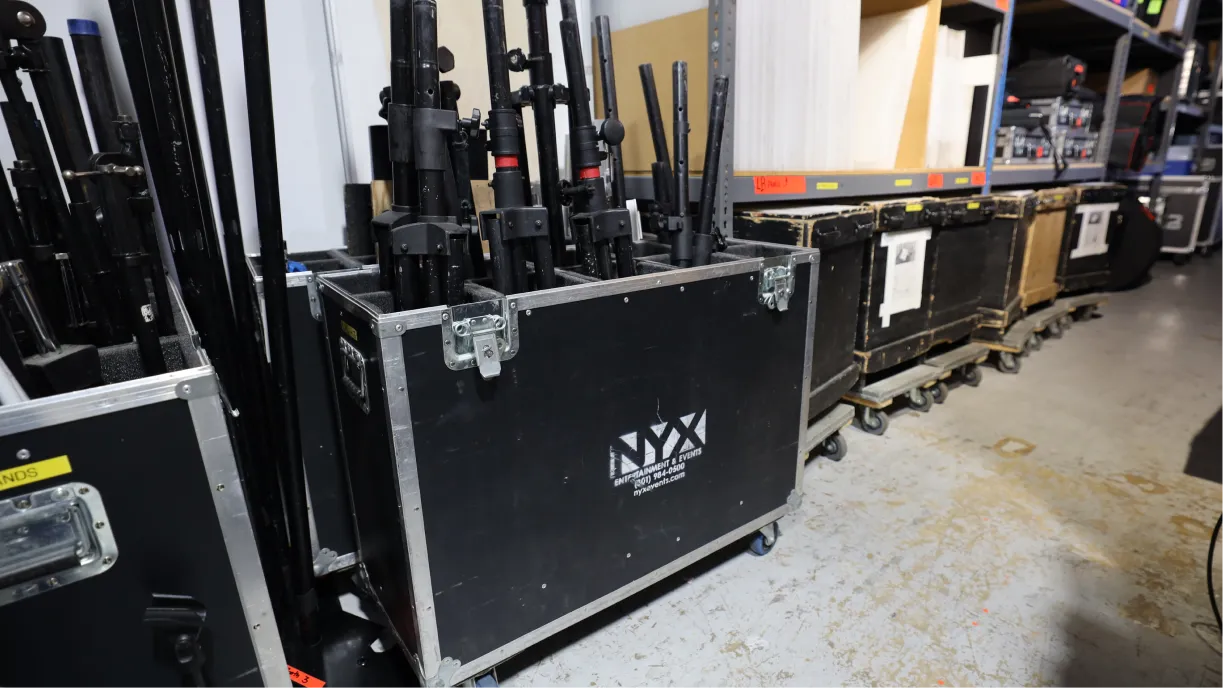
NYX Entertainment & Events started as one DJ working backyard parties and grew into a full audio, video, and lighting production company serving the DC, Maryland, and Virginia area. Today the team runs roughly 150 to 200 full events a year — plus thousands of photo booth setups — out of a warehouse in Rockville that’s smaller than you’d expect.
On a recent tour hosted by Goodshuffle Pro, founder Howie Teger and the NYX team walked through how the space itself is the system that makes that volume possible.
Key Takeaways:
-
A warehouse that scales is built so anyone can run a show.
NYX groups gear by type and labels everything so a new tech always knows where to look.
-
Standardizing your equipment is what makes growth repeatable.
When every photo booth and production kit is identical, you can train faster and trust the handoff.
-
Store by weight and frequency, not just category.
Heavy, rollable items go low, everyday gear sits at waist height, and rarely-used pieces go up and out of the way.
-
Photographing your inventory pays off at every event.
Each item in NYX’s system carries its own photo and warehouse location, so a pull sheet doubles as a map.
-
Knowing when to grow is its own skill.
The team treats a bigger space as a decision you make when efficiency is capping sales — not just when you feel busy.
Everything in Its Section
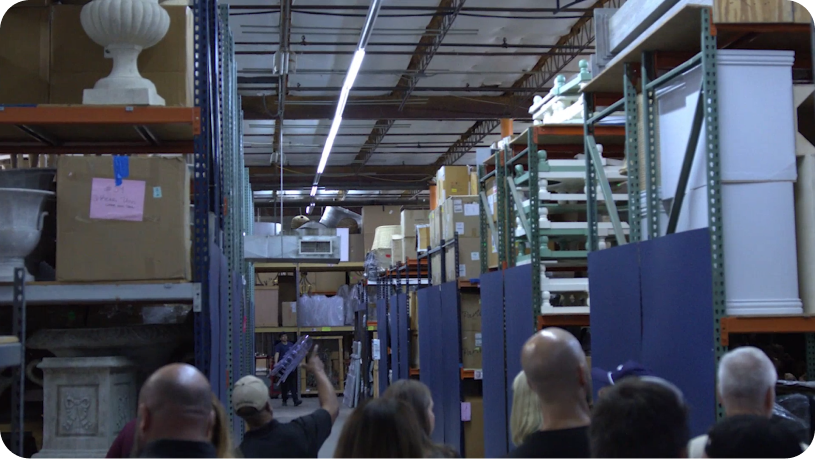
The first thing you notice walking through NYX is that nothing is mixed together. The warehouse is divided by element — a section for audio, a section for video, a section for lighting, with staging in the mix too. Keeping like with like means a tech looking for a specific piece isn’t crossing the building to find it. It’s a principle Howie says scales no matter your size: the big production houses organize the same way, whether they’re running pipe and drape or bars, because it’s simply faster to find things when they live where they belong.
Audio is with audio, lighting is with lighting, video is with video, so that when you’re looking for something, you’re not moving around.
— Howie Teger, NYX Entertainment & Events
Built So Anyone Can Run It
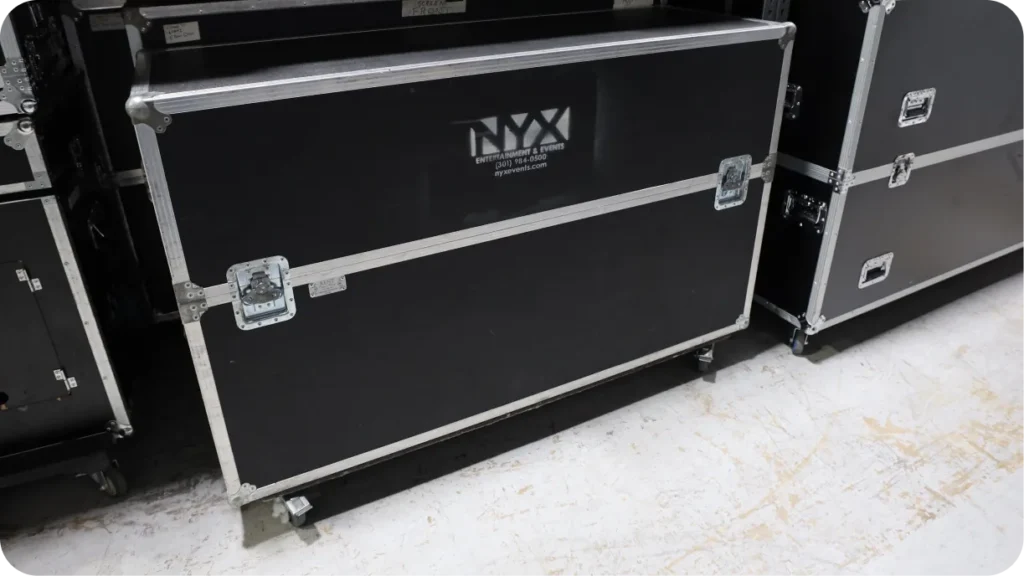
NYX’s guiding principle is to make every item obvious enough that anyone can operate it. Howie’s example: send two people to set up the same simple backdrop and one gets it instantly while the other stares at it — so the fix is to label and standardize until there’s no guesswork. The other half of that is replication. Every photo booth unit is identical, the printers are the same, and every element of a given production type matches the last one. That sameness is exactly what lets the company train quickly, hand work off, and turn its process into repeatable SOPs.
Every element of a certain type of production is identical so that you can scale and replicate.
— Howie Teger, NYX Entertainment & Events
Store It by Weight and Use
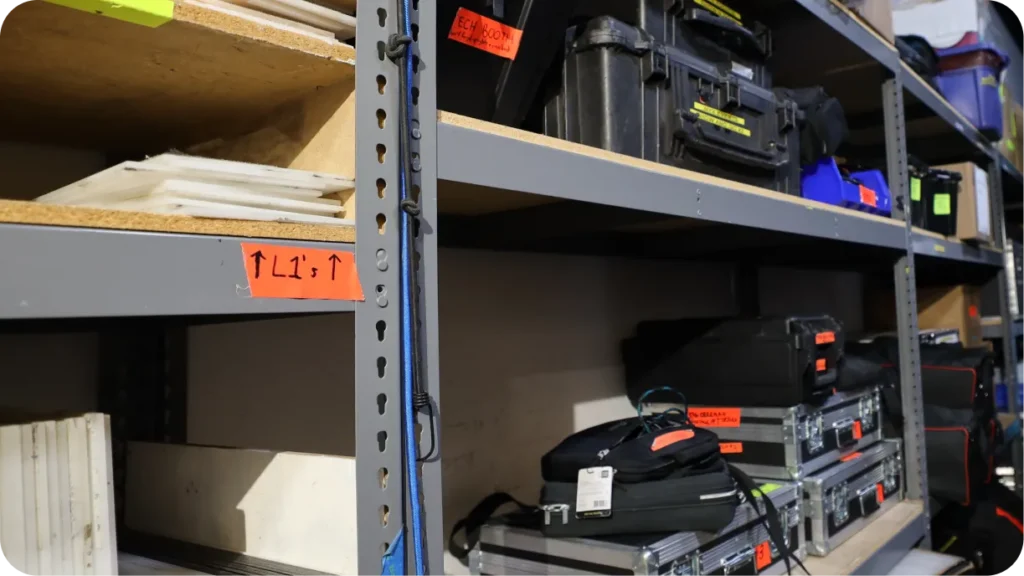
Beyond category, NYX stores by weight and how often something gets used. Heavy gear and anything on wheels lives along the bottom — no reason to lift what you can roll. The everyday middle-weight cases, roughly 25 to 55 pounds, sit at waist-to-head height where they’re easy to grab. Light or rarely-used pieces go up high and out of the way. It’s practical enough that it even shapes hiring: the team asks whether a candidate can lift at least 55 pounds, because that covers most of what fills the racks. With gear this expensive, the layout is also about protecting the investment — one dropped case can be thousands of dollars gone.
A Photo for Every Piece of Gear
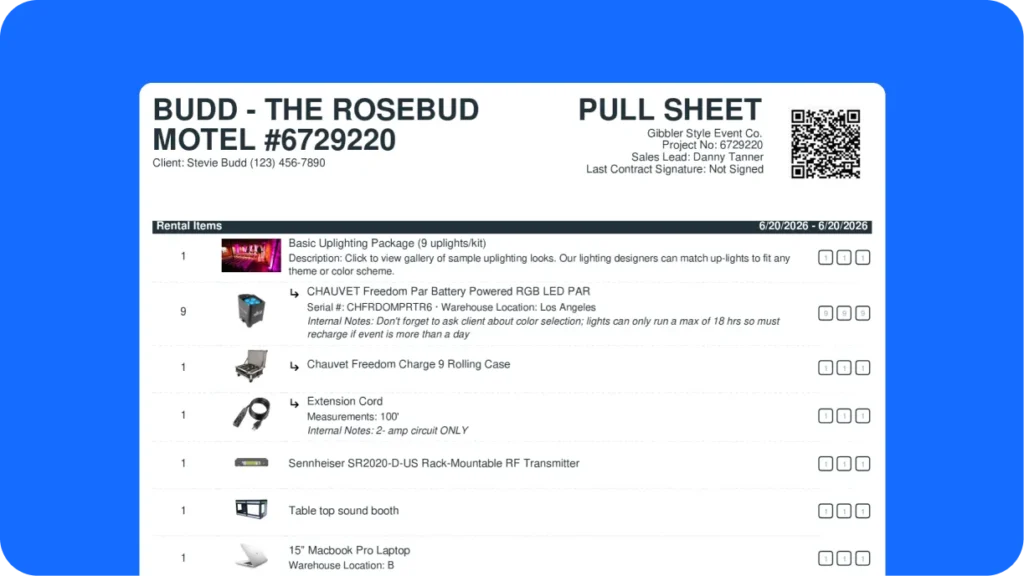
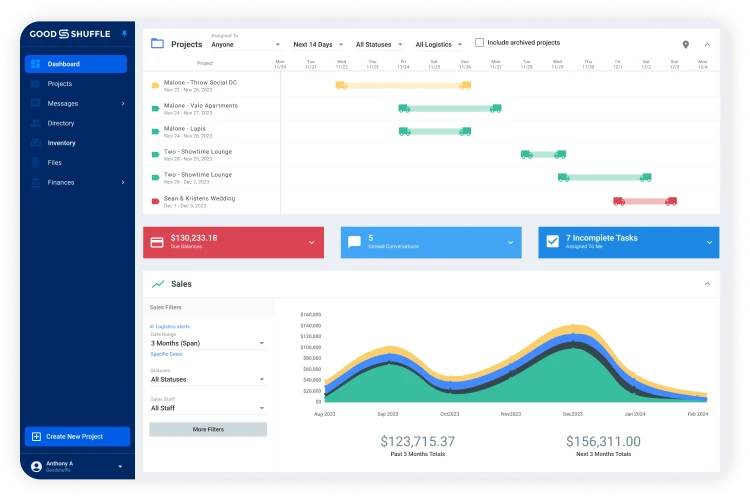
One of the most useful systems at NYX isn’t physical at all. The team spent about two months photographing every single piece of gear they put on a contract, so that each item in Goodshuffle Pro carries its own image and its warehouse location. When the production team prints a pull sheet, they don’t just see “amp rack one” — they see a picture of it and which section it’s in. New techs may not know every piece by name yet, but they know to head to Section A for audio, and the rest follows. It turns the inventory list into a map of the building.
Our Goodshuffle Pro account is integrated with every piece of equipment in here.
— Howie Teger, NYX Entertainment & Events
A Warehouse That Keeps Changing
The layout isn’t fixed. NYX has reconfigured the space many times over the past few years as new equipment comes in, and the team is preparing to grow again. To keep it from filling up with dead weight, they run an annual purge — a spring cleaning where anything that hasn’t earned its space gets cleared out. Howie treats it like a closet: if you haven’t touched it in a while, it goes. Staying organized, in other words, is an ongoing habit, not a one-time setup.
If you haven’t touched it in two years, take it out.
— Howie Teger, NYX Entertainment & Events
Knowing When to Grow
All of this organization is in service of a bigger question every operator faces: when do you expand? Howie’s answer is part math, part instinct. The math is whether efficiency is capping your sales — whether bridging that gap with more space would make the work easier to win. The instinct is harder to fake. If you’re still asking whether you can afford it, he says, you’re probably not there yet. When it’s genuinely time, you’ll know. (If you’re weighing that decision yourself, here’s a closer look at deciding whether to buy a warehouse.)
When it’s time to grow, you will know. You will just know. You won’t have to ask the question.
— Howie Teger, NYX Entertainment & Events
The Real System Is the Team
What makes the NYX warehouse work isn’t any single rack or label — it’s that the whole space is designed so the team can be trusted to run it without the owner in the room. Sections, standardization, weight-based storage, and a photographed inventory all point at the same goal: make it easy for people to do great work. Several of the same lessons came up when NYX and other operators sat down for a roundtable on growing an event business. For NYX, much of that day-to-day order runs through Goodshuffle Pro, where every piece of gear has a photo, a home, and a place on the next pull sheet.
FAQs
Group similar gear together, label everything, and arrange it by weight and how often it’s used — heavy or rollable items down low, everyday gear at waist height, rarely-used pieces up high. NYX keeps audio, video, and lighting in separate sections so a tech isn’t hunting across the building for one piece.
Standardize and label. When every kit of a given type is identical and each item’s spot is documented, a new tech can find and stage equipment without having to memorize the building first.
It ties each physical item to a record. NYX photographed every piece of gear so its pull sheets show an image of the item and the exact section where it lives, which speeds up loading and cuts mistakes.
The owners frame it as math plus instinct: invest when your efficiency is capping sales and the move would make the work easier to win. As Howie put it, when it’s truly time, you won’t have to ask.

Share On










 English
  Español de México
  Français du Canada