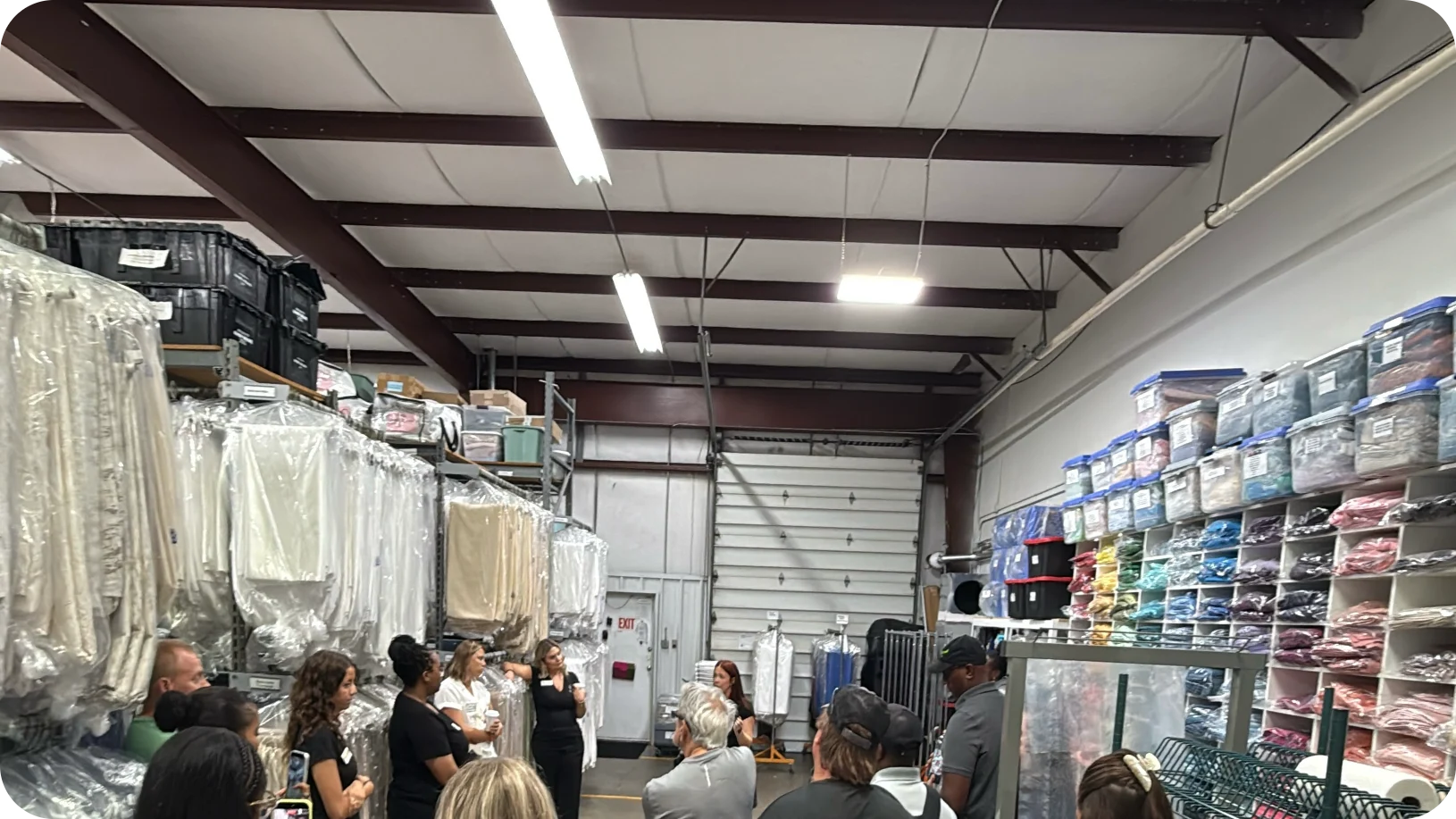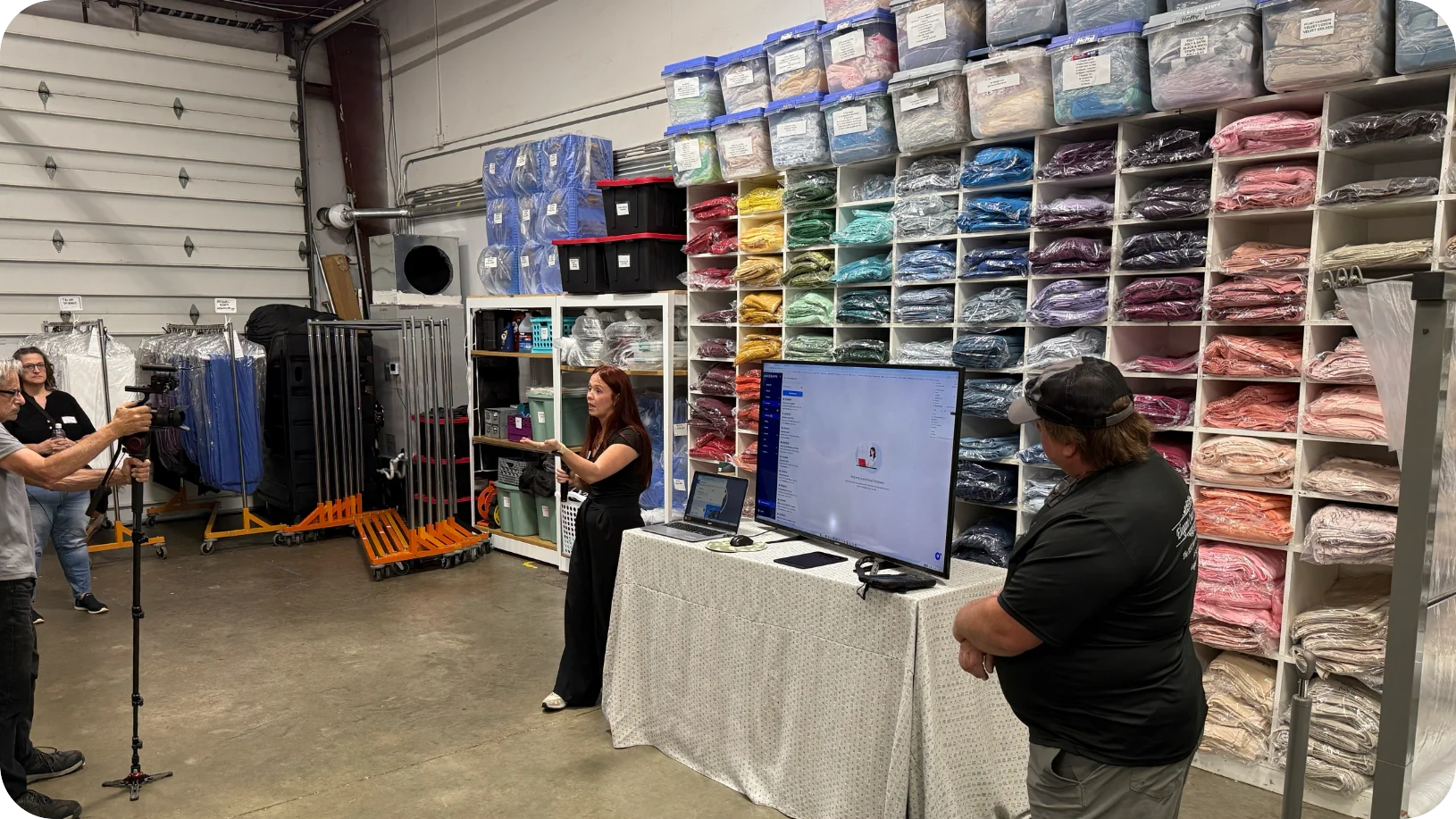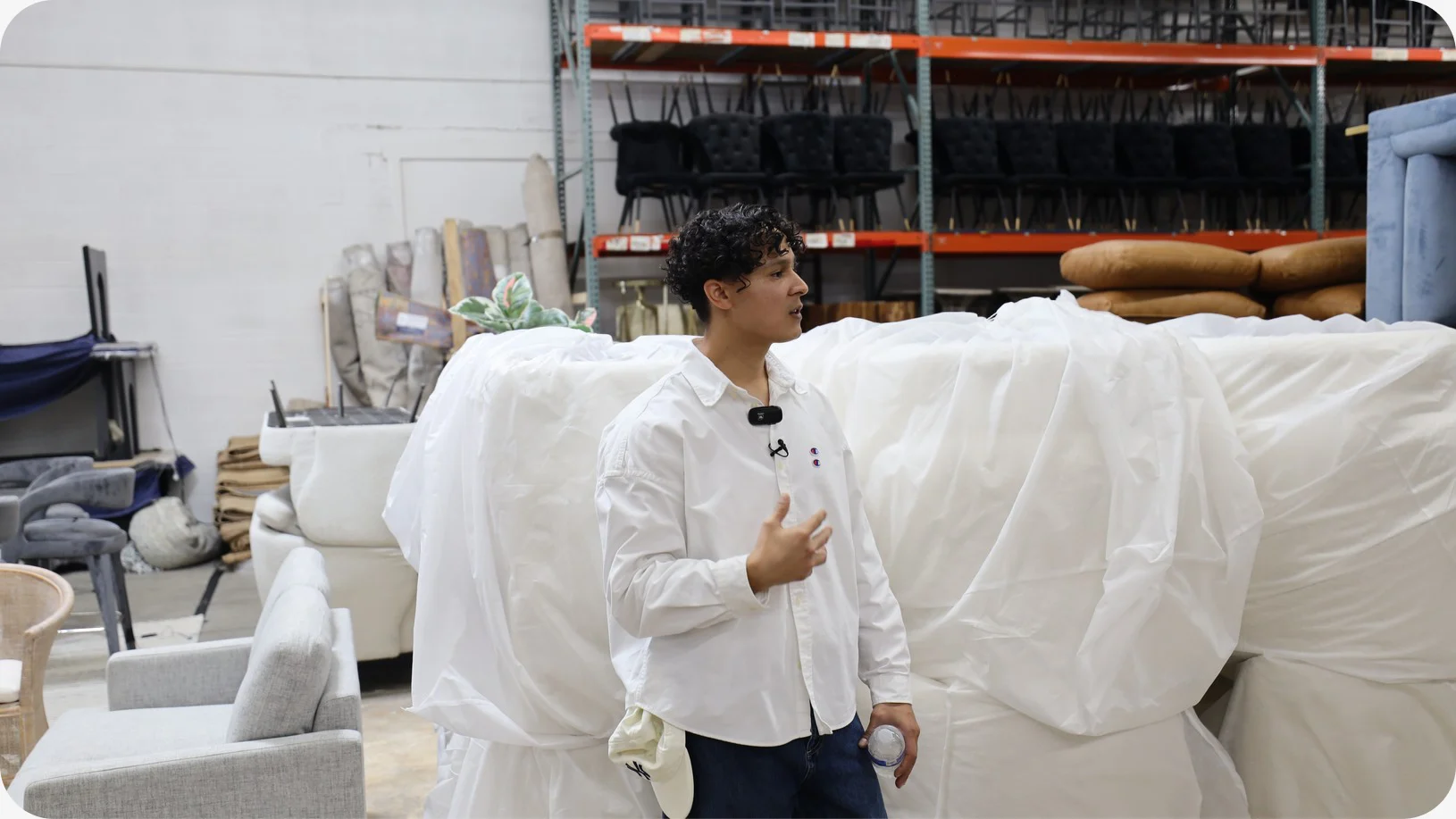
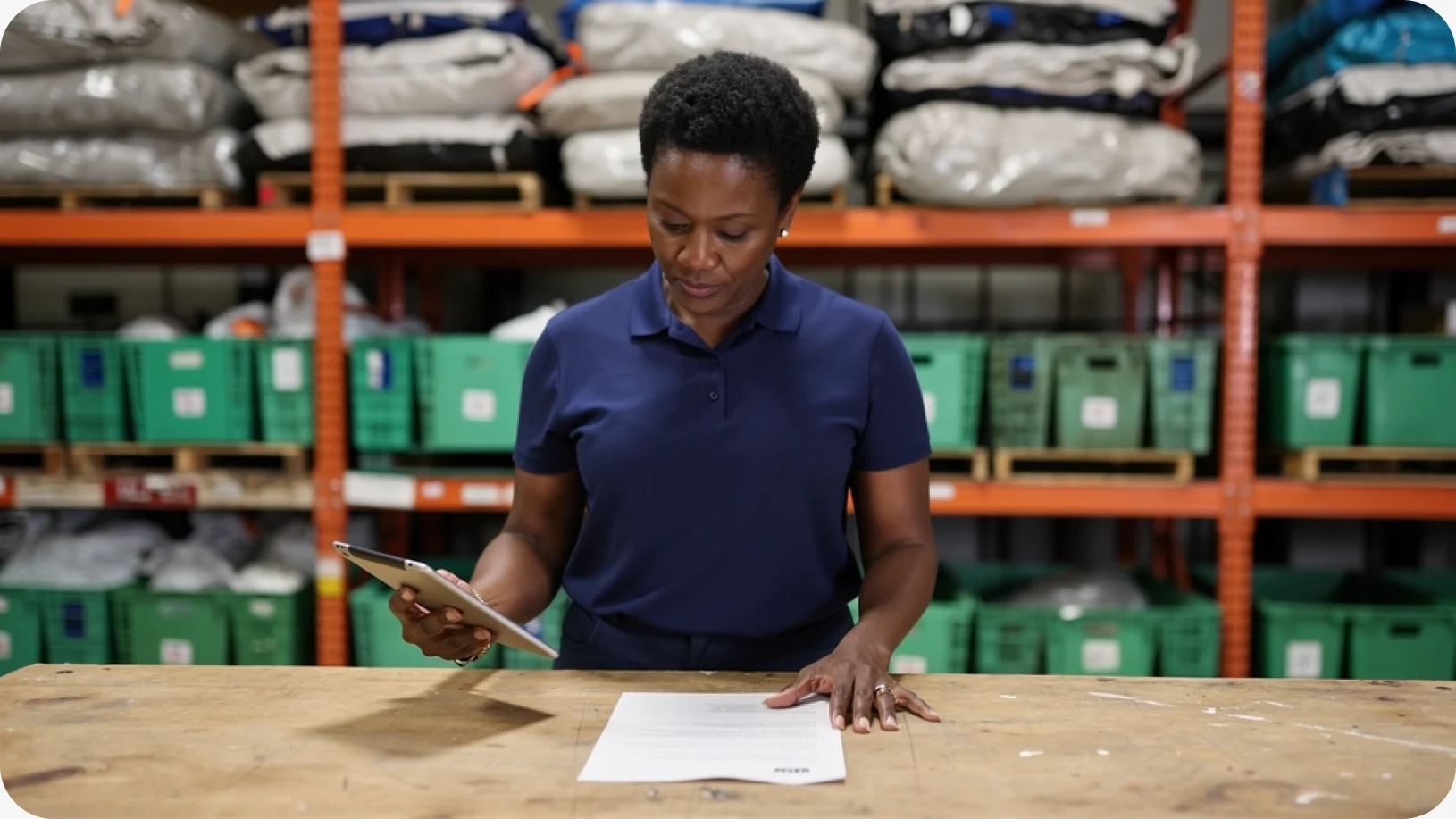
Ben Chuchinsky of AAA Party Rentals started his first answer at the User Summit by holding a stack of paper contracts up to his camera. That was his tent company before tablets. A few months after the switch, he said going back would be very difficult, even with the crew pushback it took to get there.
Ben spoke on one of two owner panels at Goodshuffle’s 2026 User Summit. On the other, owners were asked what broke first as they grew, and they named inventory, scheduling, cash flow, and chasing payments, often all at once. Here’s what each owner changed, and what it cost.
Key Takeaways:
-
In a growing event rental business, several things tend to break at once.
For owners on a Goodshuffle User Summit panel, it was inventory, scheduling, cash flow, and chasing payments, often all at once.
-
Ben Chuchinsky moved his event rental crew at AAA Party Rentals from paper to tablets and paid for it in crew pushback.
He said going back would be very difficult now, because a change reaches the whole crew at once and every step leaves a record.
-
An event rental owner's first hire should take the work the owner has become the bottleneck on.
Cam Petty of Render Events finds that work by logging a week of tasks on note cards and pulling out the ones nobody needs her for.
-
Saying no costs an event rental business some orders and gives the owner back their time.
Melissa Teague wishes she’d added a damage waiver to every order, charged rush fees, and limited how far she’d deliver much sooner.
-
Written procedures are what let an event rental business run without the owner in the room.
Alyse Conyers of Waterford Event Rentals puts everything in a fulfillment note, and Cam Petty’s advice is to write procedures before you grow.
What Going Digital Cost, Stage by Stage
Going digital costs a growing event rental business a few months of crew pushback, and it pays back in fewer mistakes and a record of who did what. Ben’s business, AAA Party Rentals in Garden City on Long Island, rents tents and everything that goes under them, from the flooring to the linens and glassware.
Before the Switch
Every job ran on a printed contract. When a client changed an order two or three days out, someone had to reprint it and walk it back to whoever was prepping the linens or glassware. That’s where the mistakes came from. Drivers already on a route got a phone call telling them to swap stops.
On Goodshuffle’s suggestion, Ben first called an owner who had already switched, someone with a business much like his in another market. That owner gave him tips before he started.
The First Few Months
Some of the crew resisted, especially the ones less comfortable with technology. Many of his crew speak Spanish as their first language, and the switch got easier once the software came in Spanish. The software can’t fix what the crew types into it, though. They still have to learn to use it, and he has to keep reminding them about the new procedures.
His regret is running paper contracts and tablets side by side so the crew could ease in. Now he’d pick a day when the paper goes away and be there in person to see the crew through it. You can’t keep both, he said.
Once It Settles In
Now a change goes out to everyone who needs it, and drivers follow route changes in Dispatch. Every contract also keeps a log. If an item never arrived at a venue but was marked as loaded, Ben can see who marked it loaded and who marked it prepared. That ended the “he didn’t tell me” excuses on his crew.
Alyse Conyers went digital too. She owns Waterford Event Rentals in Chesapeake, Virginia, a boutique rental company that specializes in linen and has been in business for about 15 years.
What surprised her team after going digital was how many mistakes stopped, and how much work went away. She remembers nights when she and her staff stayed late and split the chair cushions between them, ten each, because there was more work than they could keep up with. It’s easy to think that’s normal when you’re busy, she said, and it wasn’t.
Things run so smoothly now that a few of her staff even asked her whether business had slowed down. It hadn’t.
When to Make Your First Rental Hire
Once the paperwork runs itself, the next thing slowing a growing rental business is usually the owner’s own to-do list. Cam Petty owns Render Events in Dallas, has run it for 17 years, and hosted one of the two panels. Hiring is hard, she said, because an event rental company is capital-heavy, especially when you carry high-quality items.
“I can sometimes be the bottleneck to my own company because I have so much on my plate.”
— Cam Petty, Render Events
Her first hire was an operations person, because she was running so many events she’d started missing timings. That person took over the logistics calls, from which truck an order goes on to whether the venue’s elevator even works. Today the role is her director of logistics and fulfillment.
To find the next hire, Cam spends a week writing every task she does on a note card, with how long it takes. Then she sorts the cards into three piles:
- what only she can do
- what she likes doing
- what she neither needs to do nor enjoys
If that last pile adds up to about 40 hours a week, Cam says, you’ve found a full-time position. Twenty hours is a part-time one.
Melissa Teague, who spoke on the same panel, ran her own event rental company before joining Goodshuffle. She knew she needed help when her chairs started going out dirty, so she hired local high school students to clean them.
The Orders Rental Owners Stopped Taking
Another way owners get their time back is by turning some work down. Melissa grew that company from her garage until it supported her family.
“When I first started, I didn’t say no to anything. I took on every order to where it was literally drowning myself, my husband, my family, our time.”
That meant late-night pickups and deliveries two hours outside her area. Customers hauled furniture off on open trailers, unstrapped, and a couch would go out in the rain.
The fix was a set of policies:
- a damage waiver on every order, so she stopped chasing customers over a broken charger or napkin
- rush fees
- no deliveries to certain areas
- a contractor for the far deliveries she still wanted
She wishes she’d done it sooner. She thinks saying yes to everything burned her out.
Cam uses minimums the same way. She sets a different rental minimum for each area she serves, so a job in Austin has to be big enough to be worth taking her crew out of Dallas.
Test Rental Inventory Before You Buy
Good inventory is a big part of what makes a rental business expensive, so Cam is careful about what she adds. Her inventory rule is to grow slowly and fast at the same time: list new items fast, buy them slowly. Before she buys something, she puts the supplier’s stock photo on her website and markets it as if she owns it. If it rents, she buys it.
She did that with dining chairs she loved, texting them to planner friends and even lowering the price. Not one person wanted to rent them, and the test cost her nothing.
What she already owns has to pay rent on her shelves, like tenants in an apartment complex. An item that stops earning its space gets a grace period and a new photo or a new name, and if it still doesn’t rent, it’s sold off. Cam finds them with a last-rented column on her Goodshuffle Pro inventory view.
She pulled it for an audit before her warehouse move. It turned up an item she thought was one of her best, one she’d said she could never part with, that hadn’t rented in a long time. Our newsletter on inventory audits makes the same case.
Write Procedures Before You Grow
The last change both panels came back to was writing things down. Alyse’s team works “the Waterford way,” which means steaming every linen and taking the extra care. Her office has one more saying.
“Memory is the enemy.”
If someone has to remember it and it isn’t in a fulfillment note, it goes in one. Everything gets a paper trail.
Her biggest constraint now is getting the business to run on its procedures. If someone doesn’t come in one day, everyone else should know how to carry on. She calls it the hit-by-the-bus mentality.
Cam’s advice is to write procedures before you grow. You’ll redo some of them, she said, but it’s easier to adjust procedures you already have. If you’re starting from zero, our SOP primer covers the basics.
Decide How Big You Want to Grow
One owner pushed back on growth itself. Near the end of Ben’s panel, the owners were asked what they most want for their business. Patrick Hamilton co-founded The Wild Ones Rentals, a lounge and reception furniture company in the Bay Area. With everyone telling owners to scale up, he said, he doesn’t want to grow too much.
“I’d rather make it sustainable, awesome, and provide meaningful work and compensation for our teams.”
Other sessions from the Summit are in our User Summit on-demand library.
Watch the Summit sessions
Every recorded session from the 2026 User Summit is one form away.

Session Transcripts
Here are the cleaned transcripts of both owner panels. Cam Petty (Render Events): For our last session, we’d like to have a conversation. We know the most useful thing that you hear today is gonna come from the people doing exactly what you are doing on from the first day and thereafter. The owners who started small and grew, whether it be fast or slow, and want to give you the honest version of what actually changes when you grow, what nobody warns you about, and what they would do differently. So I would like to first bring back Melissa, who we had earlier this morning, who was able to grow her business from the garage and eventually have it as profitable enough to sustain her and her family. We also have Maury Littleton of A1 Party Rentals in Lufkin, Texas. Well, I’m excited to just kick this one off with you guys. I’m gonna also participate in this, and so as we go we’ll just chat through it. The first one we’re gonna talk about is what actually broke first as you grew your company. Was it inventory, scheduling, hiring, cash flow, or something else entirely? And then help expand on that as well as we answer it. Melissa Teague (Goodshuffle): I can start. I ironically wanna say all of the above. I think everything broke as I was starting, and I just learned the hard way through it all. I inventory, I found myself having to buy new inventory all the time because I didn’t have the correct damage waivers in place. And and then scheduling was a nightmare for a long time because I didn’t set certain boundaries. I think I mentioned that in my first session. We were delivering too far. It was just a nightmare. And then just cashflow was always tough until I just really got an accountant in place, too, to really help me understand where my money was going what I was spending the correct money on, and so on. So at first I learned all of the hard lessons. I don’t know, what about you guys? Maury Littleton: I don’t know. I’d say for me it was kind of just the learning curve of the inventory and keeping up and making sure you had the right thing going out and going through I’m with Goodshuffle now, but I was with another company that was a lot more complicated to get through their programming and their software. And so just learning that and then switching over to Goodshuffle’s just been kind of like a aha moment, where it’s just been a breath of fresh air for us. Then getting back with customers, the keeping up with if, are payments made before their event. And that’s the great thing about Goodshuffle. It sends automatic payment reminders, and then you can just see that people paid online. It’s just, that has been so helpful. But it is, when you first start a business, everything is just very daunting. It’s just, and it can be very overwhelming. Cam Petty (Render Events): Yeah. I would back that same thing up. I feel like when I started my company 17 years ago, it was spreadsheets at first, like keeping track of what I actually had and owned, also invoicing that way, and then having to then put it into some sort of a I can’t even remember what I used. Probably like a QuickBooks template or something. Or Give Cash or like Venmo or something. And so then I was with another software that was doing it, and then I grew a little bit more, and then outgrew that software, and it just wasn’t capable enough for me. And so this is a Goodshuffle event. I don’t wanna sound like I’m a broken record on this, but Goodshuffle literally was part of the thing that helped me not break the inventory, and the invoicing and the signing of contracts and all the things that we try to do for cheap when we start because obviously we’re investing in the product. We want our money to go somewhere where we think we’re making money on it, like product. And it’s hard to sometimes get out of the mindset of, well, if I’m investing money into the software, I’m actually gonna be saving myself money down the road. You look at software prices and you’re “Well, I don’t know. Should I buy this for that amount or should I buy software?” And so I get that’s a hard decision sometimes in the very beginning, but Goodshuffle literally was the thing that helped us outgrow what we were using before. So that was helpful. All right, moving on to hiring. How do you, or how did you know when it was time to hire your first employee or bring on help at all outside of your own family members that sweated and helped you in the very beginning? Maury Littleton: That’s such a loaded question this week. We’ve had two people quit this week, and we’re going into insane season, and you just never know. A lot of your workers that are working outside right now, putting up your tents in this heat right now, it gets to them. It really does. And I’ve had a couple employees say, “I can get I think I’m gonna move inside and work in a factory or somewhere else.” Hiring is always challenging. Fortunately for us, we’re in an area where there’s a we’re a college town area, and so there’s always college students we can pull in. Hiring for your front, answering your phones, though, that’s still something I haven’t let go of, and I need to try and let go of those reins a little bit more, and I know we would grow. Because I know there are times I’m too busy doing too many things. And like he said earlier, when you don’t call somebody back within that first little while, they’re already looking and moving on. So I’m still I would love to be able to give better advice on that, on letting go of those reins, but I’m still not quite there yet. Melissa Teague (Goodshuffle): Yeah, I really struggled with this too. I think I mentioned this in an earlier session of, that for me, the turning point was when I couldn’t add the level of customer service that I really strived for because I was trying to do it alone. For instance, I noticed how dirty my chairs were going out, and I really needed to hire some kids to clean them. Like, I mean, that ended up being some high school boys locally. It just, I just knew I needed help. It wasn’t, it became more than just a one-man or a two-man job. Cam Petty (Render Events): Yeah. Hiring is hard because it is a capital-heavy business. Having a rental company is not cheap. It’s not it’s not an, a cheap company to run. It’s an expensive company to run, especially when you have expensive stuff. If you have high-quality items, it’s expensive. We try to have good high-quality items, and that comes with an expense. And so when you are in the midst of trying to figure out, “Okay, who do I hire? When do I hire? When is a good time to?” It can be really tough to what comes first, the chicken or the egg? Like, what comes first? Is it my sanity, or is it someone to help take some things off of my plate? I mentioned this at the last warehouse tour at Party Dallas and was “I can sometimes be the bottleneck to my own company because I have so much on my plate.” And so hiring people and being also able to delegate to those people is really important, especially when you are the face of the company or you are the one that kind of puts your face forward and hiring the people that are gonna represent you well. And it is hot. It’s we, all three of us live here in Texas. But even if it’s not hot where you’re from, maybe you’re up in the northern area in the wintertime, it’s freaking cold. Yeah. And that stinks to deliver to as well. And so this isn’t an office job 24/7 for every employee that we have. It is hard work. And unfortunately, the hard work aspect of it in the people that are working in your warehouse and on deliveries, it is gonna be a little bit higher of a turnover out there. You might get a few years out of some of those people, but it is a little bit higher turnover because the working conditions are hard. They are tough. And I don’t think we’re shy to say that, ’cause it is but for us, my first hire was an operations person. Today, I have a director of logistics and fulfillment. That’s the official title for that position right now. But back in the day, it was I just need someone to help me figure out what trucks to send it out on, and someone to coordinate just when can we show up and when can we strike it, and do you have a layout, and kind of all the little things. That was my first hire because we were too, doing too many events that it, I was missing timings because I had too many things going on. And that was an easy one that I don’t necessarily have to be the one that’s doing the communication about what time can I get in, what time does it need to be set up by, what, where am I putting it, what does your loading dock situation look is there stairs, does your elevator even work? All of those questions, I don’t have to be the one that has to figure that out, and so that was my first hire, outside of help with deliveries and such. Also what I have done at various times within my company is I’ve done a note card a challenge or exercise or whatever, where I take little note cards like the ones that you get for school, and I write down the tasks that I do and how much time it takes me to do it. And it usually takes me a week to do all those things because I have so many different things that I do. And so if I’m starting to put a Goodshuffle quote together, all right, put a Goodshuffle quote together. Each one takes me X amount of time, and I’m doing it 50 times this week. Or run payroll. Payroll takes me an hour and a half. Write checks. Checks take me 20 minutes. Check the mail. That takes me five minutes. Like, all the things that you do, put a timeframe on it, and then you will be really surprised. You’re “Wait, that is 120 hours a week. Did I really work 120 hours a week?” Crazy. Which some weeks you can. It’s very easy to get there. Especially when you love what you do. But then what you can do is then I put it into three different piles. One pile is the things that I’m the only one that can do that. Nobody else can do this thing because that’s what I’m uniquely gifted in doing. Then there’s the pile of this is what I like to do. I like to do these things. Could somebody else do it? Sure, but I like to do these things. And then a pile of I don’t have to be the one that does these things, and I don’t particularly like doing those things either. And then that can help you delegate really easily. Okay, I have 40 hours worth of the things that I hate doing that I also don’t have to do. That’s a full-time position that I could hire to do those things. Or maybe it’s 20 hours. Maybe I have a part-time position here, and I might be able to get rid of some of these over here to make a full-time position if that’s what you wanna hire for. And so that exercise alone has helped in various different seasons, and I’ve actually had some of my team members do that in the past as well when I have seen their plate getting a little too full. Say, “Hey, let’s pull out the note cards. For this week, I want you to note everything that you do and the time it takes you to do it. There may be some things that we need to take off your plate because we’ve grown in a way that outgrows your role that I hired you for in the first place.” So that can be helpful in understanding hiring and such. Okay. Another one is a decision that you got right early and one that you’d make differently if you were starting over. What do you wish you didn’t do in the beginning? Or what did you do in the beginning that still is working? Maury Littleton: Well, I wish I would have waited to buy my rental company and merge my two businesses till not November of 2019, till maybe 2021, gotten through COVID. But none of us foresaw that. So I think that what I wish I would have done earlier when I was merging two businesses, I had two businesses in two separate towns, is I would have focused on finding that right manager sooner instead of me trying to do it all. Instead of me trying to drive back and forth for so long and go back between the two stores and be the one that ran the inventory back and forth. I wish I would’ve found that really strong manager, and I did later down the road. But I think that what you said is looking at your time, doing a time audit, is so important. And when I finally put that person in place, it seems like I was able to step up to the next level to manage both, and it I That’s my biggest takeaway for anybody who is just starting out, is just really learn that sometimes you can lose more money not hiring somebody. Cam Petty (Render Events): Yeah. Space is always gonna be a thing. And I almost would say grow slowly and fast at the same time. And so what I mean by that is sometimes it’s really easy to just go out and buy more stuff, more things to rent out. I have a couple different little things that I like to do instead of just going out, and Melissa, I think you mentioned this in a, in a chat earlier. Instead of going out and just buying a whole bunch of stuff, go to the sites that you know that you wanna buy from, and then take the stock image, put it on your website. Brand it. Put it on there. Market it even. And if it rents, great. Buy the product. But if it doesn’t, it might have saved you money. I used to have a course called Rental Biz Academy, and in one of my modulars we talk how do you price something and how do you know when it’s the right time to buy it, and all those things. And there was an example that I gave that I really wanted to buy some chairs. The, there were some dining chairs that I was looking at. I was gonna buy 100 of them. I was really excited about them. I loved them. I thought they were so cool. And I was “So I’m just gonna list it on the website. I’m just gonna see what the bites are.” I texted it to a few of my planner friends. I emailed it out. We put it on social media even. And I was “These are so cool. We’re about to get them in. Like, can’t wait to rent them to you.” Not a single person wanted to rent them. Of course. Of course. No one. And so I was “Okay, let’s try another way. Like, maybe let’s put a story together. Maybe if I one, and show it, show us unboxing it. Like, maybe then.” And still no one wanted to rent it. And so I was “What the heck, y’all? Like, this is such a cool rental.” I even tried lowering the price. I was “I don’t even own this stuff yet, but maybe if I lower the price and see if somebody wants it then.” Still no one. Because what if I would’ve bought those, and then I would’ve been stuck with that inventory that nobody wanted to rent, and then I’d be selling it off for pennies later on and I lost that investment. So that can help you, one, not take up your storage right away with product that isn’t even gonna rent for you. I look at my inventory as paying their rent on my shelves, kind of like an apartment complex. My warehouse is an apartment complex for the products that I own. And so I have figured out cubic feet and all the mathematical things to figure out this needs, this rent is due every month. And so if you are not bringing me in revenue that equals out to this amount of space based off the cubic square footage that this product is taking up, then you gotta go. You’re getting evicted. I’ll give you a grace period, like most apartment complexes give you. We’re gonna market it. We may have to change the picture. Maybe the picture isn’t very good online. Maybe that’s why. Maybe you need to showcase it at a sponsored event to show the product in use. Maybe we need to do a styled shoot. Maybe we need to put it on Instagram. Maybe we need to rename the sucker. Like, there’s so many different things that you can do to see if that product can get renting for you again. But I look at it as if you’re not bringing in the revenue that I need you to bring in, then you gotta go. And so that can also help on that storage solution as well as if you aren’t growing too fast and you still have a lease, you can’t get out of your lease and getting another warehouse is out of the question for you. If you have to stay, figure out what’s renting for me, what do I need to sell off to make room in my place. The timing is kind of fun. We are moving into a new warehouse that’s way bigger than I was expecting to get right now. But it’s fine. It’s gonna be all good. But I had to give up portions of my office at the last place because we grew too fast. And so, for example, I gave up my showroom for the last six months and put racks in my showroom, because I knew that we were having an end of a lease. I didn’t wanna go sign something too early and then be paying two rents and all these things. So I gave up my showroom for six months, and you might have to do the same thing in different seasons of your business. When I moved into that warehouse, I was “Oh, my gosh, there’s so much room. This is fantastic.” Then I moved in and I was “Shoot, this is gonna be a problem.” Never enough room. Yeah “This is not good.” I’m hoping that’s not the case at my next place. It is more than double the square footage as my last place, so I think I have some room to grow there. But all that to say think about what you have in your warehouse that might help you with storage solutions. Do you need to sell things off? And Goodshuffle is really helpful in that to where you can pull some reporting on when was the last time that this thing rented. I can guarantee you if I pull that report, there are gonna be items that have not rented in the last year that I’ve had it, and I talk about that your item should pay you rent, and you should be tracking this. Do I track it regularly? No, I don’t. I don’t take my own advice all the time, but I should. But Goodshuffle can give you that report in real time. If you have a Goodshuffle account already, just go to inventory, filter by make sure on your template you’ve got the last used or last rented on, and toggle it to figure out when was the last time certain things were. I think I pulled it recently because we’re in the midst of doing our Goodshuffle audit on all of our inventory as we move. There was something that hasn’t rented, y’all. So that shows you I haven’t-. Maury Littleton: You probably thought it was one of your popular items, you know? Cam Petty (Render Events): Yeah, I was “Man, this thing is so great. I can’t ever part with this.” It’s been a little bit. So those are some little tips or tricks, I guess, to kind of figuring out that storage thing. Maury Littleton: But it’s also kind of funny, too, though, because colors come back around. Cam Petty (Render Events): They do. Maury Littleton: I mean, I sit here thinking, “Oh, let’s get rid of all the lavender,” and I mean, what the heck? Then lavender comes back. Cam Petty (Render Events): Yeah. And then peach. I mean, I don’t get rid of pillows nowadays. I had someone who was “Get rid of all those green pillows.” We bought a ton of pillows for an event and their logo has green in it. And it was like a chartreuse green. And I was “Nah, it’s, it’ll come back around.” What is one of the biggest popular colors right now is chartreuse and burgundy for floral and rental and all of that. Thank goodness I didn’t listen to that. Also, I got a request the other day for wooden slices and mason jars. Maury Littleton: No way. It’s back? Cam Petty (Render Events): That’s apparently a possible comeback. And I was “Dear Lord, I hope not.” Maury Littleton: I’m in East Texas, it never left. Cam Petty (Render Events): I’ve heard that it is by market, especially in Texas. Maury Littleton: Yeah. In East Texas, we, and we have different wood styles. So you can pick cedar, you can Oh my gosh or you can pick oak. And they all look different. Cam Petty (Render Events): I can see it renting in East Texas. In Dallas, it does not rent. I haven’t rented that stuff in 10 years. Maury Littleton: It’s funny, ’cause I actually grew up in Dallas and came to East Texas because I went to Stephen F. Austin State University, and I never left. Cam Petty (Render Events): Love it. Yeah. No, I mean, that rented in Dallas 10 years ago, and I still have I keep these memories. I have one slice, a wooden slice left. I have one mason jar. I have one twine-wrapped bottle. Maury Littleton: Hey, if you get a phone call, I come up to the Dallas area. I was there yesterday for the day. Cam Petty (Render Events): Oh, good. Maury Littleton: I’ll just bring you wood slices if you need them for anybody. I’ve got them. Cam Petty (Render Events): Okay. Kept in mind. I will not invest in them, I will just sub-rent them from you, Maury. Maury Littleton: There you go. Please call me. Cam Petty (Render Events): Also, when you’re in Dallas next time, come see me. I’d love to see you. Maury Littleton: I will. I go to Dallas all the time. I was thinking about trying to send my husband, ’cause we’re looking at building a warehouse. We own our property, and we just have not taken the plunge to build because I am so scared I’m gonna build the wrong thing. Cam Petty (Render Events): Okay. What is something about running a bigger operation that surprised you? Maury Littleton: Huh. Anything surprising? I think when we first go into this business of the rental world, when I first bought A1, I had a wonderful party store and did lots of kids’ parties, and then jumped in. And I’d always done weddings. But then I thought, “Oh, I’m gonna buy my rental dream store, and I’m gonna get to have so much fun.” And the true bare bones are tents, tables, and chairs. And when I thought I was gonna dress cute every day and plan weddings, I could end up outside cleaning a tent top all of a sudden or wiping down chairs, like you said earlier. And so after about the first six months, I was Or washing dishes. Yeah. And so I think that you need to go in it realistically, and you’re not always gonna be able to do the front, fun stuff of just planning everything. You’re gonna have to get dirty at times. And I would think that both of y’all can totally relate to that. I mean, a dish order, a plated dinner for 500 comes in, and not That doesn’t just take your two people in your kitchen or three people doing your dishes. That’s all-hands-on-deck. Yeah. ‘Cause that’s 500 pieces times what, eight items? Of 500? Right. So it’s that kind of thing of when you start your business, be realistic and be really ready to jump in, ’cause it’s not just the fun planning part. It’s also the back end. Melissa Teague (Goodshuffle): Right. I tell people that all the time. My I have friends that are “Ooh, I wanna start a party planning business or a balloon business or whatnot.” And I’m “It sounds a lot of fun,” and it’s great. It is. It is such a great industry. But just know it is hard work. I mean, even if you think you’re gonna have all these employees and you’re gonna have There’s The work doesn’t stop. I mean, you’re right. Like, you have to, 90% of the time, get in the weeds with it and wash those dishes or clean something or load in the heat. It just, it doesn’t stop, even as much as you scale. So I totally feel you on that. Maury Littleton: And it’s also a hard business too. I tell a lot of young people, ’cause there’s a hospitality department at Stephen F. Austin, and I tell them, “If you don’t wanna work weekends, don’t do this.” I mean, that’s the another big thing, is that you do, you do work weekends. There’s a lot of weekends that you’re busy. Cam Petty (Render Events): Did you see this chat? One of our attendees says she’s a planner for 10 years, and after two she learned to keep rain boots in the car after spilling water on herself several times by dumping water out of floral vases. Maury Littleton: Yes, there’s always something. Cam Petty (Render Events): Yeah, you might think that you, even when you scale bigger, you’re “Well, weekends don’t always have to be in my repertoire. Like, at some point I’ll hire people that can do the weekends for me.” I do have people that do my weekends for me, yet I still go out on site on weekends. Right now we’re in the midst of football and cheer season, so it is check in at this wedding, go to cheer. Check in to the next wedding, go to football. Check into the other one, and then come back to football. So there’s a lot of moving parts, but as you grow, you still wanna maintain, one, your personality that grew your business in the very first place. And two, you wanna make sure that the relationships that you’ve grown and the expectations that you have of your team are also being met. And you can’t do that if you’re not on site. And so I try to make it. Doesn’t happen all the time, but I try to make it at least to most of our events every weekend by showing up. It doesn’t necessarily mean that I’m unloading the trucks with my guys, although I can and I will. Yeah. Doesn’t always mean that I’m gonna be inside managing and delegating things. There are some hard work that has to happen, but-. Melissa Teague (Goodshuffle): I would even argue you might work more weekends the bigger you grow in the very beginning. And so as a as a smaller business, you may have two weddings this weekend and none next weekend and none the following weekend, then you have one the following weekend. Enjoy that, because at some point it’s gonna be you have 20 on one day, Yep on a Saturday, and that’s not abnormal as you grow, is to get bigger and bigger. Cam Petty (Render Events): Something else that I would recommend as you get bigger is then figure out what the lever is of what can you say yes to. That’s where rental minimums will fluctuate and come into play. For us, we’re in Dallas, and we get requests to come down to Houston and Austin and San Antonio. Well, I have to have a different minimum in different areas of the state based on our capacity. Oh, okay. If I have five weddings here, and I have a big one in Austin, my Austin one has got to be worth me taking my crew out of Dallas to go down there. And so you may have different rental minimums based on the service areas that you serve. But the minimums are gonna help you maintain how many can I actually do versus booking as many as you can. It is, depending on where you live it’s not always easy to get more labor in a quick amount of time. You may live near a college town. That’s great. Doesn’t mean college kids are always available. I live in a there’s a lot of high school football players. That’s how I started my company is hiring high school football players that needed date money. That meant I couldn’t have them on Friday night because they were playing football. And so what do you do when you have a Friday night thing come in, and your crew is playing on the field? And so you do have to kind of understand as you grow, what are you capable of doing based on trucking, based on people, based on your inventory, of course and what’s possible? Maury Littleton: I think we’ve also mentioned hiring students and stuff, and I think that’s a really Getting involved in a, with a school where you can say, “Okay, this is what we do.” Because we’re a college town. Okay, so right now it’s football season, so we have the baseball team that can work with us. Well then when the baseball team goes into season, the football, basketball team. And you can rotate and getting your foundation with a good group of people and finding some people that you can be a mentor to, ’cause then the coaches wanna recommend you has a, been a really positive thing. Not only in the fact that it’s helped our business, but it’s also led to so many great relationships with students who’ve graduated and moved on in their lives, and we still have relationships with them today. So remember that too. Plus, you’re getting an opportunity to train that next generation on work ethic. Yeah. And we all hear that all the time. And look at it as not you’re hiring employees, but I try to look at it as I’m a phase in their life for I’m their training phase in life. And we give lots of grace and love. Like, if you have a big test, really serious test, and you’re really worried about it, call me. Send somebody else in your place. And I think that’s really helped us the last few years of being in the rental, and then with years of being at our other business. Cam Petty (Render Events): Yeah. Love that. Okay, what would you tell someone in this room who’s nervous about growing past where they are right now? Growing is scary. What would you say is an encouragement for that? Melissa Teague (Goodshuffle): Take the leap. I just think you’ve just gotta do it. You just have to take the chances. I mean, they don’t have to be big. Cam, you mentioned that earlier, like start small. Throw an inventory item on your website. Hire a local student. It can be small, but don’t be scared to take some chances. You’re gonna find out quickly what works and what doesn’t. Maury Littleton: Yeah, I would agree with that. Just have faith in yourself and have confidence in yourself to know the steps that you’re ready to take, and take on projects one step at a time. And if you’re being pushed to grow, it’s because you’re doing something right. If you’re already seeing that you’re ready to take the next step, it’s already because you’ve had success. So right there, believe in yourself and just continue to take a step forward. Cam Petty (Render Events): Right. I would also say work on your systems and your processes now before you grow. That’s also gonna give you the confidence that when you are in a growth phase and that you are growing, that you have something to stand on. At some point you’re gonna have to redo some of those software or those processes and systems. At some point you will have to adjust, but it’s easier to adjust from some existing procedures and SOPs. SOP is a standard operating procedure. It’s basically how you do what you do. It’s a step-by-step thing. And so if you can start on those now, and then eventually you’ll have to use them, it’ll give you the confidence to do that later on. I’m gonna give the floor open to each of you to share anything that you wish somebody would have shared with you when you had your company. Is there any piece of advice that you feel like you could give to the people who are watching now and later that you wish you would have known? Melissa Teague (Goodshuffle): No problem. I’ll start. One of the things and we kind of talked about this earlier too, is I wish someone had told me earlier to like know my worth. I took on When I first started, I didn’t say no to anything. I took on every order to where it was literally drowning myself, my husband, my family, our time. We were doing late night pickups. We were driving two hours outside of our area. I was letting people come pick up items and take them without really properly let, like knowing that they weren’t strapping them down, or a trailer that was open. And a couch would go, and it would be raining, and they were destroying my inventory. I just didn’t have the correct policies in place. And and so once someone was “you need to take control, and really you don’t have to take every order,” it was a game changer for me. It also allowed me to scale. I Another thing too is I added like a damage waiver to every order. And so I didn’t have to chase down all those like one broken charger or broken napkin. I started adding rush fees, started I saw Cam did minimums. I started contemplating minimums, you know. We decided not to deliver to certain areas. I actually found a contractor that I could hire to deliver, and I still was able to have that contractor go and do those deliveries. I just stopped wasting my time on things that just weren’t gonna bring me joy within the job. I wish I would’ve done that earlier. I feel like that burned me out way sooner. But but I just value yourself value your time. Don’t be scared to price things accordingly. It, you don’t have to just drown to run your business. Maury Littleton: I think that’s really good advice. I think the thing that I watched a seminar one time and it’s, it said, “It’s okay not to deal with everybody, and it’s okay to say no.” And I think that we all run into that. There will There are some times where I can just sense that there’s nothing I can do. I can go above and beyond, work multiple hours, and when I’m talking to this person, there is nothing I’m gonna do that’s gonna make them truly happy. And I have learned to know when to say, “No, I am so sorry, I’m just not gonna be able to do it.” And that is also good for my staff. I also know that because we own our own businesses, there are times that we have to protect our staff and ourselves, and so we do have some blackout time zones. Like, we do not On Memorial Day weekend, everybody gets that Monday off. We will, we will see you on Tuesday. We will not charge you for that extra day, but we’ve come off of that whole spring and graduation and everything, and then we’re about to hit summer, right? So Memorials and Labor Day are we take those Mondays off and rest. And so protect your staff and protect yourself. Give you those little bitty tidbits, because we’re always working on Halloween. We’re always working the day before Thanksgiving, right? There’s so many others, and so that’s another thing. For years, I didn’t. For years, I pushed it to the edge and pushed it to the edge and somebody finally said, ” it’s okay. People will understand.” And when I tell people, “Oh, we’re gonna take off Memorial Day weekend and Labor Day weekend. You can keep everything an extra day, and we’ll see you on Monday. You can drop off on Tuesday,” I get more and more, “That’s so great for you to give your staff off that day.” I get more positive than negative. So know your boundaries. Know when you need to give your team a break, and know that it’s okay to say no. Cam Petty (Render Events): I love that. One of the things that I wish I would’ve done sooner was go to more networking events. I really didn’t start going to any networking events until I was Gosh, probably at least five years into my business. And now I go to a networking event at least once a week at this point. For a little while I was growing my family, I didn’t go to very many. But I try to go to networking events or throw networking events. I threw a Mahjong party for planners last night. And so that was really fun. But make connections with the people that you wanna do business with, and you can either meet them at networking events where there’s a whole bunch of other people and it makes it less scary, or take people out to lunch and have connections, meaningful connections there, meaningful conversations. One of the very first networking things that I went to was NACE, National Association of Catering Events. You’ll notice that a lot of these networking events have a lot of acronyms. It’s very true. NACE was my very first one in Dallas-Fort Worth. The great thing about Dallas-Fort Worth is a lot of our chapters are very strong, or some of the largest chapters in the nation for a lot of our networking, so we are blessed to be here and have so many opportunities. In fact, there’s, every Monday on our Facebook group page for Dallas-Fort Worth vendors, there’s one gal that posts every Monday all the networking opportunities in the DFW Metroplex, and there is a networking opportunity every single day, and some days there’s multiples on those days. Wow. And so you may just check out some Facebook groups in your local market and get connected to other people. And if someone’s doing that, great. If not, maybe you can volunteer to do that. It’s kind of fun to see. But my first one was NACE, and somebody told me at that one, and I’ve tried to do that for so many years now, is be the first person there and the last one to leave. Be the first person there to make the connections and be the last one to leave. Go to some of the after parties and the after-after parties that people just go out for drinks afterwards, because those are some of the moments that you make the best connections with people, the people who are going to give you business for years and years and years and years. We do business with a major wedding planner that does weddings all over the nation, all over the world. He lives here in Dallas-Fort Worth. And it wasn’t until we had good conversations outside of the actual networking event that led to understanding, “Oh, you like that type of food? I do, too. What’s your favorite restaurant?” Like, having those conversations that have nothing to do with your business is what links you to those people. And that’s important because it’s part of how you grow your business. NACE is great for kind of any type of event. Then you have some specialized networking opportunities. Here in DFW, WIPA is a very big one. It’s more of the luxury weddings. It’s not corporate at all, so it’s very niche. WIPA stands for Wedding International Professional Association. There is one locally called the SWP, which is Society of Wedding Professionals. I could make a book on all of the acronyms, unfortunately. I know a lot of them now. But if you are looking to make connections with corporate people, you go to MPI, which is Meetings Professional International. If you want to connect with luxury wedding planners, you go to WIPA. If you want to connect with other vendors, SWP is a great place to go. And you’re gonna find your people at one or more of those. And unfortunately, in DFW, I cannot go to everything, so I’ve had to figure out, who do I want to be connected with? What education opportunities do these networking events provide? What does the membership look like? Who do I want to be in the same circles and same rooms as? And that’s where I have put my time in, is figuring out where do I want my business represented. You could attend those all day long, but the way that I have seen the biggest growth in those is when I’ve sponsored some of those events, showing off my product in real time at the events that people can see, sit on my things, order from my bars, things like that. And then also taking a step further and volunteering, whether it be as a board member or a committee member or a member at large. Those are helpful to, one, giving back to the associations that do so much for us, but, two, it furthers those relationships that you have with some of those people in that association. We have multiple planners that we work with, and I was on the WIPA board at one point, and I continue to work with some of those people because we got to know each other on a different level as board members versus just going to the events. And so get involved where you can and where you can allow some of that time to be. But at least going to the networking events is helpful to grow that network that you that will, you will lean on heavily as you grow your business. Maury Littleton: In smaller towns, we don’t have the big organizations like they do in the Dallas-Fort Worth area or the Houston area. So if you’re starting a business in a smaller town, a smaller venue, reach out to your chamber of commerce. Join your chamber of commerce. That’s a great way. I’ll be volunteering tomorrow night with the chamber of commerce because their forest festival’s there and I’ll be in the ticket booth. Volunteer to be a part of that. I’m on the sawmill board for SFA, for athletics working with the football players and working fundraising for the football. That gets me involved in SFA. You can be involved in different counties and different organizations. Boys & Girls Club, that’s another group I’m involved in. And so in your smaller communities, there are still networking events. They might not totally gear just to that profession that we’re in for events, but all of those have ribbon cuttings. And they need bar high tables and table cloths. And some of them, especially if they’re corporations I had a corporation walk in and say, “We’re doing a ribbon cutting thing. What do we need?” They don’t know, and you’re their person because they met you at the event. So following what Cam said, you’re So get involved. And plus you’ll feel good getting involved in your community. Cam Petty (Render Events): Yeah, that’s great advice. Right? It can even be school boards, PTAs, sports associations. I’m a board member of our football and cheer organization that my kids are a part of, and I’ve gained business just from being on that board. That I’m All I’m am is the cheer director. Did I think I was gonna get business from it? No. But I have. I met one of the families who, she owns a wedding planning company, and now I do all of her weddings for her clients. That’s great and so it might not even be an association. Maybe it’s just getting involved in your community, in where you and your family participate. Melissa Teague (Goodshuffle): I remember living off of this too, is any time a new venue would come in the area, I would go and ask to be a part of their preferred vendor list and sometimes would need to give them a discount for it or give them a referral or whatnot. But once I was on those list for those local venues, I mean, that fed so much business more than I could handle at first. So hit up your local venues too and yeah, all of those local places. Cam Petty (Render Events): Yeah. And be a part of some open houses. Those are a great opportunity as well. Sometimes you have to be a preferred vendor to be a part of an open house. But even if you’re not, even, I mean, as rental companies, we all have different stuff. And so even if they do have one rental company that’s on their preferred vendor list, they might not have the same product that you do. And so offering and giving them suggestions of saying, “Hey, what if I helped you with your cocktail hour space, and they helped you with your reception space? Or maybe I help take care of the ceremony venue portion of your place, and somebody else does these things.” That can be helpful to, one, show off their spaces really well and also represent your company. And so open houses can be really helpful. Is there any other last little tidbits that you want to share before we close up? Maury Littleton: Jump into meetings like this. Today has been really helpful. The worst thing I’m at has been working on my website since we came into Goodshuffle. It got integrated, I got really busy, I’ve kind of blown it off, and today I’m super motivated. It just helps recharge you. I know it’s time away from your business, but I needed today. I needed today to learn more about Goodshuffle, to see the things coming forward, to just know that I have now a resource up in Dallas who I could call. I’m looking forward to so meeting Cam. Like, this has just been a great day, and you need to take time to re-energize and re-strengthen yourself during this process. And always remember that. Melissa Teague (Goodshuffle): That actually brings tears to my eyes. I love hearing that. I mean, being on the other side of it now and getting to help all of our vendors, the thing I see is our vendors are craving networking, and especially being able to relate with other event pros. And so, yes join the user summits. Go to the warehouse tours. I had so much fun hanging out with Cam and everyone at the last warehouse tour, and I’m not even in the business anymore. But just being a part of this network of people, we all have similarities. Like, we want to bring joy to events. We want to take good care of customers. And so agree. Like, attend. Be a part of this vendor network. It’s life-giving. Cam Petty (Render Events): Yeah. It is. And just being able to relate to people who do what you do and share little tidbits about “Well, I do it this way.” “Oh, that’s neat.” Like, “I didn’t know about that. That’s pretty cool.” I even learned something about Goodshuffle today, earlier. I was “You can do that? Okay.” I’m “I didn’t know that. That’s awesome.” Colin Connor (Goodshuffle): For this final session, we’re gonna be handing the room over to the people who actually run it. This is a peer panel, and it’s deliberately unscripted, so there’s no polished takeaways, there’s no slides, just owners talking honestly about what is genuinely hard right now and what’s happening with client demand, what hiring looks like, and how everyone is figuring out AI, and what it does and doesn’t do for a business like theirs. But with that, I would love to welcome our speakers that we have today. We’ve got Kristina, Andrew, Tanya, Benjamin. Welcome. So where I would love to start is turn things over to our fantastic panel that we’ve got here to introduce themselves and chat a little bit about their business. Ben, I will kick things over to you first to hear a little bit about yourself and AAA. Ben Chuchinsky: Yeah. So AAA Party Rental is based out of Garden City, Long Island. We serve Long Island, Manhattan, Tri-State Area, and we rent primarily tents, the flooring of the tent and everything in between, tabletop linens, glassware, all the above. Colin Connor (Goodshuffle): Very nice. Perfect. I will turn things over to you, Tanya, to hear a little bit more about Bright Light. Tanya Mishigian: Good afternoon everyone, and thank you for having me. My name is Tanya Mishigian, and I am the head of sales with Bright Light Events and Entertainment. We are a Chicago-based company that services events across the country, and we specialize in interactive entertainment and event experiences. Colin Connor (Goodshuffle): Very nice. Well, pleasure to have you with us here today, Tanya. Next up, I would like to turn things over to Kristina to hear a little bit more about Party at the Moontower. Kristina Gonzalez Sander: Hi, everyone. My name’s Kristina. I’m the COO at Party at the Moontower Event Rentals based in Austin, and we are a specialty event rental and fabrication company. We actually celebrated our 10-year anniversary this year, so very exciting. Colin Connor (Goodshuffle): Happy anniversary. Kristina Gonzalez Sander: Yeah. Thank you. We’re building and customizing for our clients now, so it’s very exciting. Colin Connor (Goodshuffle): Well, good. Right on. Well, pleasure to have you with us here today, Kristina. Would love to turn things over to Andrew. Andrew Hart: Hey, everyone. Andrew Hart. I’m the managing director and partner at All Event Party Rental. I acquired the company about a year ago. It’s been around for about 50 years, serving Philadelphia and the tri-state area. So pretty similar to Benjamin’s business. We’re pretty vertically integrated in the same stuff. But yeah, having a lot of fun with it, and really happy to be here. Colin Connor (Goodshuffle): Excellent. And Alyse, I would love to turn things over to you to hear a little bit more about your role and Waterford. Alyse Conyers: Yes. Okay. I’m Alyse Conyers. I own Waterford Event Rentals in Chesapeake, Virginia. We have been in business for about 15 years, and we specialize in more boutique rentals, primarily linen. Colin Connor (Goodshuffle): Perfect. Right on. And we recently did, I think last month or a couple months ago, we had the pleasure of touring your amazing space and meeting your team down in Chesapeake. That was always highlights of my role is doing those on-site visits. And Ben, we of course got to connect during the TGIF one we did in New York. And then, Kristina, I met some of your team in DFW. I would love to turn things over to Patrick and hear a little bit more about The Wild Ones. Patrick Hamilton: Hey, everybody. Hello from the Bay Area. I’m Patrick Hamilton, co-founder of The Wild Ones Rentals. We are a mom-and-pop shop based here in the Bay, founded in 2018. We focus on really bold, colorful, pattern-forward rentals, specializing in lounge furniture and reception furniture up here in Northern California. And yeah, really stoked to be here. Colin Connor (Goodshuffle): Sweet. Well, pleasure to have you with us here today, folks. I love that we’ve got such a diverse panel, both in terms of industry, geographic location, and focus of the business. Where I would love to start is Ben. I know you and I have chatted a little bit, especially when we connected during the TGIF tours, about the transition digital. I would love to hear a little bit more about what the business looked like before making that transition, and what was the moment that you realized the old way couldn’t hold? Ben Chuchinsky: Okay, I brought a visual aid. This was the business before the transition. All of this stuff. These were contracts which all our guys were using, and basically we were going through reams of paper constantly. And we’ve moved everybody to tablets, and in the beginning, it was a tough transition, obviously, specifically for some of the guys who might not be as good with technology, right? Some of our younger workforce, they grew up with technology. It was an easy transition. But now that we’ve had, I think, I don’t know, four or five months pretty consistently with it, it would be very difficult for us to go back. I feel that the amount of work we can take on now simultaneously, there’s less. We’ve outsourced a lot of what we were having to remember and keep track of to the computer. And one of the biggest changes is, I’m sure everyone deals with this, right? As you get closer to the event and clients make changes, then you have to go reprint out the contract, and then go back to the people who are preparing it. Maybe they’re preparing linens or they’re preparing glassware, or whatever it is, and it’s like, “This has changed now.” And that used to lead to, of course, a lot of mistakes when clients are making the changes the week of or two, three days before. Now, when a change is made, it gets pushed automatically to everyone who needs to know, and that has certainly cut down on a lot of mistakes for last-minute changes. And then as well, if they’re on a route, a major change has been, before you’d have to call them and say, “Okay, make your third stop number four and go back to six,” and then, “Oh, pick this up,” and the client doesn’t want. Now we just make the change on dispatch, and the guys just follow what’s going on. Just updates. As long as there’s Wi-Fi, which sometimes out in Montauk, on the very edges of Long Island, that can sometimes be a tough thing. But as long as there’s 5G, everything’s amazing. So, yeah. Colin Connor (Goodshuffle): One thing I’d like to double tap on, just to paint the full picture. You mentioned that it wasn’t easy at the start. What do you feel was the most difficult part about making that transition? Ben Chuchinsky: There was definitely resistance from some of the workforce. And I think when we started, Goodshuffle didn’t have the multi-language feature at that time. Right? So we have a lot of guys who speak Spanish, and that’s their primary language. And once the Spanish feature came out, it definitely made it easier. I think the major difficulty is kind of something that technology won’t ever solve, is that garbage in, garbage out. The guys still have to learn to use the system, and we have to remind them that this is the new protocols. Here are the new SOPs, et cetera, et cetera. But the major difference is specifically with the log ability within each contract. There’s no more hiding of, “Oh, he didn’t tell me, and she didn’t tell me that that was supposed to be the way it was done.” It’s like we can see every action that was taken. So if something didn’t arrive at the location, but it was marked as loaded on, we can go see who marked it as loaded on and who marked it as prepared. So you can now hold people accountable. So sorry, Colin, if that answered your question. I kind of turned into a positive. But there you go. Colin Connor (Goodshuffle): No, of course. Hey, you’re doing my job for me. I love it. One question I would love to ask Alyse. I know your team has been making the transition digital, both in terms of, as Ben was mentioning, dispatch and using some of the other digital features. What surprised your team the most about the switch that you didn’t expect going in? Alyse Conyers: Oh, man. I would say the accuracy, the amount of mistakes that are not happening anymore. I mean, it has really, really improved our accuracy in general. Also, the amount of work that we’re not having to do anymore. I mean, I remember the days where myself and some others included would be staying late, and we’d all be passing out the chair cushions and, “All right, you do 10, you do 10,” because we couldn’t keep up with it. And it’s easy to think that it’s that way because you’re just really busy. And it’s easy to think that that’s normal, but it wasn’t. And I think that our staff is just shocked by how smooth things are. And almost, some of ’em have came up to us like, “Are things slower?” Or, “What’s going on?” And no, it’s just more intact with having everything digital. Colin Connor (Goodshuffle): Gotcha. I appreciate that insight. And so we’re moving down the timeline to folks who have implemented or transitioned digital. I would like to turn things over to you, Tanya, ’cause I know this is kind of the bleeding edge, or this is something that your team is approaching right now. One question I have to ask you, similar to Ben, what prompted you to make the change? Tanya Mishigian: Yeah. We were using so many different disconnected platforms instead of having one centralized system, so it made the sales process less autonomous and efficient. And therefore, that also impacts staffing, payroll, warehouse inventory, so on and so forth. So I loved how Ben opened with all those stacks of paper because we were using Dropbox, spreadsheets, old school credit card authorization forms. So now that we have everything in one central location via one system, it’s like the liaison, right, between all different departments that need to be informed of that certain project or event or customer. And it’s wonderful that clients can just also log on and do everything electronically versus the old school way of using Adobe Pro and asking them to print it all, sign it, scan it back, so on and so forth. So the amount of time and the efficiency and the autonomy has just improved our processes tremendously. Colin Connor (Goodshuffle): I love to hear that. And my big question that I always like to ask is, how are you feeling now? Tanya Mishigian: Oh God, I am a huge CRM advocate. This is something that we knew was going to be implemented. It just took a little time to get everybody on board. And internally, I’m the designated CRM admin, which also saves a lot of cost for the company. And because I’m internal, anybody can contact me at any time to say, “Hey, can you please look into this and make this change or do this?” And so that’s one recommendation I have, is if you don’t have a designated person internally, maybe consider asking somebody to become the CRM specialist and admin, because it really saves on cost and time and all that, instead of having to constantly go to somebody that you outsource those functions to. But yes, I love it. To continue to answer your question, Colin, we also just started barcoding. So excited, again, to help eliminate things being forgotten at the event venue. Hey, who left this there? Alyse, you mentioned that. And we can now see things. Who worked that event, who was supposed to mark it as loaded back onto the truck, but you didn’t, so okay, you need to drive back 100 miles to go get that thing. So it’s just, our warehouse manager is incredibly excited. It does take time just to get it up and running, and printing everything out, and sticking it on, and so on and so forth, but once you’re up and running, it’s wonderful. So looking forward to formally implementing that within the next two weeks. Colin Connor (Goodshuffle): Yeah. Right on. And Patrick, I believe the phrase is raising the roof, and I think I saw you raising said roof. So we’d love to hear a little bit more about your experience with transitioning digital or the barcoding features. Patrick Hamilton: Yeah, totally. Yeah, the barcoding’s gonna be huge for us, too, so we’re excited to also roll that out in the coming future. But I think we all kind of started with a love and hate relationship with spreadsheets and QuickBooks, right? We’re all in there to start. But Joanna and I were lucky, and we adopted Goodshuffle really early on in our business. And I think the thing that we found out were that we needed to go more into digital as soon as possible, like in 2024. So we were really focused on how do we take processes that are manual outside of the system and just bring them in. And then also empowering our employees to have access to information and allowing it to be a lot easier. So I agree with what everybody said, the transition and the adoption obviously is a little bit of an uphill trek. But with patience and showing people the mobile website, it’s allowed our team to get a lot more efficient. Colin Connor (Goodshuffle): The one thing I wanna give you a shout-out on, Patrick, is your team has been doing an amazing job of booking regular sessions of, “Here are some of the challenges we’re facing.” The cadence in which you keep the conversations going of, “We’re gonna book these sessions out. Here are the challenges that we faced.” I know, Tanya, Ben, we’ve been connecting on some of those sessions, and I know, Alyse, your team has been doing an amazing job of connecting, and when questions come up, keeping those conversations warm. That would be the advice that I would give, or that’s where I’ve seen success of folks implementing the features or implementing digital resources. And I know, Kristina, your team has been meeting with, kind of exploring what some of these digital features are. I would love to go through Tanya, Ben, Alyse, and Patrick. What advice would you give Kristina, or would you give someone who is looking to implement moving more digital, and what would you say you would’ve done differently from your side? Patrick Hamilton: I’ll take it first. I think diving into the routing system as soon as possible should have been something I’d done a year ago. Just the amount of time it’s gonna alleviate for you, and then setting up all the connectors that you can, like to your calendars and to your QuickBooks. Right away do those things. And then, if I could give more specific advice, just also being ready to grow and know that it’s gonna take a little time to use the system and adopt it. Kristina Gonzalez Sander: Yeah. I feel like we’ve always talked about implementing some of the more digital components of Goodshuffle, but I think you also have to have a team in place. I would actually love to know how many people y’all have on staff, because that’s really hard with making sure that there is a point person that’s gonna lead the project, and I’m on a lot of other fronts, so I can’t transition everything digitally. But I’m really excited because we have a really, really awesome team in place now that I feel like could transition us into going digital. We’re starting a little beta testing this fall, ’cause we’re already in our high event season in Austin. So it’s popping off today. But yeah, I would actually love to know from everyone else how many people you guys have full-time and how many contractors? It sounds like most people have contractors and part-time people on Goodshuffle as well, right, from what you guys are saying. Ben Chuchinsky: So we have a mix, right? In the peak seasons we use labor services. We’ll bring in a lot of guys. But they’re not really dealing with Goodshuffle, right? I’ve kind of made sure I have my lead guys, and those guys are solid on Goodshuffle. The other thing, just to kind of touch on the question that Colin posed. One thing that I wish I had done sooner, okay, first was that when I did the transition, I was thinking to myself, “Okay, I’m gonna be really smart and clever, and I’m gonna do this double system. I’m gonna keep contracts, and I’m gonna keep digital, and we’re gonna do this transition together for these guys.” And in retrospect: “Okay, starting January 1st, contracts go away. I’m gonna be here to oversee it with you.” But you don’t get to do both. So that was one. The second thing I would say is that, and this was actually recommended to me by Colin, and then I ended up being on the other side of it. First, I called somebody who had implemented it and asked them, and Colin hooked me up with somebody. And I was like, “What should I know?” He found someone who was a very similar business as mine, right? In a totally different market. And they gave me some tips, and then that happened again, where I became the person to give some advice, and that was very helpful because everyone at Goodshuffle is amazing. But the people who are in your specific type of business might just know some things from every day that only they would experience and say, “Oh, you should set it up this way.” I can go into many, many specific examples. I don’t wanna take up too much time, but there’s specifics that might be important to you that might not be important to a different type of business within the rental world, right? Maybe Tanya, she’s doing entertainment. It’s not the same as us doing tents and tables and chairs. So it might not apply exactly the same way. Tanya Mishigian: Yeah, I’d love to jump in too. So Kristina, I completely understand what you said about the in-person connection and having a lead. So we are very much an in-person business. One thing that we’re really known for is our casino parties, and we have a big warehouse with a bunch of casino tables and that type of equipment, to give you an example. Or arcade games, things like that. But every event, we have attendants or dealers working these events. There’s always an event lead that is there early checking the rest of the staff in, is the client onsite contact and liaison between our staff and the guests and the client. So that’s one thing, is as you’re going digital, don’t forget the power of human connection. And don’t forget to pick up the phone and continue to have calls and check-ins with your clients, your staff, your vendor partners. Because I think sometimes when people make the transition to digital, they might forget, “Oh, this is so easy,” and, “Oh, the computer does everything for me.” But don’t forget the power of human connection. And yes, it’s an in-person business for sure, everybody here. So I think that’s really important. But in terms of behind-the-scenes administrative efficiency and productivity, it’s amazing. Kristina Gonzalez Sander: Yeah, yeah. I was talking about I need someone on my team to lead the project to transition. It’s mostly for us delivery and warehouse staff. It was Ben that had all the papers. We have a massive printer. And it’s been a little bit of a slow roll. But like I said, I feel like we have a point person that’s gonna try and do that, just ’cause we also launched a new arm to our business, a new service this year. So I personally am stacked on all fronts. But I would love for the people on our team now to move into that. I think it’ll be a lot easier. Patrick Hamilton: Yeah, I mean, imagine all the shifts your team is scheduling, right? And then the change that happens up the ladder, and it’s in an email. So then it gets changed in one place, then it needs to get changed manually. And then you’re gonna change it with your staffing, and text them all individually to make sure they all see the update, right? If you go into routing, you’re gonna have that all happen in one consistent swoop, and then there’s significantly less points of contact for you to make sure that the team gets and accepts the update. So dive into routing as soon as you can. That’s a big one. Tanya Mishigian: Yeah, and that’s one thing too with the inventory that we’re currently in the process of implementing and the barcoding is, we’ve got full admin users, mostly us sales managers, and then we are adding licenses for the advanced inventory to our team leads, right, that oversee the events. Colin Connor (Goodshuffle): Awesome. Right on. One point I would like to circle back on for our next area of conversation is, I believe it was you, Tanya, who mentioned that human connection cannot go away. That still needs to be part of the business, part of the operations. That’s actually part of the reason why I came to work with Goodshuffle. My previous job was all remote, all digital. I think I met my boss twice in the three or four years I worked with them. So I was really missing that in-person ensemble with my background in theater, that complicité that comes with working with people in person. And so I’d like to turn things over to you, Andrew, especially as we enter into this era of AI with tech and moving digital. What are you doing to help keep your team feel like a team? Andrew Hart: Yeah, I think, so my partner and I come from the brand media digital world, so we’re both pretty well-versed in technology platforms. So the first thing we said when we were gonna come in and buy this business and put some new blood into it was, anything’s better than what they got, right? So I think there’s a lot of human connection in there. When it comes to the AI piece, I think we’re just now diving into it. We don’t have a huge staff that’s on Goodshuffle using tablets or anything like that on a day-to-day basis, so it’s black and white when it comes to how they’re using the technology. But we’re printing pull sheets and kind of easing them into eventually giving them a tablet, and eventually getting them to lean on the technology a bit more. I think the jump to Goodshuffle was a big one as far as everyone saying, “I’ve never seen a platform that has photos and things like that.” So it was already a one step up, I think. Before we jump into really using AI, we need to ease them in a bit more. But yeah, I don’t know if that answered your question. Colin Connor (Goodshuffle): Nice. Yeah, absolutely. And one of the ways that I’ve seen other companies, especially when we were on site with your team, Alyse, is you have such a beautiful way of maintaining a system of culture and support. Can you talk to us about the star board that you had? I just think it’s such a lovely, quick and easy idea. Alyse Conyers: Yes. Everyone loved that star board. And shout-outs to Kari for starting that. So for the longest time, and I feel so bad admitting this, but we had so many incentives and goals for the sales side, constantly wanting to get more in, get more in. But very little on the operations side of things. And I thought to myself, “Gosh, we definitely need more incentives for these people that are working so hard in the back and our delivery staff.” So Kari helped come up with this star board. And there’s different sections of the star board and different ways that you can earn stars. And we have this box that people can input little notes about things that somebody had done really great. So based on the note, you get stars, and once you get a certain amount of stars, you’re able to pull from this big gift basket of different prizes. So it’s a way to give back to those that are working hard, and it is for those that are in sales too, but it kind of started to pep up those in the back. But it has been going really well, and everyone really, really loves it. Colin Connor (Goodshuffle): Right on. Does anyone else have an internal employee shout-out system that they feel has worked, or that they would like to shine some light on before we continue? Tanya Mishigian: We did something like that but with Google reviews. So if somebody from our operations team or just event staff was able to have a guest write a Google review and drop their name, like, “Oh my God, Jerry was the best dealer that we had at our event,” they received an incentive for it. Our staff also, they felt they got bragging rights, and it made them feel really good too, so. Colin Connor (Goodshuffle): Nice. One thing that stood out to me, Kristina, when we met some of your team at the Dallas tour, is everyone seemed motivated and excited to be there. It didn’t seem like anyone was being forced to attend. They were all active and participating and motivated to interact with the other attendees. How did you foster some of that culture for your team? Kristina Gonzalez Sander: Yeah. I think one really important thing that we’ve implemented, I think maybe it’s been a couple of years now, but we really hammered in on our core values. So at Party at the Moontower, ours are ingenuity, teamwork, drive, and… Well, we had changed one from dependability to teamwork, but anyway. And then positivity, because in events, what we say is events are a team sport. You kind of have to learn how to roll with the punches. And having those four core values really helped us drive how we hired our team, how we fired, how we explain a lot about what our expectations are. And us as a leadership team, so myself, Christie the owner, and then Olivia, who’s our director of sales and CX, client experience, we all came to an agreement. These are the things that we felt like are most important for the team. And then we all decided what’s our core reason for being here all the time, spending all this time with all these people? And it is creating a damn good time together. And I feel like that extends not only internally for us as a team, but also externally for our clients. We all kind of gravitated toward the events because of our love for people and experiences, and bringing people together, and I feel like we try to make sure that that mentality and that core purpose of ours is kind of bled into basically everything that we do. So I’m glad that our team seemed really happy. Colin Connor (Goodshuffle): That’s good. Of course. That’s what I like. And I love that when you said to me the motto or the ethos of creating a damn good time together, I think it’s such a beautiful, simple, focused way to describe that, a north star to aim towards. And this is always one of my favorite questions to pitch to a group like this. Does anyone else have a core value or a motto for their business that they wanna share for other folks? Patrick, in addition to have maybe one of the best mugs I think I’ve seen in my entire 37 years on the planet. Patrick Hamilton: Yeah, it’s a weird one. Colin Connor (Goodshuffle): It’s great. It’s so amazing. So would love to turn things over to you and hear if there’s a motto that you have for The Wild Ones. Patrick Hamilton: Yeah. We just have one quick one for the warehouse, which is don’t hose the next guy. So anytime you’re working, what you’re doing is you’re setting up your teammates or you for success for the next thing you do. So put your issue away, do what you’re supposed to do, and don’t hose the next guy. Let somebody come in and just have an easy, awesome, really simple day at work. Colin Connor (Goodshuffle): Right on. Ben Chuchinsky: Ours is, just because it’s designed to take a beating doesn’t mean you need to give it one. You know? It holds up well, but it could hold up a lot well-er if we don’t throw it. So that’s one. Alyse Conyers: Ours is the Waterford way. So it’s paying particular attention to detail. It’s steaming all the linens. It’s going above and beyond. It’s the extra care. It’s sometimes feeling like, “Why am I doing this?” And we just are reminded it’s ’cause it’s the Waterford way. We have a little saying around the office, “Memory is the enemy.” So if it’s something that you have to remember and it’s not written or put in a fulfillment note, there has to be a paper trail of everything, so nothing gets left up to the memory, because it is the enemy. Colin Connor (Goodshuffle): I love that. I was in high school, in one of my science classes, the test was memorizing the periodic table. So I still remember the mnemonic device of memorizing all the elements on the periodic table, and my father, who’s an emergency medicines doctor, watched me to practice and memorize and do all these things, and he’s like, “Why would you ever need to memorize the periodic table?” Any lab he works in, they have it on the wall, because you should just be able to go, “What is it? Ah, yes, this,” and get the values you need. There should be nothing committed to the soft, squishy gray matter behind your eyes. It should be documented and easy to access. And one thing I would like to transition to is, Tanya, I know we chatted a little bit about building some of those standard operating procedures and making that context easy to track. So I’d love to hear from you how you came to this realization that your SOPs need to be upgraded. Tanya Mishigian: Yeah, I think there was some inconsistency from an operational standpoint, and part of that was, as leaders, we take accountability on that too. So some event leads would run an event this way, but another event lead might run it that way. So our staff, they’d have to adapt based on whatever event lead they were working with for a particular event. So we actually just brought on a couple months ago a VP of operations who has a ton of experience and expertise in this area, and we are slowly implementing some new operating procedures that we’re gonna roll out as a formal training, and basically do a culture reset, if you will, so that, hey, if we weren’t holding certain things accountable as leaders before, we take full accountability, but guess what? We’ve got a new way of doing things that’s gonna be more productive, more efficient, and please be patient. We’re here to support you. We’re here to help you through this transition, but it’s gonna be better for everybody, and hopefully the consistency will improve, because with consistency, the result is better. You service better events. You have happier staff and retention. Retention remains high. So looking forward to it. A lot of transition this year. It’s exciting. Colin Connor (Goodshuffle): Very good. Right on. And one thing that we’ve heard peppered throughout the conversation is leaders have to be proficient and have to know how to use the platform. Can you talk to us a little bit more, Tanya, how that worked for your team? Tanya Mishigian: Yeah. So before you ask your staff to learn something and adapt something, leadership has to do it first, right? And adapt it first. So what we’ve been doing, our leadership team, sometimes it takes months to a year to come to the decision to, okay, we are going to do this. This makes the most sense. And we learn everything first inside and out from a fundamental level so that when we then onboard our staff, and some of our staff have been with us for over 15, 20 years. So we know that some folks might be willing to adapt sooner than others. There’s always the differences there. But the proof is in the pudding. We want to show them that, hey, we believe in this so much that, look what it’s doing for us, and we can’t wait to give these tools to you all, so that they can feel more confident and secure and more productive when they’re running the event. So hopefully that answered your question. Colin Connor (Goodshuffle): Super. Yeah. Brilliant. We had a session earlier on this morning regarding retention, and they talked about good dismissal and bad dismissal in your staff. So with that in mind, I would love to turn things over to you, Andrew, and I would love to hear if there are any things that you have seen that either have worked with retaining your staff, or things that you felt might need to change in terms of increasing retention of staff. Andrew Hart: Yeah. So again, we’re a year into this business, so we haven’t really had a couple of cycles of hiring, firing, and finding good people. A couple of guys have been with us for 10 years, 15, 20 years, so it’s really great. There is retention there. But I think for us, training is gonna be the biggest thing that we need to implement, more SOPs to get people to feel comfortable, so that when they’re working hard, they’re also not confused, ’cause it’s tough to be working hard and also be confused, right? But if you know what you’re doing and work hard, and you feel confident in what you’re doing, I think it’s easier to stick around. But we did see in the beginning, when we’re drinking water from a fire hose in busy season, when you get new guys in there and they don’t know what they’re doing, and they’re also really tired and they’re confused, it is tough to keep them, right? So I think that that is the biggest thing that we’re going to invest in over the winter season, is training, and I think that that will at least keep people confident in staying. Where we find them, that’s still a code that I’d love to crack, so. Colin Connor (Goodshuffle): Gotcha. Does anyone have any suggestions of where to find and where to hire from? Kristina Gonzalez Sander: I wouldn’t say that we’ve cracked the code or anything like that, but we do have a pretty high retention rate at Party at the Moontower. So a lot of our staff has basically come on and never left, which is really nice, ’cause we’re not having to retrain a lot of people, and that goes from admin all the way to our delivery staff. And I would definitely say that it’s because of the culture that we’ve built here. I feel like we’re a very people-first company. And I think that everyone really knows that genuinely the leadership team cares about them as people, and we value their input, their collaboration, and that’s made it so that everyone from the top down has really bought into what we’re doing there. And I feel like that has been something that I’ve definitely seen in the event industry here in Austin, ’cause we go to many event networking things, and we have event friends all through town. And I think that that is probably the biggest difference between certain companies, is how invested you are in the people. And yeah, I’m really proud of that. It’s been really great. Colin Connor (Goodshuffle): And one thing I will say, it shows with the companies that I’ve seen at the networking events like the warehouse tours, but also whenever we’re at ARA. I believe, Patrick, we ran into each other at the recent convention or one of the recent networking events there. And I love to see companies that invest in their team to bring them to these events. On your side, Ben, by sending them to those local education sessions, show that you as an operator are investing in those teammates and help them learn a little bit more. So it’s always great to see that connection. My first question that I’m gonna go around the room here and ask is a question that comes from a book called High Output Management. Has anyone heard of this book or read this book? No. That’s all right. One of the key components of the book is it talks about what is the number one constraint in your business? So it gives the example of, imagine you’re running an Airbnb or B&B, and every morning guests come down for breakfast. They want hard-boiled egg, coffee, and toast. So what’s your number one constraint? Is it how fast you can boil water? Is it how fast the coffee brews? Is it literally how fast the waiter can get from the kitchen to the table? So trying to identify what those constraints can be. When I’ve asked this in the past, it ranges from, “Oh, it’s our warehouse. We have all these choke points. We have all these areas that can create bottlenecks.” Then we have other people who have said, “The number one constraint is me. I am too controlling over the business. I need to let loose of some of these controls and let the business flow.” So the question is, what is the number one constraint for your business? We’ll start with who I have in the top left. Kristina, what is the number one constraint for Party at the Moontower? Kristina Gonzalez Sander: Ooh, we just talked about this. Right now we’re all pretty maxed out on bandwidth. We can’t even execute on all the things that are coming in right now. I feel like Austin is very busy, and since we opened up the floodgates for the fabrication, it has taken a huge jump for us in terms of revenue, and then also management with that, because basically everything’s custom. So I think with rentals you could pretty much streamline things and have a really clear process for that, but with the customization, you could talk to a client, right, and from the team they’re saying clients want specific materials, and everything, sometimes down to the nitty-gritty, can be super, super custom, and that just takes up a lot more time. So probably that. Colin Connor (Goodshuffle): Heard. Andrew, what is the number one constraint for your business? Andrew Hart: I would say it’s a tie between finding good people and then also training, and processes and things like that. Again, the business that we acquired had been around for a long time, but there were a lot of “that’s the way we’ve always done it” kind of thing, and everyone was kind of trained on the fly and in the field. There was nothing done ahead of that. So I think getting ahead of training, I think you can take decent people and make them great people. Finding a great person out of the gate is really hard to impossible, so I think starting with training will get us better people. Colin Connor (Goodshuffle): Gotcha. Tanya, how about for yourself? How about for Bright Light? The number one constraint. Tanya Mishigian: I would say it’s keeping up with our growth. We’re getting inquiries from more locations, and we wanna be able to offer our clients the same level of service and the right entertainment options no matter where their event is taking place. So being able to scale quickly while maintaining the level of quality and consistency is a big focus for us. Colin Connor (Goodshuffle): Heard. And I’ll turn things over to you, Ben, for your number one constraint. Ben Chuchinsky: Yeah, I think it’s skilled labor, right? And for that I’m thinking specifically about the guys who can put up the large, difficult tents, right? Because if I have more of that, right, for me I look at every tent as, it’s not the loss leader, but it’s the leader of the job. If I get the tent, then I can get everything under the tent. So everything kind of flows from that. So skilled labor can be grown, like Andrew was saying, or you can hire. Both are tough, ’cause the good guys command, and are usually happy at where they are, and then it takes a long time to develop that talent, to get to somewhere where you can trust them and they can run the job without having to call you every five minutes. Colin Connor (Goodshuffle): Gotcha. I’ll pass things over to you, Alyse. Alyse Conyers: So I would say one of our biggest constraints would be to move from relying on individuals within the company and more so onto the processes and procedures. Kind of having that hit-by-the-bus mentality. Just making sure that if somebody didn’t come in one day, how are we gonna proceed, and will we be able to proceed? Making sure that all the processes and procedures are in place and everybody knows how to do all of them. Colin Connor (Goodshuffle): Gotcha. And Patrick, to round us out on this question. Patrick Hamilton: Yeah, I think everybody touched on problems we’re having, too. Our main ones right now are expanding capacity while we train new hires. And then the demand for our inventory is beyond our stock. We are continually asked to do bigger things than we can do, and as a little guy we’re growing and growing every event, right? Colin Connor (Goodshuffle): Very good. I’ve got one final question to ask y’all, and these questions come directly from our co-founders. And they are all in service of bringing joy to the business of events. It’s not something that we literally do print on T-shirts, but it’s so we can be a better partner for yourself and your team. It’s what informs the features that we build out. It informs what we prioritize when we are looking at our roadmap, in addition to y’all’s feedback. And the answer to this question can be as detailed or as brief as you want. The question is, what do you deeply desire for your business? And the responses I’ve heard to this question could be, “Deeply desire? I desire money,” or, “I desire a new warehouse,” or, “I desire a legacy that I can hand down to my kids because this is a business that’s been running in my family for generations.” So with that, we’re gonna go in about reverse order here. Patrick, I’ll start with you. What do you deeply desire for your business? Patrick Hamilton: Yeah. I talked to Joanna about this, and I think we both wanna kinda not scale too much. I think that’s our first and foremost. Everyone’s, with all this AI, everyone’s like, “Scale your business. Get it bigger.” No. I’d rather make it sustainable, awesome, and provide meaningful work and compensation for our teams instead of growing the business so astronomically. So that’s our big goal. Stay true and compensate our teams better and better every year. Colin Connor (Goodshuffle): I love to hear that. Alyse, how about for yourself? What do you deeply desire for Waterford? Alyse Conyers: I would say shipping our linens nationwide in the next five years. Colin Connor (Goodshuffle): Very good. Ben, what is your desire for AAA? Ben Chuchinsky: It would be growth. We’re trying to grow the company as quickly and as big as possible while, of course, maintaining standards. Colin Connor (Goodshuffle): All right, cool. Tanya, for Bright Light? Tanya Mishigian: Yeah, I deeply desire, I want to see us continue to improve performance through a consistent company culture. From leadership to an event team member. I think when you have a consistent culture, it helps for team members to work better together, which then results in more successful events for your clients, and all of that impacts bottom line. So that’s my biggest desire. Colin Connor (Goodshuffle): Gotcha. Andrew, how about for yourself? Andrew Hart: I’d say the price of diesel to maybe chill out. Let’s start there. Colin Connor (Goodshuffle): That too. Andrew Hart: I’d say retention, and that’s both client and employee. I think if we have those two things, then it’s a circle of life. And I think that’s it. Colin Connor (Goodshuffle): Very good. And to bring us home, Kristina, how about for yourself? Kristina Gonzalez Sander: For us, maybe a warehouse with everything in one building. But also definitely for us to be the essential provider for the Austin event experience. I think we want to be the one that everyone says, “You go to Austin, got to work with Party at the Moontower.” Colin Connor (Goodshuffle): Heck yeah. Right on. Well, I appreciate all y’all’s insight and those candid responses. There were a couple of questions in the chat that I want to make sure we circle back on. One of our attendees asked a question about reviews. They’ve tried emails, texts, and QR codes and post-event emails, but they don’t seem to quite hit. Tanya, you mentioned something in the internal chat here, so I would love to turn things over to you to hear a little bit more about your experience. Tanya Mishigian: Yeah. So how we’ve been able to get more Google reviews is our event leads will bring, we have these four-by-six stock cards that have our Google review QR code on them, and it says, “Leave us a Google review.” And our staff will ask on site, for example, if it’s a casino party, and a dealer sees, “Oh my God, this guest is having so much fun. They haven’t left my table.” So right then and there we’ll show them the stock card, and we’ll ask them to leave us a quick Google review. And the guest will scan it, and they usually do. And they might even take a picture and upload it. That has really worked. You’re asking them while they’re at maximum engagement, and they’re having so much fun, so they’re happy to do it. We’ve had a lot of luck with that. Colin Connor (Goodshuffle): Very nice. And we’ve got one final question from one of our attendees. They work with live entertainment, dance and circus, out of Canada. They just expanded their space, so they’re able to add small props and staging to their services. Did you always have rentals, and how much do you rely on rentals versus the entertainment for scaling your business? Tanya Mishigian: Thanks for the question. So the majority of our rentals are still reliant upon live talent. For example, casino tables come with casino dealers. Our photo booths come with attendants. Carnival games come with attendants. Mini golf comes with an attendant. So how we’ve scaled the business is via our vendor partnerships. Our vendor partnerships are so important to us, and vice versa. And through that we’ve been able to not only increase our offerings, but also expand our national footprint. Happy to talk further on that. Colin Connor (Goodshuffle): Very good. And that’s why we’re here, to expand those partnerships and to expand those connections that you have within the industry. And one of the main things I noticed throughout the day today, the most useful moments weren’t necessarily the slides. There were a moment where someone said something and someone said, “Oh, that’s interesting,” or “Oh, here’s a challenge I’m having.” And hearing how people have been ping-ponging ideas about where they’re getting things right, or maybe more importantly, where they got things wrong, and what they tried, and then maybe what didn’t work. And that’s not an easy thing to do. It’s not easy to admit that you can make mistakes and that you’ve learned something from that. So my ask for y’all is simple. When the session closes, if someone said something that landed today, follow up with them. Be intentional, reach out, find them on LinkedIn, follow their company on Instagram and social media.Expand to read the full transcripts
Leveling Up: Real Talk From Owners Who’ve Done It
The Rental Owner’s Reality
FAQs
Fix whatever is breaking first, and expect each fix to cost something. The owners on two panels at Goodshuffle’s 2026 User Summit paid in crew pushback, a first hire’s salary, turned-down orders, or time spent writing procedures. Melissa Teague ran her own event rental company before joining Goodshuffle. She said the change she wishes she’d made sooner was saying no to orders that drained her time.
Make your first event rental hire when you’ve become the bottleneck. Cam Petty of Render Events hired an operations person first, because she was missing timings with too much on her plate. To size the next hire, she writes a week of tasks on note cards and adds up the ones nobody needs her for. About 40 hours of those is a full-time job, she says, and 20 is a part-time one.
Pick a day when the paper goes away, and be there to see the crew through it. Ben Chuchinsky of AAA Party Rentals ran paper and tablets side by side at first, and said he’d skip that now. Before he started, he called an owner with a similar business who had already switched, and the change got easier for his Spanish-speaking crew once the software came in Spanish.
Test demand before you buy it. Cam Petty of Render Events lists a new item on her website with the supplier’s stock photo and sends it to planner friends before she orders. If nobody books it, she hasn’t spent a dollar. Items she already owns have to earn their shelf space, and ones that stop earning get a grace period before they’re sold off.
Share On