



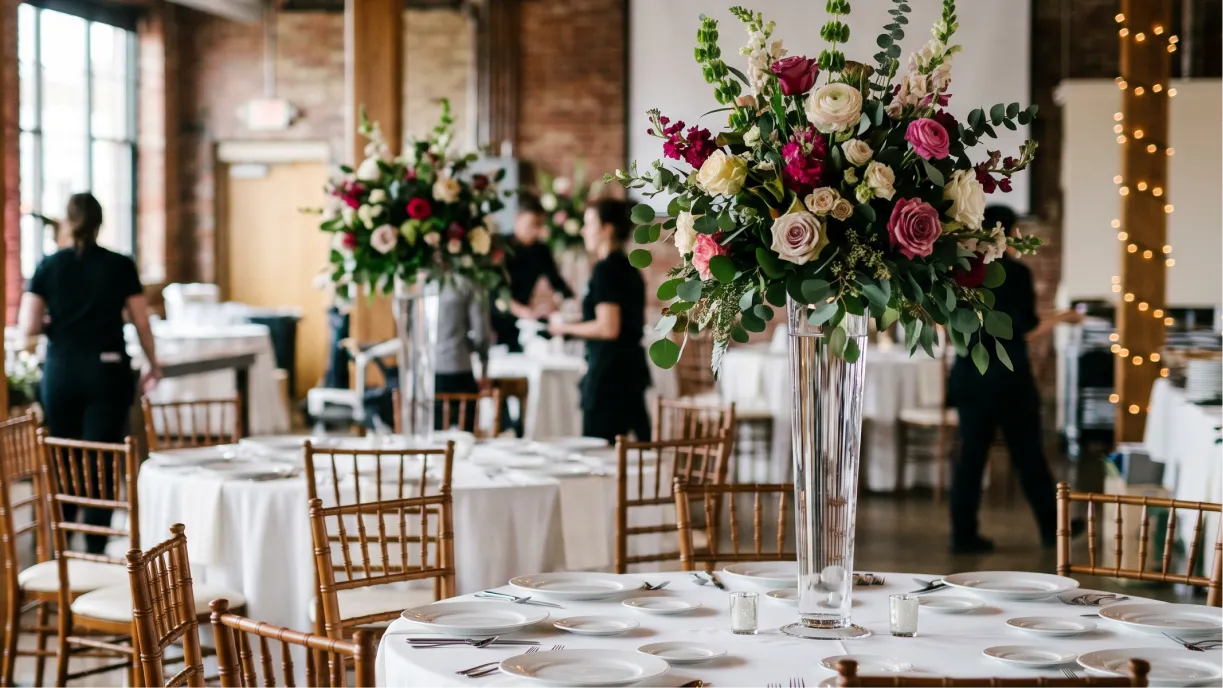
Good florist inventory management starts with a problem you can see on Monday morning: the rental vessels that never came back.
Guests carried the centerpieces off, or they vanished in the teardown shuffle — and now your compotes are short for the next wedding. Here’s how to stop the bleed and actually track what you own.
Principaux enseignements :
-
Most “stolen” rental vases were never actually stolen.
Guests assume centerpieces are theirs, and the rest vanish in teardown. The fix is process and tracking, not security cameras.
-
Missing vessels are really a florist inventory management problem.
If hardgoods disappear without you noticing, you’re quoting the next event off a guess about what you still own.
-
The client who signs the contract is who you bill.
Spell out rental terms and per-item replacement costs, and a walked-off vase becomes a recoverable line item instead of a loss you eat.
-
A deposit or loss waiver covers you before the first stem goes in.
You stop chasing people after the event, because the number’s already agreed to.
-
You can’t bill for what you can’t prove went out.
Checking each rental item in and out tells you what’s missing, what it’s worth, and what’s free for the next wedding.
Why Rental Vases Disappear
Most missing rental vases were never stolen in any real sense. They walk off because guests assume the centerpieces are party favors, or they get swept into a venue’s teardown and end up in the wrong box, the trash, or someone’s trunk.
The “centerpieces are up for grabs” assumption runs deep. Wedding etiquette forums are full of couples asking the same thing — how do you keep guests from carrying off the arrangements? — which tells you the instinct is widespread and not something a single sign on the table is going to fix.
Teardown is the other big leak. At the end of the night, flowers get pulled, vessels get stacked in with the venue’s own glassware, and yours don’t make it back to your cooler. None of it is malice. It’s what happens when nobody decided in advance whose job it is to get your hardgoods home.
Vessel Loss Is an Inventory Problem
Here’s the part that costs more than the vases themselves: when vessels go missing without you noticing, you don’t really know what you own. That’s a florist inventory management problem, and it shows up every time you quote the next event off a guess.
Your hardgoods — compotes, urns, footed bowls, arches, votives — are rental inventory that has to come back to be rented again. Track them by memory or a spreadsheet that’s a week behind, and a depleted shelf doesn’t surface until you’re loading the truck for the next wedding. The vessels are just the slice of your inventory that physically walks away; the fix is treating them like the assets they are.
Put Rental Terms in the Contract
The single best protection is boring: write down which items are rentals, what each costs to replace, and when they’re due back, then have the client sign it. A vase that walks off a signed contract is a billable line item, not a write-off.
Name the vessels as rentals, not sold goods. Set a per-item replacement value and a return window, and make the responsibility plain: the couple or planner who signed is on the hook, not the guest who grabbed a compote. This is also the place to settle the keep-versus-return question. Tell the couple early that guests are welcome to the blooms but the vessels come back, offer the “take the flowers, leave the vase” option, and ask the planner to relay it on the day. If you’re not sure what belongs in the agreement, the clauses worth putting in every rental agreement are a good starting point.

Protect Your Margin With a Deposit
Money changes behavior. A refundable security deposit or a damage-and-loss waiver means a missing urn is covered before the first stem goes in, so you’re not chasing anyone down after the fact.
One option is to demander une caution sized to roughly cover the hardgoods going out — refund it when everything’s back, keep the part that covers what isn’t.
The other is a damage-and-loss waiver: a small line item that covers breakage and loss without a deposit to manage. Either way, the client sees the number up front, so settling up at the end isn’t a fight. It’s standard for anyone renting out real hardgoods.

Track Every Rental Item In and Out
This is where florist inventory management actually lives: tag your vessels, count them onto the truck, and check them back in. So the moment something’s missing, you know what it was and what it’s worth. Discreet labels on the underside, an itemized list per event, a count out and a count in: that’s the whole system.
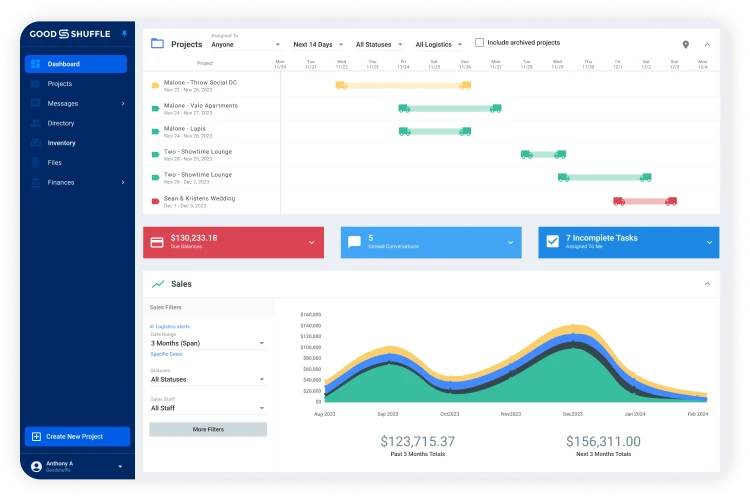
When your rental inventory lives in software built for event florists like Goodshuffle Pro, each vessel is tied to its event. That way, you can track your event inventory at a glance, see what’s still out before it gets promised to the next wedding, and keep the contract, deposit, and replacement value on the same record.
That’s how you protect back-to-back weekends. A compote that hasn’t come home shouldn’t be sitting on the next quote.
None of this turns your shop into a fortress. It just means knowing what you own, putting your terms in writing, and giving yourself a clean way to prove what went out. Get those three right and a missing compote becomes a line item you recover rather than a hole in next weekend’s order.
Explorer Goodshuffle Pro
Réservez une démonstration pour voir notre logiciel d'organisation d'événements en action.
FAQ
Most start with a spreadsheet and end up trusting memory, which is exactly how vessels go missing. The reliable version is tagging each rental item, keeping an itemized list per event, and checking everything back in after the date. Rental-management software makes that automatic: each vessel is tied to its event, so you can see what’s out, what’s back, and what’s free before you quote the next wedding.
Yes — a refundable security deposit is the simplest way to protect rented vessels. Set it to roughly cover the replacement cost of the hardgoods going out, refund it once everything comes back in good shape, and keep the portion that covers anything missing or broken. Spell the amount and terms out in the proposal so there are no surprises when you settle up.
You mostly stop it before the event, not during it. Decide with the couple early whether guests can keep the blooms, and make clear the vessels go back to you either way. A common move: let guests take the flowers wrapped in paper while you keep the compotes and vases. Put it in writing and ask the planner or venue to relay it on the day so the message actually lands.
Whoever signed the contract. The couple or planner who booked your floral work is responsible for the rented items, not individual guests — which is exactly why your rental terms and per-item replacement costs need to live in the signed agreement. If a vessel doesn’t come back, you bill the responsible party at the rate they already agreed to.
Both models work; the trick is being clear which one a given item is. Renting protects your nicer, pricier hardgoods and keeps inventory stocked for back-to-back events, while selling cheap cylinders can be easier than chasing them down. Decide per item, label your rentals clearly, and make the rental-versus-keep terms obvious in the proposal so the client knows what’s expected back.

Partager sur













 English
  Español de México
  Français du Canada