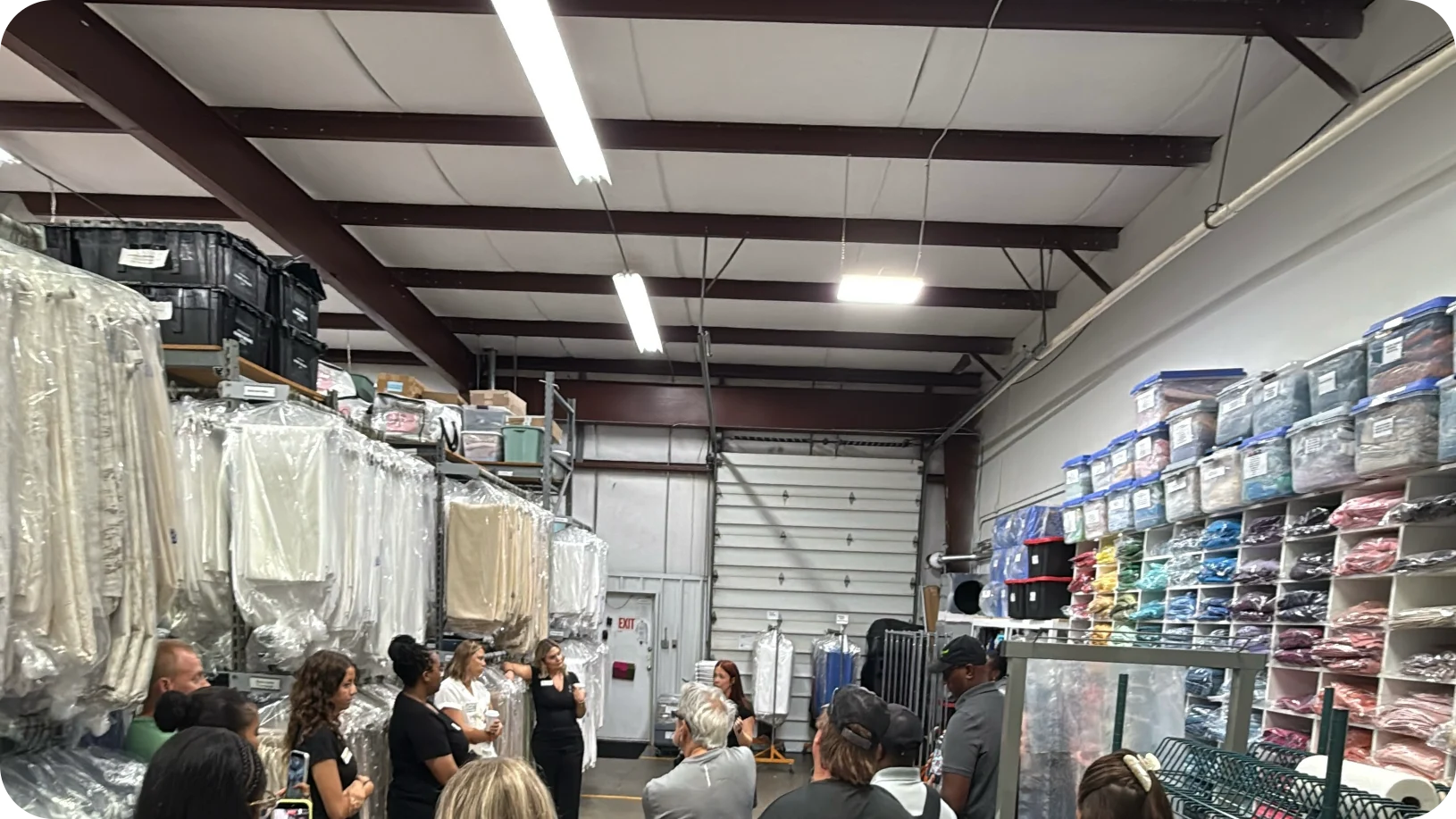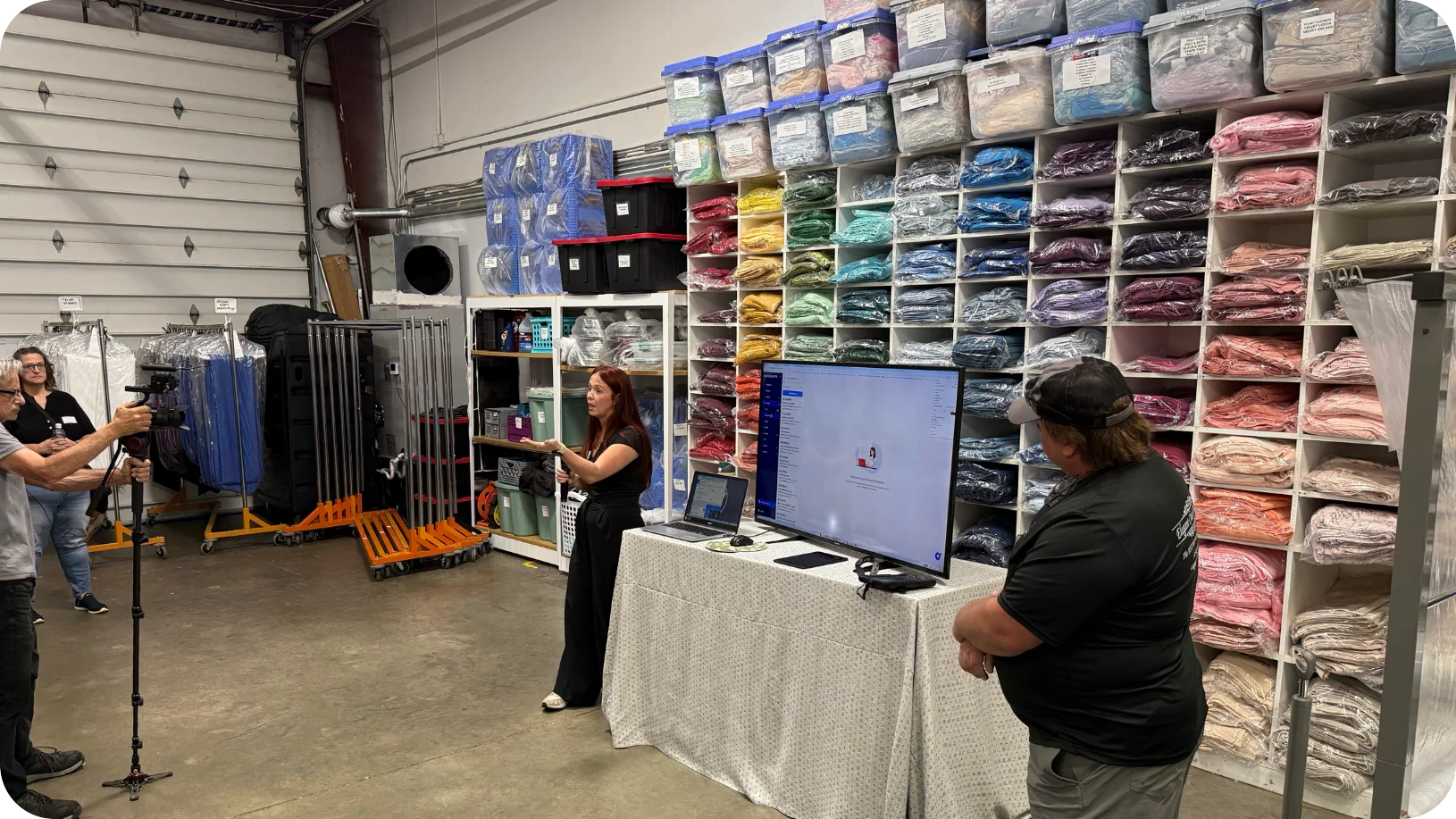
Monique Walker is an AI strategist with Midasweb, which helps event and rental businesses put AI and automation to work. She spoke to event rental owners the day before her honeymoon, leaving her own business “in the capable hands of my systems, my people, and my rules.” Her first question to the owners watching: can you leave yours for a week?
For most owners the answer is no. Every small decision still routes through their phone, and nobody has written down what the team is allowed to decide. Monique’s answer is to decide those calls now, in writing, before the phone rings. Her six rules cover the calls that would otherwise find you on vacation.
Watch Monique’s full talk on demand here: “The Call Is Coming From Inside the House”.
Puntos clave:
-
Event rental owners who can't take a week off usually have a design problem.
Monique Walker’s fix has three parts: shared systems, one trusted person in charge, and written rules.
-
Six written rules cover most of the calls that reach an owner on vacation.
Approve, substitute, credit, staff, weather and “call me” each answer a question an event rental team asks its owner today.
-
Each event rental owner sets the dollar limit in their own decision rules.
Write the number into the rule, and your team can act on it without texting you.
-
One shared inventory count stops the call asking whether you have 50 chairs or 49.
When pull sheets and damaged items update in one place, an event rental crew can check for itself.
Can You Leave Your Rental Business?
You can leave your event rental business for a week when three things are in place:
1. Your systems keep everyone on the same current information.
2. At least one person you trust takes the lead.
3. Written rules cover the decisions your team hits most.
Monique calls the three parts systems, people, and rules.
An owner who never takes a day off is usually running a business built to need them every day. Monique calls that a design problem.
(es-419) Español de América LatinaFive Signs Your Rental Team Needs You
Mallory Mullen of Goodshuffle made the case that the owner is often the bottleneck in her bottleneck newsletter. Monique’s five signs turn that into a fast self-check. Count how many sound like your week.
1. You wrote the same quote three times this week, rebuilding the same tables and chairs from memory.
2. You turned down a job because you weren’t sure what was available.
3. Your team asks you what’s happening. You’re at dinner with your family when your crew texts to ask whether they can swap the ivory tablecloth for the white one.
4. You heard about a problem after the client did.
5. You haven’t taken a full day off.
(es-419) Español de América LatinaSystems and People Come First
Some of Monique’s clients run three systems at once.
There’s an inventory list of everything they own, a whiteboard of what’s going out this week, and the event rental warehouse where the broken pieces actually sit. “Now you’ve got one, two, maybe even three different systems not talking to each other,” she said. That’s how someone ends up walking the warehouse to find out whether you have 50 chairs or 49, because one broke on the way back from the last job.
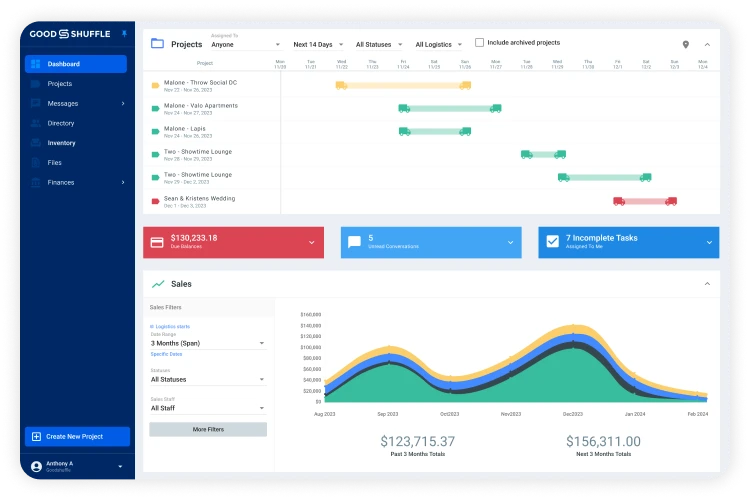
Her fix is one shared count that everyone checks and updates in the moment. In Goodshuffle Pro, your crew checks items off a Digital Pull Sheet on their phone as they pack. After the event, you set aside damaged items and anything missing, which takes them out of the count your next quote uses. For the quote you keep rebuilding, she pointed to packages: save the items that always go together once, and nobody has to remember them.
Check-ins belong here too. Monique wants the crew to report in at setup and again at return. Clients should hear from you seven days and three days before the event, then again on the day.
Then you need people. Whether that’s your first hire, an admin or a partner, at least one qualified person has to take the lead while you’re gone. “You’re going to put somebody in your place to make the right decisions while you walk away,” she told the audience.
(es-419) Español de América LatinaSix Rules for Your Event Rental Team
Rules are the part Monique calls hardest, because you have to let go of control. “The rules are simply your judgment written down,” she said, and they tell your people what to do with the outliers.
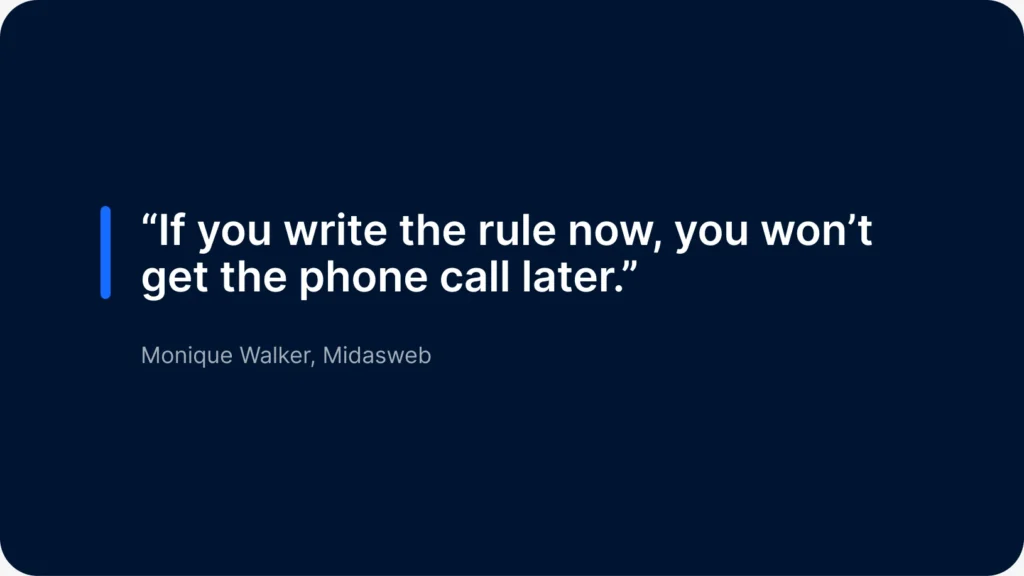
Each of her six rules answers a question your team is probably texting you today.
Approve: Linen Swaps and Changes Under Your Limit
What can your team approve without you? Her examples are a client change up to a dollar amount, a swap from ivory to white linens and a new layout for the decking. Monique leaves the number to you, so set it at a figure you won’t second-guess from the beach.
Substitute: Same Value or Better
Monique’s example of a fair swap rule is that the substitute costs the same or is the same quality or better. If a piece can never be swapped, the rule says so.
Credit: What They Can Offer
Write down what your team can offer when something goes wrong, including credits, refunds and your cancellation fees. Nobody likes those conversations, and your team will handle them better when they know exactly what they’re allowed to offer.
Staff: Overtime, Crew and No-Shows
Decide overtime, extra crew, early send-homes and no-show cover before the day of the event. Monique was with one owner when he worked through the overtime question with his team, and she says these calls have to be thought through ahead of time.
Weather: Outdoor Exceptions Decided Ahead
Write down what your crew can do when the weather turns and which exceptions they can offer a client without calling you. Then your team and your clients both know the policy.
Call Me: True Emergencies Only
The last rule covers true emergencies. Give your team one way to reach you, like a text number or an email you check each morning, and define what counts. If the other five rules are written well, your team will rarely need to use it.
(es-419) Español de América LatinaStart With This Week's Crew Texts
Monique suggests three questions to start.
1. What runs without you touching it?
2. Who holds down the fort when you’re gone?
3. What decisions still go through you?
For the last one, scroll back through this week’s texts and the calls you took at dinner. Each one is a rule you can write this week. Our SOP guide will help you turn it into something your team can follow.
She lives this herself. When her kids visit about once a month, she shuts her laptop for three days. She closed her talk by telling the audience, “If the call is coming from inside the house, answer it, then leave.”
Descubre Goodshuffle Pro
Reserve una demostración para ver nuestro software para la gestión de eventos en acción.
Session Transcript
Anyone can watch the full recording by registering on the session page. Monique Walker: Hey, everybody. I am so excited to be with you today. I work with Midas Web, and we do systems. And so we’re gonna talk about your house, AKA your business. What if the call, that spooky something going bump in the night, is actually happening from inside the business? In other words, what if the bottleneck is actually you? What if you’re the one making those calls that’s preventing you from leaving for a week? So that’s my first question to you: can you leave your business for a week? Because I have something exciting to share. I just got married, and tomorrow I’m actually leaving for my honeymoon. So this was perfect timing. When Dominique asked if I was available, I was like, “Yes, that’s the day before I take off for a week.” I’m leaving tomorrow, and I’m leaving it in the capable hands of my systems, my people, and my rules, and that’s what we’re talking about today. Can you leave? What does that look like? What will give you the power to walk away for a week? We’re gonna do that by looking at five signs, five indicators that maybe the bottleneck, maybe that issue, is actually coming from the way things are set up. And after we look at those indicators, we’re gonna talk about how to fix them, how we address each of them. I know it can be scary to step away. This is not the first time that I’ve stepped away, and I remember when I walked away for just a weekend. It wasn’t even a week. It was scary. It was like, “What if something goes wrong? What if a client needs me? What if something gets delayed?” I had all these concerns. I get it. It can be scary. But what’s even scarier is having a business that can’t run without you, ’cause that means it’s not scalable. It’s not something that you can push to the next level. You are creating a system that is a hundred percent on you and your shoulders. That’s not good for your health, for your mental stability, for all of those things. So the scarier part is not having the systems. So let’s rip off the Band-Aid and jump right in. Here’s sign number one. You wrote the same quote three times this week, or maybe even more. And this can be anything from “I’m adding the same table and chairs to every single order, every single time, and I have to remember these three items always go together,” or you’re having to redesign something from scratch. They want a wedding, or they want three balloon arches, or whatever it is, and you’re like, “Okay, what would that look like, and what are all the pieces for that?” There’s nothing that’s templatized. There’s nothing that’s got a system to it, ’cause everything’s in your head. Everything’s from your experience. So how do we fix that? We create templates. We write down these pricing rules. If they order five tables, they get a certain discount. If they have this type of tent, it needs these types of pieces. A lot of that can be handled with packages and templatizing and all of those wonderful tools that Goodshuffle already provides. Where does AI come into this? The way we use it, and I’ll talk more about that specifically in a little bit, is AI can draft this. So you can take that client intake call and feed that transcript and have AI say, “Hey, this is what it sounds like they need,” and now it’s drafting those quotes. It’s drafting those proposals, and you as the human come in and you actually approve it. You make sure that every little nuance is done, ’cause you are the expert. And then you train your team to know those rules, too. So AI can support you in even the initial quote. So sign one, you don’t wanna be doing the same thing over and over again. Find what’s templatized or can be, and then create that. Sign two, you turned down a job, and that’s revenue, because you didn’t know where things were, what was available. I’ve actually seen this in real time with some of our clients. They have their inventory database. That’s great. That tells me everything that they’ve bought, everything that’s in the warehouse, but it doesn’t show me what’s going out that week, what’s already been assigned to something. So they have a whiteboard. They literally have a whiteboard that says, “These items are going out to this event,” and the inventory is a master list, and the whiteboard is the current leaving list. And then you have the warehouse, which is a third location. Everything that is actually in the warehouse, or broken, or out of stock needs to be assigned somewhere else. Now you’ve got one, two, maybe even three different systems not talking to each other. Three different places, three different people, or even teams. If you have a warehouse team, that might be four, five, six people not communicating effectively to your whiteboard, and your whiteboard’s not communicating effectively to your inventory. They’re just disparate systems. So what do we need to do? We need to connect them through a source of truth. Goodshuffle has that for you. There’s a lot of other tools that you can use to communicate. So you wanna find those tools that help you tell everybody and update those pull sheets, update those set-asides, update those lost inventory items in the moment, so you’re not having to guess whether you have 50 chairs or 49 because that 50th broke. You don’t wanna have to go look at that in the warehouse and put eyes on it. You need to have a system and the protocols in place to update it in real time. So have that source of truth that everybody looks at at the same time. That way, when you update it, it updates all the other pieces simultaneously. Sign three: your team relies on you to find out what’s happening. This is very common with new companies. They’re a solopreneur, they’ve just added their first set of employees, they’re just getting their feet wet. They’ve been in business one, two, three years, and they’re so used to doing everything that everything stays with them. You’re the person the client calls. When something breaks or needs to be replaced or something needs to be substituted, you get called to update it all. So now you’re at dinner with your family and you get that text: “Can we exchange the ivory tablecloth for the white one if they all match?” Those are just rules. You’re gonna hear about rules in just a second. You have to decide ahead of time what needs you. If your team is always asking you for information, then you’re not scalable. So you need to have, again, that source of truth. The system we just fixed for sign two is actually for sign three as well. So you just need that source of truth. You need those real-time updates and the SOPs, which are standard operating procedures, in place. Now, an SOP is only as good as the process it’s describing. So we’re not talking about throwing systems and processes onto everything everywhere that’s not gonna get used or not enforced. You wanna make sure you’ve tested those, and that’s a whole other conversation, but don’t just type something up and say, “Here.” You have to have checks and balances and train your team to use them. But once they do, everything flows downstream, and your revenue increases because you’re not so stressed. All right, sign four. You found out something went wrong after the client did. How many of you have actually received a call that said, “Hey, this didn’t get brought, and I remember I explicitly emailed for it”? You have the client issue, and they’re calling you, or you’re finding out from a review that there was something that happened. No check-ins happened. There was no communication between your company and the client, or your management team and the client. You were oblivious. You assumed everything was going right, and then after the fact, found out something went wrong. So how do we fix that? Checks. You need to have some systemized, consistent check-ins. Usually for your crew, this is at setup and at return. You might have a few more, depending on the specific way you run an event, but your crew needs to say, “All set up, all good.” That way your entire team knows and your management team knows it’s all good. And then once things get returned, if something gets lost in transition or falls in the truck and breaks on the way back from the event, these things happen. There’s got to be a note that says, “Hey, we loaded 50 chairs correctly, we got back and a box fell on one of them and it’s broken. We’re down to 49.” You gotta have those kinds of notes and checks with your crew. With the client, very similarly: we’re three days out, we’re seven days out, let’s confirm information. So before the event, your client knows that you’re thinking about them, that you’re taking care of them, that you’re on the ball. And then day of, the communication that we’re on our way, we’ve arrived. If there is an issue, your team needs to know how to handle that with the client. If a tablecloth is missing or they’re short a chair, what are you gonna do about that? We never wanna ignore a client. We never wanna say, “Don’t tell them. They’re not gonna find out. They’re not gonna realize it’s 49 chairs and not 50.” They’re gonna find out, especially if they have 50 registered and 50 show up and one doesn’t have a chair. So you have to be honest with them and find that solution, and we’re gonna talk about those solutions in just a second, ’cause that’s just a set of rules. It’s a set of if/then statements where the owner decides what is okay and what is not okay to make decisions on. You’re giving permission to your team. So going one step beyond delegation, and telling them, “Not only are you in charge, but here are the powers that come with that. Here are the responsibilities that come with that delegation.” So just having check-ins is vitally important. So the fifth sign is the most obvious. You haven’t left. You haven’t taken a day off, a complete day, or two, or three. Maybe we’re not at a week, and that’s okay. But if you haven’t taken at least some time for yourself, your family, your friends, your hobbies, that’s not a discipline problem. This isn’t you needing to set aside more time. It’s a design problem. You’re literally not structuring your environment to support you walking away. And I’ve learned how to do this because my children come visit me from Dallas into Houston about once a month. That’s three days I walk away from my business, usually once a month, where I just shut my laptop and I walk away because I can. So that’s what we wanna do. Let’s talk about building that design. I’m gonna talk about our three-part design: systems, people, and rules. Even though we are big proponents of AI, and we have AI agents and AI systems and automations in place, that is only the systems. It is not the people. You still need humans. You need humans in the loop. Large corporations are starting to realize this, and they’re training their people to use AI, not getting AI to replace them. So it’s vitally important we understand people belong in the business. We’re not replacing them. And then the set of rules. So the first part is intentional systems. This is your SOP. For us, every consultation we have is recorded. We get a transcript, and I do have an AI agent that reads that transcript, reads our past proposals, past quotes, and can actually generate the entire draft for me. It suggests pricing, suggests deliverables, everything that we’re going to provide from that first recording. That’s not me listening to an hour of dialogue and then trying to extract pieces. I have templates for AI to use as training to create those consultations, and then my job is to check it, or to have my sales team check it before sending. So, intentional systems. Automations are a part of this, reminders, those check-ins. That’s all just systems. This is my favorite place to live. I love building these. And then, of course, you have the people, and we’re talking about your qualified human team. One, two, three people, you decide based on your business, and what can they do? Is this just a VA, or is this an executive assistant? Is this a full admin, a co-owner, a partner? Who is this qualified human who’s going to take the lead when you step away? Because here’s the thing most people don’t realize. When you step away, you’re not closing the business, and that’s why we can’t have everybody take off at once. You’re going to put somebody in your place to make the right decisions while you walk away. If anybody’s worked in corporate or had a W-2 job, you had to ask for vacation time, because they had to make sure they didn’t get too many people out of office at the same time. They still need them in the office doing their job. So you find that qualified person, hire that executive assistant, find that partner, that admin that can come in and understand what you do, how you serve your clients, all of those pieces. You have to have at least one person to walk away. And then rules. Rules is probably the most challenging piece, ’cause this requires you to really let go of control. You have to decide what does not need your oversight, what can be decided. That’s one of the things rules can help with, and we’re gonna talk about those different rules next. Now, I have to be honest, your Saturdays don’t look like mine. On my Saturdays, I do a lot of consultation, a lot of computer work, and I actually love the space I’m in. Your Saturdays have more moving parts and more people and more oversight. So I want you to ask yourself three questions as we move into the rules. What runs without you touching it? Where do you already have a team in place or systems in place where you can run this part of your business without touching it? Is that intake? Is that fulfillment? Is it the follow-up? What part of your business can run without you? Who holds down the fort when you’re gone? Where are the people? Who do you have on your team that you actually trust to do that job? And what decisions still go through you? Where and when are people calling you? I want you to think about number three a little bit deeper, because we’re gonna decide what actually needs you next. I want you to think about today. What questions were you answering on your text? What emails came into your inbox? What decisions are actually coming to you this week? That’s where we’re gonna start looking at rules. So the good news is you don’t need a clone. We’re not talking about creating a clone of you, a mirror, a mimic, somebody who can be exactly who you are. We’re only talking about systems that think like you and someone you trust. That’s it. You need just those two parts. You have those two parts and you can walk away. So let’s talk about the rules. The rules are simply your judgment written down. Systems are how things run, the connections, the data from one part to another. The people manage those systems, and then the rules are what they do for the outliers. And if you write the rule now, you won’t get the phone call later. So the first rule is approve. What can your human team approve without you? If the client changes up to X amount of dollars, you’re gonna pick it. What can they approve? Exchange of tablecloth colors, arrangement of the decking. Where can they just approve without you? Write those down. Substitute. This is another rule. Where is substitution okay? If you can never substitute a flower arrangement, then that needs to be in there. When can they substitute, and what can they substitute? What are the rules around that? In this example, it needs to be cost equal, or it needs to be the same quality or better. Again, we’re just trying to make sure the event runs smoothly without you. Credit. If something goes wrong, can you offer credit? Can you offer a refund? What are the cancellation fees? Your team needs to be comfortable having those conversations. We don’t want them, but we have to be comfortable with them, so you have to give your team the power and responsibility to say, “I see that this didn’t work right. We’re gonna credit you XYZ.” Give them that parameter. Create that rule. Staff. This is a big one. I was working with a client recently, and he had the overtime conversation with his team while I was there, and you have to decide when overtime is okay, when it’s not okay, up to what level. When can we add more crew? When can we reduce crew? All of those pieces are very important for a successful event. If a person doesn’t show up, can we substitute another crew member for that space, or can only one person fulfill a certain type of job? You have to think these things through. There’s a lot of nuances. Where can staff be taken care of without you being called? And then we’ve got weather. Because you’re in events, weather is an issue. Sometimes you have outdoor events, sometimes you have indoor events. If weather becomes an issue, you need a weather policy. You need to have something for your team and your clients to understand: if inclement or unsavory weather comes in, what are the exceptions? What are the things that you can do? So these are all decisions that you can make. And then the final one, of course, is call me, you, the owner. There will be some things that need your approval. These are the emergencies. So I hate to break it to you, but when you go on vacation, you still need an emergency contact. You need to have one way for them to get a hold of you, whether that’s the concierge at the hotel, or by email that you check every morning and only in the morning, or an emergency text number. Somehow, because you are the owner, and ultimately it falls on your responsibility. But those emergencies shouldn’t happen very often. So you decide what is that ultimate, urgent, everything-must-stop-and-I-need-to-handle-it. That’s a call me. Notice how all the other ones, they’ll be okay, but that last emergency one is the one you really need to think about. So again, I’m Monique Walker. I build these systems all the time for our clients. We look at every piece of their operations, from client intake all the way through fulfillment and follow-up, to make sure that they have the systems in place, the people to manage those systems, and the AI on top of it to make that life and that job so much easier. And my final note for you is: if the call is coming from inside the house, answer it, then leave.Expand to read the full transcript
Monique Walker: The call is coming from inside the house
Preguntas frecuentes
Nombra a una persona a cargo, reúne el inventario y los pedidos en un solo lugar al que todo el equipo tenga acceso, y anota qué decisiones puede tomar el equipo sin ti. Monique Walker llama a esto «sistemas, personas y reglas». Luego, elige una forma en que tu equipo pueda comunicarse contigo en caso de una verdadera emergencia.
Un equipo de alquiler para eventos puede encargarse de la mayoría de las llamadas que recibes hoy: pequeños cambios solicitados por los clientes hasta un monto en dólares que tú establezcas, cambios por artículos de igual o mayor valor, créditos dentro de un límite, llamadas relacionadas con el personal y las horas extras, y llamadas por condiciones climáticas según una política por escrito. Solo las verdaderas emergencias requieren la intervención del propietario.
No existe un límite de gasto estándar para un equipo de alquiler de eventos, y Monique Walker deja que cada propietario decida esa cifra. Elige un límite que se ajuste a tus márgenes y a tus clientes, e inclúyelo en las reglas para que nadie tenga que adivinar.
No. Las reglas son tus decisiones por escrito, así que un documento compartido sirve. Para actuar en consecuencia, tu equipo también necesita un registro actualizado de lo que se ha reservado, lo que va en el camión y lo que regresó dañado. Goodshuffle Pro mantiene en un solo lugar los paquetes de inventario, las hojas de entrega digitales y las reservas para artículos dañados o faltantes.

Compartir en